

Diamondback Terrapin Care: Conservation, Habitat, and Home Guidelines
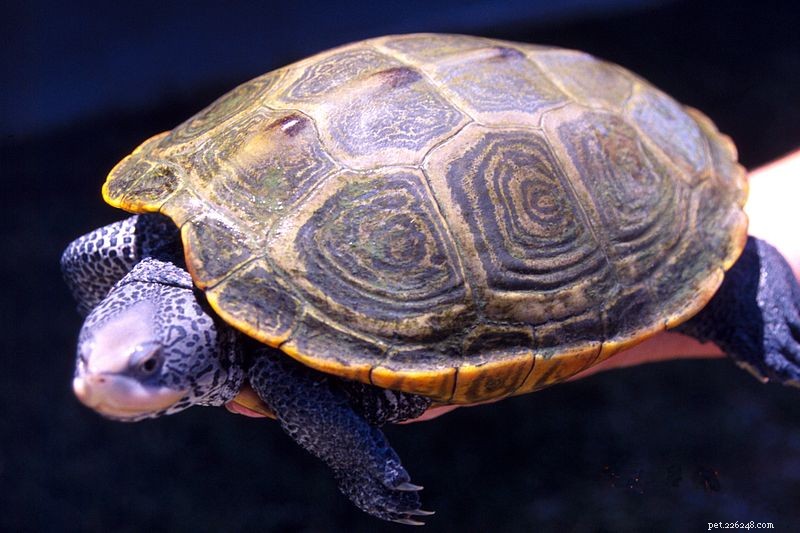 Turtle enthusiasts find the Diamondback Terrapin (Malaclemys terrapin) very difficult to resist. Sporting a beautiful carapace that is deeply etched with concentric rings, and clad in a bewildering array of gray, silver and black markings, this estuary specialist does, however, present a few challenges to prospective keepers.
A Unique Natural Habitat
The Diamondback Terrapin is the only North American turtle completely restricted to estuaries, tidal flats, lagoons and salt marshes. Neither a fresh water nor marine species, it is uniquely adapted to brackish habitats.
Diamondbacks in Captivity
Most captives do not thrive unless provided with slightly saline (brackish) water; although individuals from certain populations seem to fare better than others in fresh water, but I do not recommend experimenting.
Also, Diamondback Terrapins are extremely active and grow quite large…they require huge, well-filtered aquariums that are beyond the means of most hobbyists.
Volunteer Opportunities: Diamondback Conservation
Don’t despair if you are unable to accommodate these interesting turtles in your collection, as there are plenty of opportunities to work with Diamondback Terrapins in the wild. Due to its unfortunate reputation as a gourmet’s delight, as well as to habitat loss, pollution, road and crab trap mortality and nest predation, Diamondback numbers have plummeted in recent years. Fortunately, a number of highly effective rescue efforts have been mounted.
In cooperation with the New York Turtle and Tortoise Society, the Wetlands Institute monitors terrapin nesting behavior in New Jersey. Researchers from Vietnam, Cambodia and other Asian nations, sponsored by these 2 fine organizations, often spend summers on site, assisting in research and returning home to further turtle rescue efforts in their homelands. I count my time working with these groups as one of my most enjoyable and productive turtle research experiences.
In New York City’s Jamaica Bay Wildlife Refuge, Hofstra University based volunteers work to control raccoon predation, which in some years has reduced Diamondback Terrapin hatching success to a mere 3%.
Volunteers from the USA and abroad also have the opportunity to tag and track terrapins in New Jersey’s Barnegat Bay as part of an Earthwatch sponsored effort to understand the species’ ecology.
- Mastering Newt Care: Natural History & Captive Management – Part 1
- Mudpuppy: Natural History & Care Guide – Part 1
- Painted Turtle Care & Natural History: Expert Tips for Owners
- Dwarf Chameleons: Expert Care Tips & Natural History Insights
- Fire Skink (Mochlus fernandi): Natural History & Expert Care Guide
- Softshell Turtles: Expert Care & Natural History Guide – Part 2
- Rhinoceros Iguana: Natural History, Care Guide, and Habitat Insights