

Tokay Gecko Care Guide: Feeding, Housing & Terrarium Design
Pugnacious reptiles with “attitudes” have long been favored by herp enthusiasts. In the lizard world, perhaps none fits this description so well as the Tokay Gecko, Gekko gecko. It truly is the ultimate “big lizard in a small package”. Years ago, I liberated a group into a huge multi-species exhibit at the Bronx Zoo, mainly for my own interests. Although my fellow keepers were well-experienced in caring for venomous snakes, dangerous primates and the like, I was roundly criticized…no one wanted to chance accidentally grabbing one of these foot-long nocturnal terrors! But in the right hands (well, not literally “in hand”…most object strenuously!), Tokay Geckos make fascinating pets that may live into their 20’s. What’s more, they are beautifully-clad in an array of colors, and are not shy about exhibiting their behaviors, including reproduction.
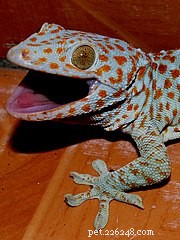
Uploaded to Wikipedia Commons by Nick Hobgood
Natural History
This accomplished vocalist draws its common name from the loud cries of “tokay, tokay” given by the territorial males. Some years ago a pet store in Manhattan began renting them to customers as a form of “natural” roach control. However, their habit of vocalizing in the wee hours of the morning doomed the scheme to failure.
Nocturnal and highly arboreal, Tokay Geckos are stoutly built. Males may reach 12-14 inches in length, while females generally top out at 8-10 inches. Among the world’s 950+ gecko species, they are exceeded in length and bulk only by the New Caledonian Giant Gecko and its relatives.
Invertebrates form the bulk of the diet, but adults will not hesitate to tackle birds, other lizards, treefrogs, snakes and small rodents.
Range and Habitat
The huge range extends from Nepal through northeastern India, Bangladesh, southern China and Southeast Asia to Indonesia. Introduced populations are established in Hawaii, Florida (of course!), Martinique and, possibly, Guam and Taiwan.
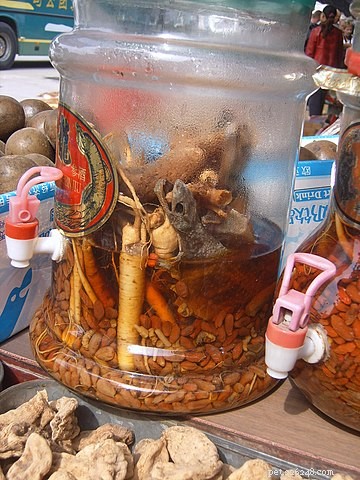
Uploaded to Wikipedia Commons by Vberger
Tokay Geckos adapt to a wide array of habitats, including homes and other buildings within such bustling cities as Hong Kong and Miami. Alleged medicinal properties have led to local extinctions in parts of Thailand, Vietnam and China (please see photo).
The Terrarium
Tokays are best suited to life in “high style” aquariums (20 gallon capacity or larger), as they spend all of their time above-ground. Terrariums with plentiful hiding spots (rolled cork bark is ideal), caves, driftwood and hanging artificial plants will encourage your geckos to exhibit natural behaviors. Sturdy live plants make wonderful additions to Tokay Gecko environments…snake and cast-iron plants are tailor made for use with these robust acrobats.
The screen cover must be secured with cage clamps.
Substrate
A mix of cypress mulch and sphagnum moss is ideal.
Light
Tokays and other nocturnal geckos do not need UVB radiation. Red/black night-viewing bulbs will enable you to observe them after dark.
Heat
Ambient air temperatures should range from 75-82 F, with a basking spot of 86 F. Large enclosures will allow for the establishment of a thermal gradient (areas of different temperatures). Thermal gradients, critical to good health, enable lizards to regulate their body temperature by moving between hot and cooler areas.
Because Tokays are out and about after dark, attention must be paid to night-time heating. Incandescent red/black night bulbs can be used to maintain temperatures, and provide the added bonus of allowing you to observe your pets’ nocturnal ramblings. A ceramic heater may also be employed.
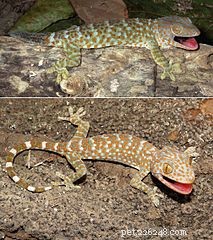
Uploaded to Wikipedia Commons by J. Patrick Fischer
Humidity
Tokay Geckos are relatively undemanding when it comes to humidity levels. A twice-daily misting will satisfy the needs of all except those kept in extremely arid homes.
Companions
Males are highly territorial and should never be housed together. Pairs, youngsters and all-female groups usually co-exist in large, planted enclosures. It is best to introduce all potential tank-mates at the same time.
Feeding
A highly-varied diet is essential if you are to have success in keeping Tokay Geckos. Don’t be fooled by their apparent robustness when kept on limited diets – crickets and mealworms alone, even if powdered with supplements, are not an adequate diet.
I rely heavily upon wild-caught invertebrates during the warmer months (please see the linked articles and post any questions below). The Bug Napper Insect Trap will simplify the collection of flying insects. Moths, beetles, grasshoppers, tree crickets, earwigs, “smooth” caterpillars, katydids and a variety of other invertebrates should be offered.
In winter, the diet should be a mix of roaches, crickets, butterworms, super mealworms, waxworms, cultured houseflies, and silkworms. Canned invertebrates may be accepted from feeding tongs.
Tokay Geckos can be offered a pink mouse every 7-10 days. Do not use adult mice, as the fur may lead to impactions. Although they will pounce on whatever small creature comes along, Tokay Geckos are adapted to a diet comprised largely of invertebrates. During my years with the Bronx Zoo, I observed eye, kidney and liver maladies in basilisks and other insectivorous herps that were maintained on rodent-based diets.
Necessary food supplements include Zoo Med ReptiCalcium or a similar product (most meals) and a vitamin supplement (ReptiVite with D3) 2-3 times weekly.
Tree-dwelling geckos rarely drink from bowls, but will lap water that is sprayed onto foliage. Exo Terra Bromeliads, intended for use with poison frogs, hold a small pool of water which may be utilized by some individuals
Breeding
Sexual maturity is reached within 1 year, although males may not attain their full size until nearly 2 years of age.
Although breeding is not all-that-difficult, wild-caught animals still dominate the pet trade. Newly acquired pets should be seen by a veterinarian if you believe they were collected from the wild. I’ll cover reproduction in a future article; until then please post below for further information.
Handling
Tokays bite readily and hard…and they hold on for dear life. They are not suitable for children or those seeking a handle-able pet.
Over the years, I’ve seen some amazingly-calm individuals at reptile shows, but have not had a chance to look into the details. Any comments on this would be most appreciated, thanks.
- Tokay Gecko Care Guide: Lifespan, Habits, and Care Tips (With Photos)
- How to Feed and Care for Tegu Lizards: A Beginner’s Handbook
- Newts as Pets: Expert Guide to Care, Feeding, and Conservation
- Day Gecko Care Guide: Ideal Terrarium Setup & Top Supplies for Healthy Lizard Pets
- Leopard Gecko Care: A Comprehensive Guide to Ideal Terrariums and Long‑Term Health
- Gecko Care Guide: Terrarium Setup, Supplies, and Key Facts
- How to Care for African Bullfrogs: Feeding, Habitat, and Longevity