

Why Shark Teeth Keep Falling Out: The Surprising Secrets Behind Their Numbers and Fossil Power
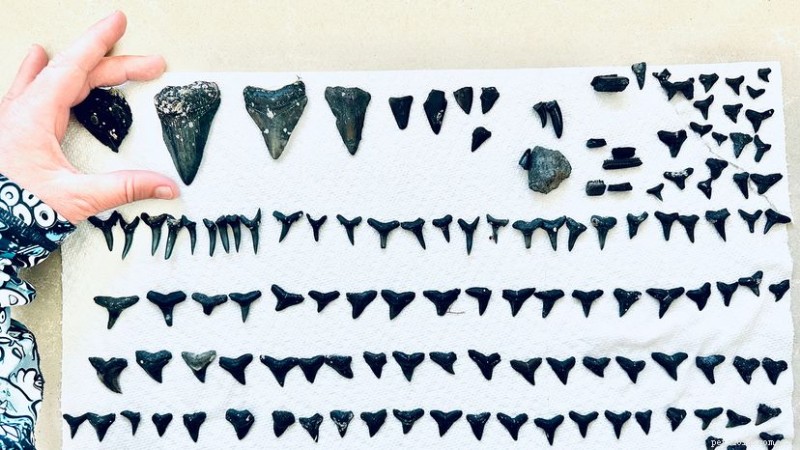
Shark teeth are more than beachcombing treasures; they are bite‑sized records of diet, evolution, and deep time, offering clues about how these ancient predators lived and changed over hundreds of millions of years.
A shark’s mouth operates less like a human jaw and more like a living conveyor belt. Rows of replacement teeth lie behind the working row, sliding forward as each tooth falls out.
Some sharks shed tens of thousands of teeth in a single lifetime, which explains why shark teeth are the most common vertebrate fossils in many marine deposits (Florida Museum).
Why Shark Teeth Are So Common
Unlike many vertebrates, sharks lack a bony skeleton. Their bodies are composed mainly of cartilage—the same flexible material found in our noses and ears—making their skeletons prone to rapid decay and poor fossilization.
Because cartilage rarely survives, the fossil record of ancient sharks is dominated by teeth rather than full skeletons (AP News). This steady stream of lost teeth has been occurring for roughly 420 million years, with the earliest shark‑like teeth dating back about 410 million years (Natural History Museum).
Inside a shark’s mouth, teeth are not anchored. New rows form behind the front teeth and advance through connective tissue. In some species, a new tooth can replace an old one every couple of weeks (Florida Museum). Depending on the species, a single shark can experience the loss of thousands of teeth over its life. For example, a lemon shark may shed more than 30,000 teeth during its lifetime (Save Our Seas Foundation).
Tooth Shape Tells You What a Shark Eats
The morphology of a shark’s teeth—size, serration, root shape, and position—provides clear evidence of its diet. Paleontologists and hobbyists alike use these traits to identify teeth from both living and extinct species.
- Needle‑like teeth are ideal for grasping slippery prey such as small fish and squid.
- Dense, flattened teeth serve as crushing tools for hard‑shelled bottom‑dwelling organisms like crabs and clams.
- Great white sharks possess triangular upper teeth with fine serrations, resembling an evolutionary steak knife. Their pointed lower teeth grip prey while the upper teeth cut (Natural History Museum).
- Tiger shark teeth also feature cutting edges adapted to tough prey.
- Bull sharks demonstrate functional differentiation: broad, serrated upper teeth for slicing and narrower lower teeth for holding (Florida Museum).
- Filter‑feeding sharks such as whale sharks have numerous small, non‑functional teeth, relying on gill rakers to strain microscopic organisms.
How Fossil Shark Teeth Form
Fossilized shark teeth typically begin their second life when they sink to the ocean floor and are rapidly buried by sediment. This quick burial protects the tooth from waves, scavengers, and oxygen‑rich conditions that would otherwise cause decay.
Mineral‑rich water percolates through the surrounding sediment, filling microscopic voids within the tooth in a process called permineralization. The resulting fossil often displays dark, gray, tan, brown, blue, or black hues, largely reflecting the minerals and sediment rather than the original tooth material (Florida Museum).
These fossils can be found in sedimentary rocks, on beaches, along riverbanks, and in deposits that once represented ancient seas. For instance, Colorado’s Cretaceous strata contain shark teeth, even though the state is now landlocked.
Fossil shark teeth can exceed 10 million years in age. Megalodon, the largest shark known from the fossil record, lived between 23 million and 3.6 million years ago, with teeth that can reach more than 7 inches (17.8 cm) in length (Florida Museum).
Megalodon Teeth and Other Collector Favorites
Megalodon teeth are highly sought after by collectors. These authentic fossils—tipped with large serrations—provide crucial data for estimating the size of the extinct shark, whose cartilaginous skeleton rarely survives.
While a single tooth offers limited information, its size and shape still reveal important details about ancient ecosystems and predator‑prey relationships (AP News). Collectors encounter a wide range of options: from authentic fossils to affordable specimens, display pieces, or even gift packs. Prices vary based on size, condition, color, root quality, and any repairs.
Large, pristine teeth with strong serrations can command prices up to $3,000. One of the most well‑known online retailers, Sharksteeth.com, has sold shark teeth since 1997 and still offers a spectrum from smaller finds to museum‑quality examples.
Lee Creek Mine in North Carolina is famed for shark teeth—including mako, bull shark relatives, and megalodon—from its marine deposits. Because access regulations can change, collectors should verify current rules before exploring any mine, beach, or riverbank (Fossilguy.com).
How to Find and Identify Shark Teeth
Begin your search where water naturally sorts small, triangular objects: the wrack line on a beach, gravel bars along riverbanks, or shell beds exposed by low tide. South Carolina beaches are popular hunting spots, with state tourism agencies recommending early morning low tides for easier spotting of fresh material.
Look for triangular, curved, hooked, or glossy teeth that stand out against shell fragments. Modern white shark teeth are typically whiter, whereas fossil teeth often display darker hues acquired during fossilization. However, color alone is not a definitive age marker; combine shape, location, and context for reliable identification.
To identify specific species, compare overall morphology:
- Great white teeth: broad, triangular with serrated edges.
- Mako teeth: narrower and more slender.
- Lemon shark teeth: slimmer, with distinct curvature.
- Nurse shark teeth: designed for crushing rather than slicing.
- Cookiecutter shark teeth: form an entire lower plate, unlike the single‑tooth view most people imagine.
Throughout hundreds of millions of years, the underlying principle remains: a shark’s tooth is a specialized tool perfectly adapted to its diet.
Historically, humans have recognized the utility of shark teeth. Native Hawaiians used them as cutting edges for tools, while other cultures fashioned weapons, projectile points, and amulets. During the Renaissance, fossil shark teeth—known as glossopetrae—were believed to cure snake bites.
Recent research indicates that shark tooth surfaces contain natural fluoride, offering resistance to cavities—a fascinating engineering lesson from the sea.
This article was produced with AI assistance and subsequently fact‑checked and edited by a HowStuffWorks editor.
- Eliminate Compulsive Dog Behavior: A Proven Guide
- 7 Clear Signals Your Cat Uses to Communicate
- Top Dog Breeds for Families with Children – Vet & Pet Expert Picks
- Are Possums a Threat to Chickens? Protect Your Flock from Nocturnal Predators
- Premium Travel Pet Carriers for Cats: Safe & Comfortable Cabin Transport
- FIV Explained: What You Need to Know About Feline Immunodeficiency Virus
- Top 5 Gift Ideas for Cat Lovers: From Gadgets to Cozy Accessories