

Discover Sunburst & Green Diving Beetles: A Fresh Take for Insect Keepers – Part 1
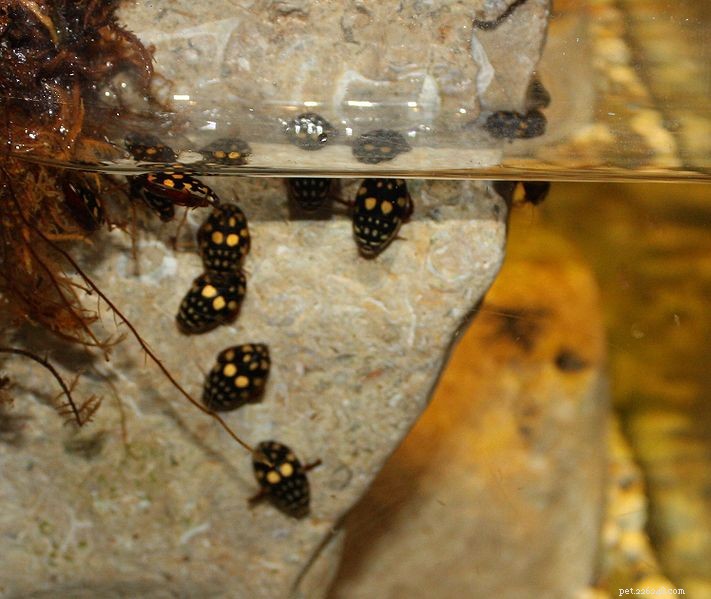 I cannot imagine why aquatic insects have not attracted more interest from invertebrate enthusiasts. Thousands of species, many of which are large and active by day, may be kept in relatively simple aquariums. Aquatic insect exhibits that I have established in zoos and museums are invariably very popular with visitors. From Dragonfly Larvae that flick out extendable “lips” to snare prey to Giant Water Bugs that can tackle small turtles, these other-worldly beings are fascinating to observe, and most are simple to collect. Today I’d like to cover the natural history of 2 species that are sometimes available in the pet trade, the Sunburst or Marbled Diving Beetle (Thermonectes marmoratus) and Green Diving Beetle (Thermonectes sp.). I’ll discuss their captive care in Part 2.
Classification
Diving Beetles are members of the insect order Coleoptera (the Beetles). With over 330,000 species described, Coleoptera is the largest of all animal orders – in fact, one quarter of all known animals are beetles! Curculionidae (the Weevils) is the largest family of beetles. With nearly 45,000 species described thus far (and many, no doubt, as yet unseen) weevils also comprise the world’s largest animal family.
Diving Beetles and their relatives, collectively known as Predacious Diving Beetles, are placed within the family Dytiscidae. There are at least 2,000 species, and they inhabit waters ranging from still vernal ponds to large rivers – several have even colonized extremely hot springs in the western USA and elsewhere.
Physical Description
Sunburst Diving Beetles are, as their name implies, quite beautiful – their oval, smooth-edged carapaces are dotted with gold markings on black wing covers; Green Diving Beetles range from an attractive shade of green to greenish-tan.
The unique oar-shaped rear legs are fringed with hair-like structures to assist in swimming. In contrast to other aquatic insects, Diving Beetles “row” with both rear legs moving simultaneously (other species alternate). They have biting mouthparts (that can pierce human skin!) and average 3/8 – 5/8 inches in length. Special glands emit a milky white liquid that apparently discourages fishes and other predators.
Range and Habitat
Both species are found in western Texas, Arizona, California and Mexico (exact range limits have not been well-studied).
They generally inhabit still or slow moving waters such as ponds, lake margins, swamps and canals.
Both larval and adult Sunburst Diving Beetles, and possibly Green Diving Beetles, aestivate (become dormant) during droughts. Adults may also fly off in search of water at such times.
Diet
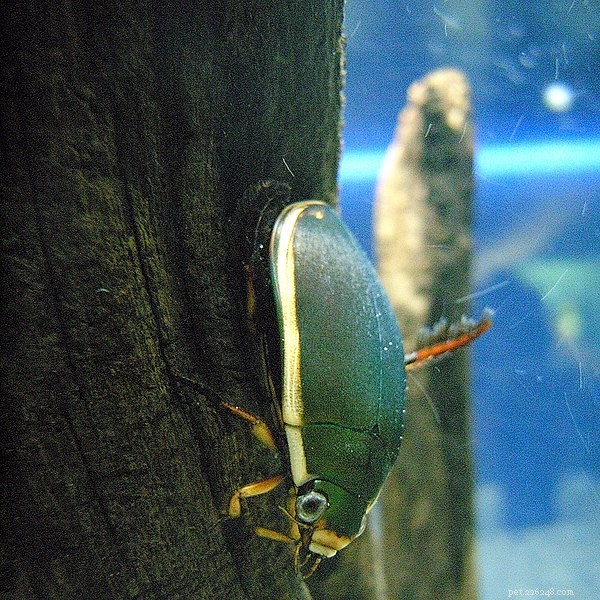 These little terrors are ravenous predators and actively hunt aquatic worms, amphipods, small tadpoles and other insects; terrestrial insects that have fallen into the water and carrion are also taken.
Reproduction
Diving Beetle eggs are attached to aquatic plants. The elongated, aquatic larvae are known as “Water Tigers” and, equipped with out-sized jaws, attack prey much larger than themselves. The larvae pupate on land – in mud at the water’s edge – and return to the water as adults.
An Insect “Aqua-Lung”
Diving Beetles carry an air bubble trapped beneath the wing covers (or elytra) when submerging. Research has recently revealed that this air bubble actually functions as a “lung” of sorts – absorbing additional oxygen from the water and dispersing carbon dioxide!
- Rough & Smooth Green Snakes: Expert Care for Naturalistic Terrariums – Part 1
- Breeding the Green Basilisk (Plumed) and Related Species – A Comprehensive Guide
- Rough & Smooth Green Snakes: Expert Care & UVB Lighting for Thriving Terrariums
- Advanced Care Guide for Aquatic Sunburst & Green Diving Beetles – Part 2
- Breeding Green Basilisks & Related Species: Expert Guide – Part 2
- 2010 Amphibian Breakthroughs: New Species, Revived Extinct Finds & Insightful Discoveries – Part 1
- 2010 Amphibian Discoveries: New Species, Algae-Filled Salamanders & a Century-Old Species – Part 2