

Addressing Egg Retention (Dystocia) in Turtles: Practical Solutions & Best Practices – Part 2
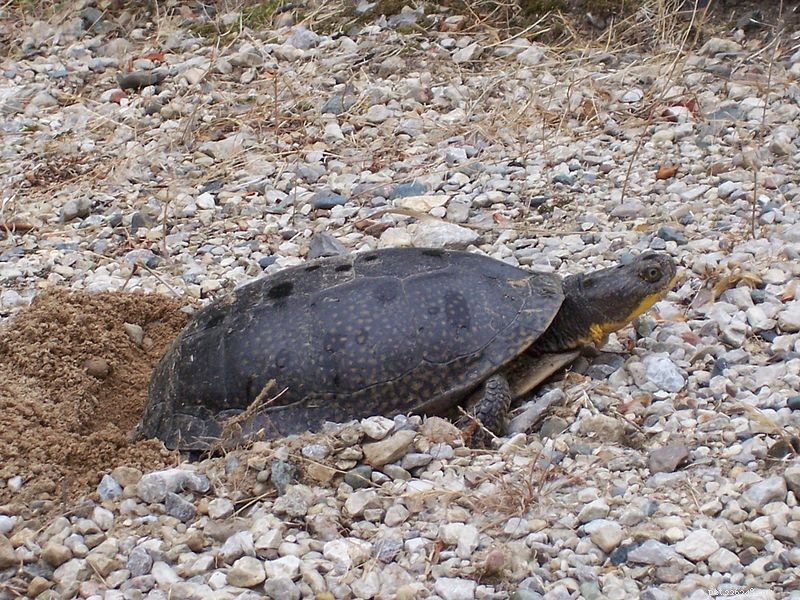 Please see Part 1 of this article for general information on retained-egg syndrome and the provision of suitable nest sites for captive turtles.
Creating an Acceptable Nest Site
Gravid turtles can be maddeningly choosy when it comes to nest site selection – even when presented with what appears to be perfectly “natural” situation, some females refuse to “appreciate” our efforts.
Moisture usually attracts nesting females, and in some cases heavy misting, to simulate rain, is useful (in NYC, I’ve noticed that a great many Common Snapping Turtles nest on the first rainy night in June).
Warming the nesting site may also induce females to use the area…as many species nest at night, an incandescent night-viewing bulb is ideal for this purpose.
Be sure to research the natural history of the turtle in question, or write to me for assistance – for some species, a covering of dead leaves or a change in the type of substrate provided may do the trick.
Humidity and Water
It is also important that the female’s environment is kept at the proper humidity, and that she has access to water for drinking and soaking, as dehydrated turtles typically have difficulty expelling their eggs. This is not usually a problem for Red Eared Sliders and other semi-aquatic turtles, but can be critical for tortoises, American and Asian Box turtles, and other terrestrial species.
Nesting Containers and Enclosures
While it is sometimes possible to create a nesting area by wedging or otherwise affixing a plastic storage box into an aquarium at the water’s level, a child’s wading pool typically allows for more nest site options. If the pool is not the turtle’s usual home, move her into it well before the predicted nesting time, so that she can adjust. While some turtles will oviposit (lay eggs) shortly after being moved to any earth-filled container, most are stressed by change and will refuse to deposit their eggs if moved suddenly.
The only pre-fabricated enclosure I know of that allows for both ample nesting and swimming areas is the ZooMed Turtle Tub – definitely worth considering if you are serious about breeding aquatic and semi-aquatic turtles.
Veterinary Options – Oxytosin and Surgery
If your turtle appears to be gravid but cannot seem to deposit her eggs, prompt veterinary attention is necessary. As mentioned in Part 1 of this article, retained eggs invariably lead to infection and, eventually, the female’s death.
Oxytosin, a medication used to induce labor in human females, is often quite effective when administered to turtles. I’ve had great success using Oxytosin with a wide variety of species during my years at the Bronx Zoo. In extreme cases, surgery may be called for. Please write in if you need a reference to a local veterinarian experienced in turtle care.
Hatching the Eggs
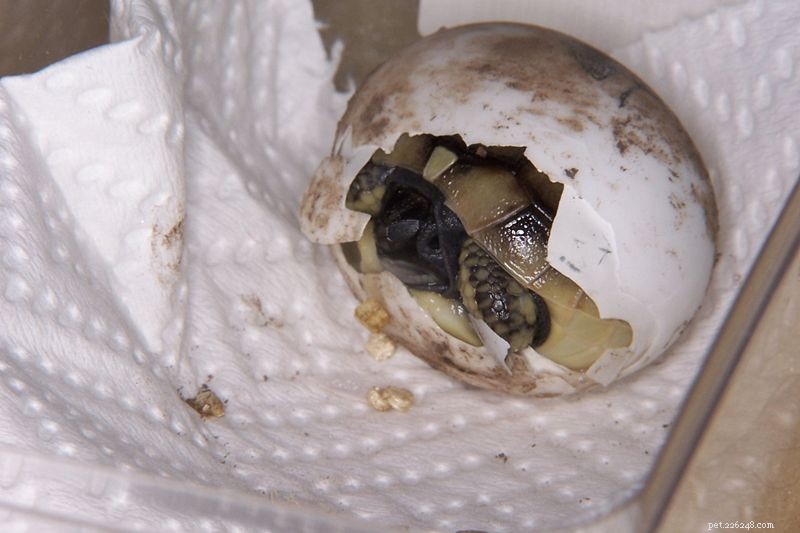 Fortunately, well-made Reptile Egg Incubators are now available, and they greatly simplify the job of hatching turtle eggs…please write in for further information once you’ve obtained a clutch.
- Mastering Newt Care: Natural History & Captive Management – Part 1
- Breeding the Green Basilisk (Plumed) and Related Species – A Comprehensive Guide
- Breeding Green Basilisks & Related Species: Expert Guide – Part 2
- Egg Retention (Dystocia) in Turtles: Causes & Practical Solutions – Part 1
- Softshell Turtles: Comprehensive Natural History & Proven Care Tips – Part 1
- Softshell Turtles: Expert Care & Natural History Guide – Part 2
- Asian Turtle Crisis: Urgent Update on Freshwater Turtle Extinction – Part 2