

Mastering Fire-Bellied Toad Breeding: Expert Tips for Successful Captive Reproduction
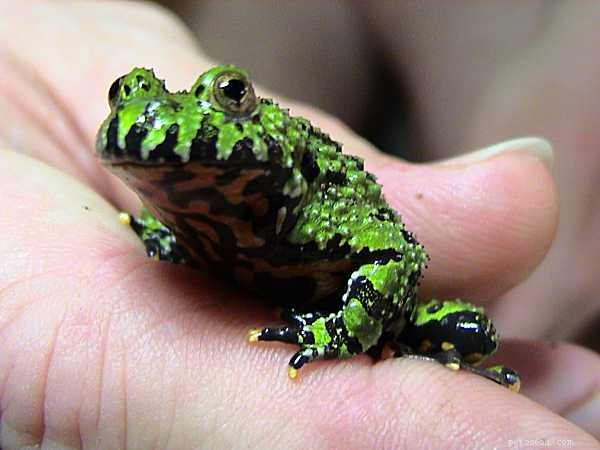 Although no frog can be classified as “easy” to breed in captivity, the Chinese or Oriental Fire-Bellied Toad, Bombina orientalis, is at least “reliable”. Two related species that appear in the trade, the European Fire-Bellied Toad, B. bombina and the Yellow-Bellied Toad, B. variegata, are also regularly bred by hobbyists.
The Oriental Fire-Bellied Toad is the most colorful and readily available of the 6 described species. Ranging from eastern Siberia to northeastern China and Korea, it makes a wonderful introduction to the fascinating world of amphibian reproduction. They are also among the most interesting anurans that one can keep – owners invariably describe them as “amusing”, and I must agree!
Step One: a Proper Diet
Frogs that are to be bred should be pre-conditioned by being fed a highly varied diet comprised of earthworms, nutrient-loaded crickets, waxworms, small guppies, beetles, moths, flies, sowbugs and other wild-caught invertebrates; please see the article below for details and suggested food animals.
Pre-Conditioning the Frogs
Unlike many frogs, this hardy creature requires very in the way of stimulation in order to come into breeding readiness. I’ve found that, when kept at typical room temperatures, normal fluctuations brought on by the changing seasons may be enough.
In order to assure success, you can lower the depth of the water in their aquarium for a few days during the springtime, and then re-fill it with water that is 5-10 degrees warmer than that in their aquarium. Alternatively, keeping the frogs at 60 F for a month or so almost guarantees that they will be ready to breed once temperatures rise.
Courtship and Amplexus
It is best to move your frogs to a separate aquarium for breeding, so that the eggs can be left in place and the adults returned to their original home after spawning has occurred. A ratio of 2-3 females for each male is desirable, but not essential.
Males in breeding condition sport dark, roughened patches, known as “nuptial pads” on their inner arms. Courting males will let forth with a short series of unique calls, and in their “lust” will grab onto just about anything within reach – including fish, plastic plants and one’s fingers!
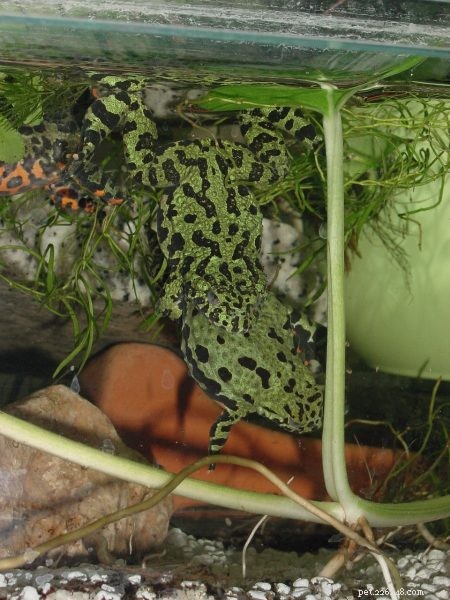
In contrast to most frogs (but in common with African Clawed Frogs and their relatives), male Fire-Bellied Toads grasp females just above the rear legs, rather than under the front legs (please see photo); this mating embrace is known as “inguinal amplexus”. Unreceptive females will straighten out their legs and vibrate the body.
The Eggs
The breeding tank should be large, and furnished with abundant (preferably live) plants and a filter that does not create strong currents (corner filters are ideal).
Females lay 100-200 eggs, usually within 24 hours of entering amplexus; the eggs attach to plants, sticks and airline tubing. At 72 F, the tiny (7 mm) tadpoles hatch in 3-4 days. They remain motionless and attached to plants for 2 days, during which time they absorb the yolk sacs.
Rearing the Tadpoles
Once the tadpoles begin to move about, they should be fed tropical fish flakes and chopped blackworms several times daily.
Hind legs first appear around day 10, followed by the front legs on day 19-22. At this point it is important to be sure that the tank is well stocked with plants, so that the froglets can easily reach the surface. The tadpoles will exit the water onto floating cork bark, a platform or a gravel island.
The newly-emerged froglets, or metamorphs, will not eat for the first 3-4 days after leaving the water. Thereafter, they should be provided with large quantities of fruit flies, 10 day-old crickets, springtails and wild-caught aphids and tiny leaf-litter invertebrates. Nutrition is critical at this point – please see the article below and write in for further details. Sexual maturity is reached in approximately one year.
Breeding Related Species
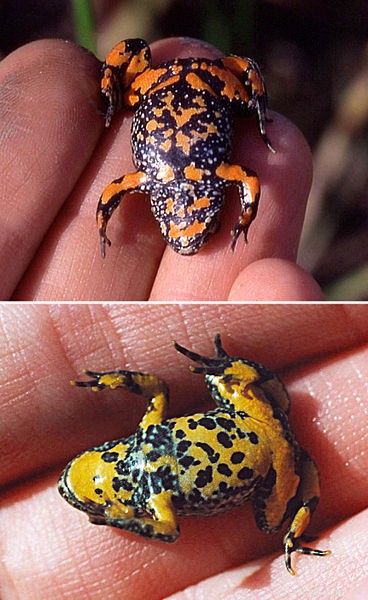 Two related species are often seen in the pet trade – European Fire-Bellied Toad, Bombina bombina, which hails from eastern Europe, and the Yellow-Bellied Toad, B. variagata, of central and southern Europe. Both may be bred in a similar manner.
In order to be primed for reproduction, these toads require a longer, cooler “winter” than does their Asian relative. Keeping them in damp sphagnum moss for 4-6 weeks at 40-43 F (refrigerators work well for this) will suffice. Following the cooling-off period, raise the temperature to 60-70 F over 2-3 weeks, at which point the males should start calling.
A rain chamber, while not essential, will help to bring Fire-Bellied Toads (and many other species) into breeding condition; please see the article below for instructions on creating a simple rain chamber.
Yellow-Bellied Toads sometimes exhibit an orange or red stomach; such individuals are difficult to distinguish from European Fire-Bellied Toads. Check the fingers on the front limbs – those of the European Fire Belly have tiny webs; the Yellow-Bellied Toad’s fingers are not webbed. They will, however interbreed with one another, as well as with the Oriental Fire-Bellied Toad, and so exact identification of captives is sometimes impossible.
- Simplify Litter Box Care: Smart Products & Tips for Effortless Cleaning
- Strawberry Pacman Frog: The Charming South American Amphibian Pet
- Comprehensive Frog Diet Guide: Nutritious Foods for Popularly-Kept Frogs & Toads
- Affordable Terrarium Designs for American Toads & Relatives
- Creating Optimal Poison Frog Breeding Sites with Artificial Bromeliads – Part 2
- Mastering African Clawed Frog Breeding: Proven Techniques & Care
- Alligator vs. Crocodile: 10 Key Differences Explained