

Mastering African Clawed Frog Breeding: Proven Techniques & Care
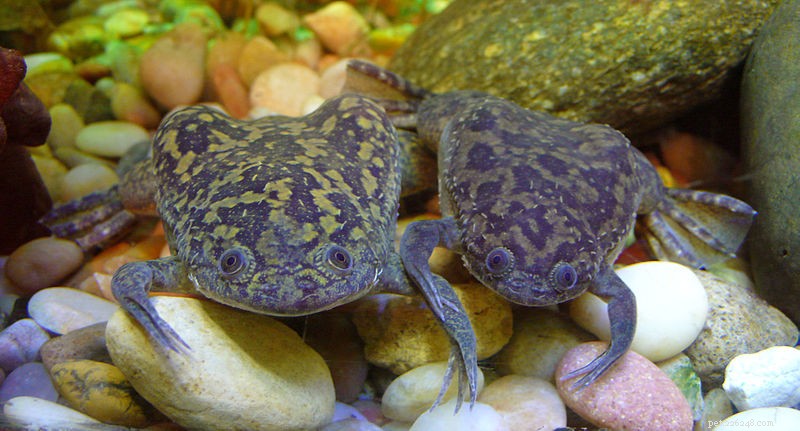 The African Clawed Frog, Xenopus laevis, is an extremely popular pet and lab animal. It is also one of the few amphibians that will sometimes reproduce “spontaneously” (that is, without being induced by artificial “rain storms” and other such tactics) in captivity. Yet there is precious little available concerning how to breed this frog, or what to do if one is suddenly presented with eggs.
Natural History
Unlike most amphibians, African Clawed Frogs may reproduce at any time of the year. This adaptation allows them to take advantage of favorable conditions whenever they occur, and is responsible for their ability to thrive as an introduced species in a great many countries.
Distinguishing the Sexes
Females are larger and stouter than males, and, when mature, bear 3 small, fleshy lumps around the cloaca (the opening that allows for the passage of eggs and waste products). Males develop areas of roughened tissue along the inner forearms, known as nuptial pads, when ready to breed.
Inducing Reproduction
Normal fluctuations in room temperature, ample space and a good diet are often enough to induce breeding. However, if you wish to assure reproduction, gradually lower the temperature of the water in your frogs’ aquarium to 66-68F for 4-6 weeks and drop the water level to 4-6 inches (be sure to filter well and do partial water changes, as ammonia will concentrate in the reduced water volume). Then add water (68-70F) and, using a heater, allow it to rise to 78-82 F over a 7-10 day period.
After this mini “drought-flood cycle”, your males should begin issuing their metallic “click-click” calls and “gesticulating” by moving their arms about in what can only be described as “an excited manner”. Soon they will begin to grasp at any frog in reach – if a male is grabbed, he will emit a unique release call and stiffen his rear legs in response. Receptive females will be grasped about the waist in an amphibian mating embrace known as amplexus.
Amplexus and Egg-Laying
Most frogs utilize pectoral amplexus, wherein the male grasps the female just behind the arms. Male African Clawed Frogs, however, latch onto the area just above the female’s rear legs, a position known as inguinal amplexus (please see photo of Dwarf Clawed Frogs in amplexus). Amplexus may last anywhere from 2 hours to 2 or more days.
During amplexus, the male frog changes the tone of his call, repeatedly tightens and loosens his grip and occasionally swipes his mate’s head with his clawed feet. Related species such as Surinam Toads and Dwarf Clawed Frogs perform an elaborate, circular egg-laying “dance”, but African Clawed Frog pairs tend to just spin about in place or swim is semi-circles. Females deposit 1-5 eggs at a time, which are fertilized by the male upon release.
When egg-laying has been completed, remove the adults as they will be hungry after their efforts and very willing to consume their progeny.
Amazingly, a female in my collection deposited eggs without entering amplexus, and a male fertilized the eggs the following day…please see the article below for details.
Observing Breeding Behavior
Despite their generally bold demeanor, paired African Clawed Frogs are extremely sensitive to disturbances and will cease breeding if disturbed by vibrations or a light suddenly being turned on (egg-laying occurs at night). Also, crowding the frogs will inhibit reproduction.
A red or black bulb will allow you to observe the goings-on without disturbing the happy couple. If you discover eggs one morning, watch your frogs for the next few nights as they sometimes breed over a 2-4 day period.

The Tadpoles
The eggs will hatch in 2-4 days at 80-82F. Newly hatched tadpoles measure 0.4 cm in length and usually transform into froglets within 2 months, at which time they are 1.3 cm long. Sexual maturity is reached by age 18 months – 2 years, sometimes earlier.
African Clawed Frog tadpoles are among the world’s oddest. They bear tentacles about the mouth and feed by filtering micro-organisms from the water. Fortunately, they are rather easy to raise – please see the article below for further information.
- Breeding the Rosy Boa: A Comprehensive Guide for Successful Reproduction
- Feeding Habits of African Clawed Frog Tadpoles: A Comprehensive Guide
- Feeding Dwarf African Clawed Frogs: Expert Tips for Healthy Nutrition
- Salmonella Risks in African Dwarf Clawed Frogs: What Pet Owners Need to Know
- Breeding the Malayan Leaf Frog: Tips for Successful Captive Propagation
- Optimal Feeding Strategies for African Clawed Frogs: Two Proven Diets for Longevity and Breeding
- Guide to Caring for and Breeding the African Pygmy Mouse – Part 1