

Green Anaconda Attacks: Insights from Venezuelan Field Studies
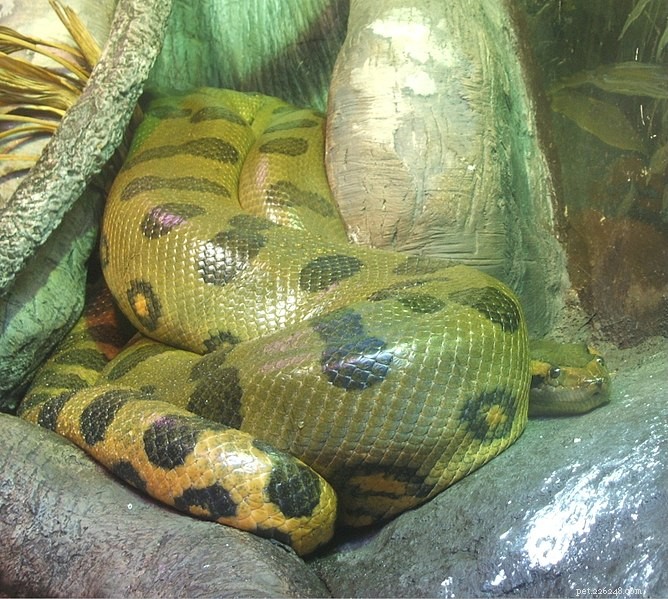 Hello, Frank Indiviglio here. Green Anacondas (Eunectes murinus) and other giant constrictors inspire tall tales among those not well-acquainted with them, and respect in those who are. African Rock and Reticulated Pythons have taken humans as prey (please see this article), and Burmese Pythons have caused fatalities, but information concerning Green Anaconda attacks is sketchy. Their aquatic lifestyle and tendency to inhabit sparsely-populated areas renders it difficult to discern fact from fiction. Today I’d like to provide some personal observations drawn from my time working with Anacondas in the field.
Tagging Wild Anacondas – a Herper’s Dream Job
In the mid 1990’s, while working for the Bronx Zoo, I had the good fortune of participating in a long-term field study of Green Anacondas in Venezuela – the first and only one of its kind. Over 900 specimens were captured, and a treasure-trove of new facts was documented.
Attempted Human Predation?
Two incidents that occurred during the study indicated that Green Anacondas may view humans as a potential meal. A co-worker of mine was grabbed near the knee by a large female while walking in shallow, densely-vegetated water. The snake bit her pants, which tore, and then struck again, higher this time. Fortunately, the strike did not connect, and my co-worked escaped unharmed.
The researcher involved was well-experienced in finding Anacondas by shuffling about in likely areas, and certainly would have noticed a large snake had she stepped on it. Therefore, I doubt that the snake’s strike was in response to being disturbed. In any event, all other snakes uncovered in this manner tried to escape. I believe that the attack was predatory in nature.
My notes indicate that, at a later date, the same snake (all were marked) rose to the surface and, for want of a better word, “watched” researchers who were poking about nearby. Perhaps she was an especially bold individual…
In the second incident, an Anaconda’s head appeared behind a researcher who was walking among floating aquatic vegetation. The snake reared up and followed the man for several feet while tongue-flicking. A co-worker noticed and grabbed the snake as it struck, causing the animal to miss her (males, the smaller sex, would be unlikely to tackle such large prey) intended target. Due to the “stalking” aspect of this incident, we can rule out defense as a motive.
Are People on the Anaconda’s Menu?
Anaconda attacks have been researched in several books and articles (the events above are recorded in Rivas, J. A. 1999. Life history of the green anaconda. Unpublished Ph.D. dissertation, University of Tennessee).
Several incidents described in Tales of Giant Snakes (Murphy & Henderson, Krieger: 1997) parallel those above, and may involve attempted human predation (the photo on the cover of this book, not well-chosen in my opinion but quite dramatic, was taken during the study in which I assisted).
In his wonderful book Snakes, the Evolution of Mystery in Nature (U. of CA Press: 1997) Harry Greene does not cite any incidents of Anacondas preying upon people.
Clifford Pope’s classic, The Giant Snakes (Alfred Knopf, NY: 1965) recounts several interesting Anaconda encounters, including one wherein a woman battled a 19-footer in order to save a duck, but concludes that all involved defensive actions. Incidentally, Mike Tsalkis is mentioned in The Giant Snakes – older herp enthusiasts will remember the dramatic photos of him wrestling an Anaconda in the 1960’s Life Nature Series book The Land and Wildlife of South America – it’s as clear in my mind today as when I first saw it!
Defensive Attacks
Most snakes will attempt to bite when attacked, and Green Anacondas are particularly vigorous in this regard. I was on hand when the study’s largest snake was found. We stumbled (literally!) upon the 17-foot-long, 215-pounder in a shallow pool that also held another individual nearly as large.
As I groped about below the water, her massive head reared up next to my face. I deflected the strike and grabbed her neck, but was bitten in the process. The tooth that lodged in my wrist as a result remains there today (it is close to a nerve, and not worth removing); other than a bad infection (in me, not the snake!), the “souvenir” has caused no problems.
A large female that we cornered in a riverside hollow seemed to access her options for a time and then charged. She may have come at us open-mouthed, but all happened so quickly that it was hard to tell. She made it through our “line”, but we tracked her progress in the river and captured her shortly thereafter.
Green Anaconda Diets
Captive Anacondas are notorious for being “picky” feeders. Various individuals under my care have refused all but muskrats, ducks or wild-caught Norway Rats.
As a species, however, they take an amazingly range of prey. Meals I’ve observed included, among other animals, a 60 pound deer, Spectacled Caimans, a large side-necked turtle, a Red-Footed Tortoise, wading birds, fish and other Anacondas. Please watch for my future article on this topic.
The World’s Largest Snake
The extinct, Anaconda-like Titanoboa may have reached 43 feet in length and weighed in excess of a ton! The Smithsonian Channel will soon air a special on this incredible beast. Please see this article and video to learn more.
Please check out my posts on Twitter and Facebook. Each day, I highlight breaking research, conservation news and interesting stories concerning just about every type of animal imaginable. I look forward to hearing about your interests and experiences as well, and will use them in articles when possible.
Please also post your questions and comments below…I’ll be sure to respond quickly.
Thanks, until next time,
Frank Indiviglio
- Delta Island Dog Rescued After Months of Elusive Escape
- Scout & Zoe's Allergy‑Free Dog Treats: Safe, Grain‑Free Options for Sensitive Pets
- Venomous Snakebites: Expert Responder Shares Real-World Experiences and Notable Cases
- Rescue Story: Violet, the Stray Cat Who Became a Beloved Family Member
- Buster: The Friendly Rescue Cat of The Joy of Cats
- From Three to Six Cats: How Expanding Our Feline Family Transformed Our Lives
- 10 Essential Facts About Rat Snakes: From Habitat to Care