

The Paradise Flying Snake: A Gliding Marvel of Southeast Asian Forests
Picture yourself face‑to‑face with a snake hanging from a branch—an unnerving yet fascinating sight captured up close by Getty Images.
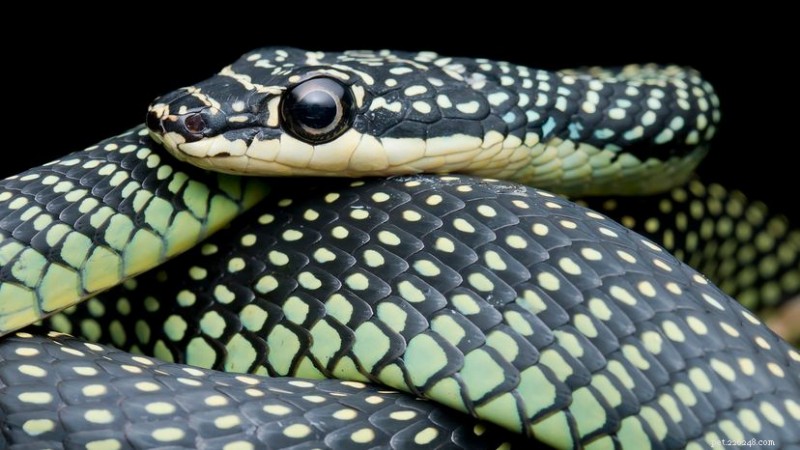
Gliding gracefully through the Southeast Asian canopy, the paradise flying snake (Chrysopelea paradisi) showcases a remarkable aerial display.
Also called the paradise tree snake, it is one of the rare limbless vertebrates that can glide, covering distances up to 30 m (about 100 ft) between trees.
Are Flying Snakes Real?
Contrary to science‑fiction fantasies, flying snakes are a well‑documented natural phenomenon. Researchers, such as Jake Socha of Virginia Tech, have used high‑speed videography and biomechanical modeling to dissect their flight mechanics.
Their glides involve a vertical wave‑like undulation that keeps the body aloft, enabling extended horizontal travel.
Taxonomy and Anatomy
Taxonomically, Chrysopelea paradisi is a colubrid, a diverse family that includes many non‑venomous and mildly venomous species.
It is mildly venomous, possessing rear fangs at the back of its jaws—a characteristic shared with other colubrids.
While not among the most dangerous snakes, its posterior maxillary fangs deliver venom that subdues primarily lizard prey.
Adults reach 0.6–1.2 m (2–4 ft) and feature a flattened, laterally compressed body with yellow‑black speckles and bold orange or red dorsal stripes.
Its vivid coloration provides effective camouflage among the forest canopy of South and Southeast Asia.
During launch, its cross‑section becomes concave, creating lift and stability.
How Does the Paradise Flying Snake Fly?
The Chrysopelea paradisi (paradise flying snake) species has excellent camouflage. Justin Ong / Getty Images
Gliding begins when the snake leaps from a branch or building, anchoring part of its body while the head stays rigid and the remainder undulates in a graceful S‑shaped wave.
This controlled aerodynamics lets the snake glide across open spaces or between trees, akin to a flying squirrel.
Motion‑capture and biomechanical studies confirm that gliding is an evolved, controlled flight rather than a mere uncontrolled fall.
Its deliberate undulations and precise aerial maneuvers likely evolved for predator evasion and efficient hunting.
Natural Habitat and Behavior
The paradise flying snake prefers forests but can also be seen around human habitats, sometimes observed scaling walls or gliding from rooftops. Though they are venomous snakes, their venom poses little risk to humans.
Nevertheless, their vivid colors and dramatic glides can surprise observers.
Their specialized care requirements and strong roaming instincts make them unsuitable as pets.
The species epithet 'paradisi' derives from Latin for 'park,' reflecting its leafy forest origins.
Few creatures combine specialized locomotion with predatory prowess; the paradise flying snake continues to fascinate scientists and nature enthusiasts, proving that flight transcends birds, bats, and insects.
This article was generated with AI assistance and subsequently fact‑checked and edited by a HowStuffWorks editor.
- Essential Tools for Effective Dog Obedience Training
- 261 Winning Blue Heeler Names: Trendy, Classic & Cattle Dog Themes
- Foamy Dog Poop: What It Means for Your Pet's Health
- Understanding the Pit Bull: Facts, Misconceptions, and Responsible Ownership
- Expert Guide to Dog Behavior & Training: Proven Techniques for Every Breed
- Expert Guide: Safely Giving Your Cat a Pill Every Time
- Price Guide for Sugar Gliders at Petsmart: Costs, Availability, and Care Tips