

Green Sea Turtle: Why Its Name Reflects Body Fat, Not Shell Color
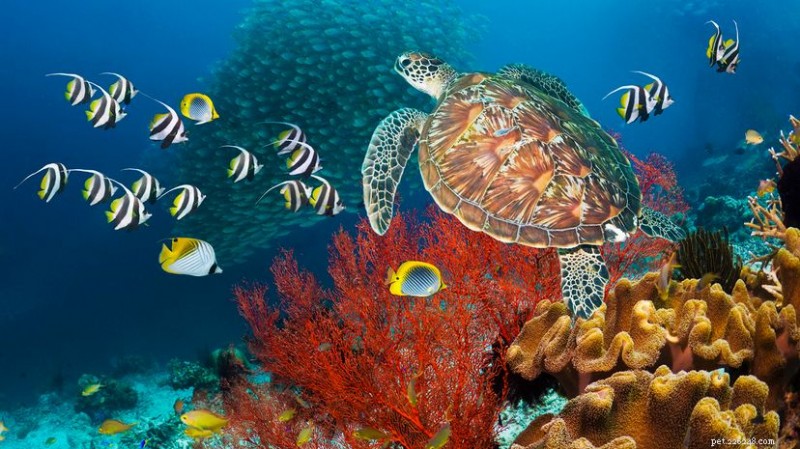
Green sea turtles (Chelonia mydas) are the most elegant of the marine turtles. Their gentle nature and striking appearance make them a favorite among marine enthusiasts, and their ecological role—especially in seagrass beds and coral reef ecosystems—is indispensable.
Unlike most other sea turtles, adult green turtles are herbivores, feeding almost exclusively on seagrass and algae. Their name actually comes from the greenish tint of the body fat that accumulates from their seagrass diet—far from the color of their shell.
Physical Characteristics
Green sea turtles are the largest of the marine turtles, with adults reaching up to 4 ft (1.22 m) in length and weighing roughly 350 lb (158 kg). Their carapace is oval and smooth, varying from brown and olive to black depending on geography. Beneath the shell, the skin is light yellow or white, contrasting with the greenish fat layer that gives the species its name. Juveniles display brighter shell patterns that fade with maturity.
Adult green turtles have a distinctive single pair of prefrontal scales on the head—an identifying feature not shared by all sea turtles. Their paddle‑shaped flippers allow graceful navigation from shallow reefs to open ocean.
Subspecies and Regional Morphotypes
While the species as a whole is Chelonia mydas, researchers recognize several regional morphotypes. The black sea turtle (Chelonia mydas agassizii) is a notable morphotype found along the eastern Pacific, especially around Mexico, Central America, and the Galápagos. It has a darker shell, smaller size, and subtle body shape differences compared to other populations.
Other major populations include:
- Atlantic group—Caribbean, Florida, West African coast.
- Indo‑Pacific group—Southeast Asia, Australia, Indian Ocean islands.
These regional variations arise from differences in climate, diet, and nesting environments, underscoring the species’ adaptability.
Social Habits
Green sea turtles are largely solitary, spending most of their lives alone in the open ocean. However, during the breeding season, they converge on nesting beaches in large numbers. Females return to their natal beach every 2–4 years to lay an average clutch of 128 eggs.
After nesting, females immediately return to the sea, leaving hatchlings to fend for themselves. While other turtle species can show limited sociality, green turtles remain highly independent throughout their life.
Life Cycle
The journey begins on sandy beaches where females deposit eggs during the nesting season. Each clutch takes approximately 60 days to hatch, with sand temperature determining incubation period. Hatchlings must sprint to the ocean, evading predators such as birds, crabs, and fish.
Once in the water, hatchlings enter a “lost‑years” phase—drifting in ocean currents while growing. Juveniles eventually migrate to coastal habitats, maturing over 25–30 years before returning to nest. In the wild, green turtles can live 60–70 years, playing a long‑term role in ecosystem health.
Habitat
Adults thrive in tropical and subtropical waters, especially near coral reefs, seagrass beds, and mangrove estuaries—critical feeding and resting areas. Juveniles spend early years pelagic, drifting with currents before settling nearshore.
Habitat degradation, including coral bleaching and coastal development, poses significant threats to these turtles.
Diet
Green sea turtles’ diet shifts over time. Juveniles are omnivorous, consuming algae, invertebrates, and sometimes jellyfish. As they mature, they become strictly herbivorous, grazing on seagrass and algae. This feeding behavior maintains seagrass meadow health by trimming overgrowth.
The greenish body fat that gives the species its name is a direct result of their seagrass‑rich diet.
Conservation Status
Listed as Endangered on the IUCN Red List, green sea turtles face threats from habitat destruction, poaching, climate change, and bycatch. Rising sea levels and warmer sands alter hatchling sex ratios, reducing survival.
Conservation initiatives—habitat restoration, protected nesting sites, and international agreements—are crucial. Organizations such as the WWF and the International Union for Conservation of Nature actively work to protect marine turtle habitats.
By supporting conservation programs and reducing plastic pollution, individuals can help ensure green sea turtles continue to thrive.
This article was created with AI assistance and subsequently fact‑checked and edited by a HowStuffWorks editor.
- Top 15 Most Friendly Dog Breeds for Loving People
- The Ultimate Keeshond Guide: Key Traits, Origins, and Care
- Why Is My Rabbit Chewing Wall Surfaces? Expert Tips to Stop the Damage
- Is Celery Safe for Cats? Expert Insights on Nutritional Benefits
- Remarkable Discovery: 100+ Pound African Spurred Tortoise Living in Arizona Desert – Part 1
- Do Parakeets Urinate? A Comprehensive Guide to Parakeet Excretion
- Why Dogs Love Sleeping Under Covers: Comfort, Security, and Bonding Explained