

Yellow Anacondas: Size, Habitat, Diet, and the Newly Discovered S‑Start Escape Move
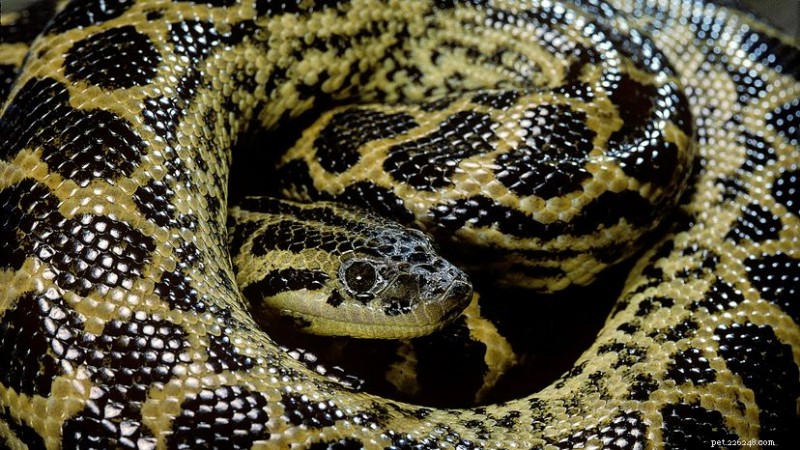
The yellow anaconda (Eunectes notaeus) thrives in the lush, water‑rich ecosystems of South America. These powerful, semi‑aquatic constrictors are famed for both their hunting prowess and an intriguing courtship ritual known as the “breeding ball.”
In 2023, researchers uncovered a rapid, side‑squirming motion the species uses to evade threats, termed the “S‑start.” This movement demonstrates an unexpected agility in these heavy‑bodied snakes.
Below we highlight the key characteristics that set the yellow anaconda apart.
Yellow Anaconda Size and Appearance
The yellow anaconda has a broad, distinctive head that sits higher on the neck, with eyes and nostrils positioned on the upper portion of the head. This arrangement allows the snake to see and breathe while the rest of its body remains submerged.
Its robust, muscular build underscores its power as a constrictor, enabling swift swimming and efficient hunting.
How Big Do Yellow Anacondas Get?
Typical lengths range from 5 to 9 feet (1.5 to 2.7 meters). Females usually outsize males, weighing between 5 and 12 pounds (2.7 to 5.4 kilograms). In rare cases, individuals can reach up to 110 pounds (49.9 kilograms).
Coloring and Camouflage
Their skin displays a yellowish or golden background, accented by brown or blackish bands and rosette‑like patterns. This coloration offers excellent camouflage in marshy, aquatic environments. Like its boa relatives, the skin is smooth to the touch.
Geographic Range
Yellow anacondas are native to southern South America, especially the Pantanal—a vast tropical wetland spanning Brazil, Bolivia, and Paraguay. They are also found in southern Brazil, northeastern Argentina, and eastern Bolivia.
They favor slow‑moving rivers, marshes, and swamps, where murky waters provide both hunting cover and a safe habitat. The humid, tropical climate supplies the warmth these ectothermic snakes need to regulate body temperature.
Summertime Predation
After the heavy flooding from June to November recedes, prey such as wading birds become more accessible, leading to heightened predation activity. This seasonal shift can also increase encounters with larger predators that can navigate lower water levels.
Feeding Habits and Diet
Yellow anacondas have an opportunistic diet. Juveniles often target birds, rodents, and amphibians, while adults expand to fish, larger rodents, small caimans, and even bird eggs. Remarkably, they have preyed on crab‑eating foxes (Cerdocyon thous) and tegu lizards.
Yellow Anaconda Mating Behaviors
Mating season occurs in April and May. Females release pheromones that attract multiple males across the marshes. Once a male locates the female, a breeding ball forms—an interlocking knot of snakes that can involve a dozen or more individuals.
A Prolonged Breeding Ball
The ball remains in motion as males compete for proximity to the female. This contest can last from several hours to days, often in or near water, with the snakes focused almost entirely on reproduction.
Gestational Periods
Yellow anacondas are ovoviviparous, giving birth to live young after a gestation of several months that usually concludes during the late rainy or early dry season. Litters can range from 20 to 40 or more offspring. Newborns are fully formed, independent, and capable of swimming and hunting immediately after birth.
A New Adaptation for Protection
Harvard researchers led by Nicholas Charles observed the S‑start in laboratory conditions. The motion involves the snake forming an S‑shape, flattening the middle segment on the ground while the curved portions slide along the top and bottom, creating a sideways leap.
In a study of 10 yellow anacondas of various ages and sizes, only the younger, more muscular individuals performed the S‑start. Older, larger snakes lacked the necessary muscle‑to‑weight ratio for this maneuver. Computer simulations confirmed that a specific balance of body mass and muscle strength is essential; deviations hinder the movement.
This article was written in conjunction with AI technology and subsequently fact‑checked and edited by a HowStuffWorks editor.
- Czechoslovakian Vlcak: Understanding Their Wolf-Like Behavior & Care Requirements
- Choosing the Right Crate Size and Type for Your German Shepherd-Husky Mix
- Quick & Safe Guide to Removing Candle Wax from Your Cat’s Fur
- Top 5 Safest Seat Belts for Your Dog: Keep Your Furry Friend Secure on the Road
- 5 Proven Ways to Boost Your Dog’s Fitness & Wellness
- Why Is My Cat Refusing to Eat? Signs & Quick Solutions
- Meet George: The Cat That Stands on Two Legs