

Why Do Cats Sleep on You? The Science Behind Their Cozy Behavior
For cat owners, it’s common to find your feline companion tucked into the most intimate spots—your chest, your legs, or even your pillow—while you try to catch a few hours of sleep. Cats, however, are not simply sleep‑aholics; they are meticulous seekers of warmth, safety, and social connection.
Across the species, the average cat sleeps 15–20 hours per day. When we see them curl under furniture, hide behind curtains, or drift off in a sunny windowsill, we’re witnessing instinctual behaviors that have evolved over thousands of years.
Some cats, however, claim the bed as their own. While many owners welcome this cuddle, others find the nightly occupation of their space inconvenient. Understanding the why can help you decide whether to embrace or redirect the habit.
“There’s a lot we don’t know about cats,” says Dr. Laura M. Holland, veterinarian at Circle of Life Veterinary Clinic in New Britain, Pennsylvania. “It’s a complicated question of why they want to sleep with or on us.”
Continue reading to uncover the biology and psychology behind your kitty’s chosen sleeping spots—and get practical tips for retraining if the situation becomes disruptive.
Why Do Cats Choose to Lie on Us?

It may help to remember how kittens behave when they’re young. “When cats are born, they pile together—think of a basket of kittens,” explains Dr. Marci Koski, cat behaviorist at Feline Behavior Solutions in Vancouver, Washington. “They’re warm, secure, and surrounded by familiar scents. It’s natural that they’d seek out family members to sleep with.”
Sleeping on you also offers a sense of security. As predators, cats rely on group vigilance for protection. “When they’re asleep, they’re vulnerable, so they gravitate toward the safest spot available—often the legs of their human companion,” says Koski. “Plus, the scent of a human is a powerful cue that keeps them calm.”
Heat is another key factor. Cats maintain a thermoneutral zone of roughly 86–100 °F, considerably warmer than the 64–72 °F range for humans. “Cats are drawn to the warmest spots, and our bodies provide just the right temperature,” adds Koski.
Does It Signal Affection?
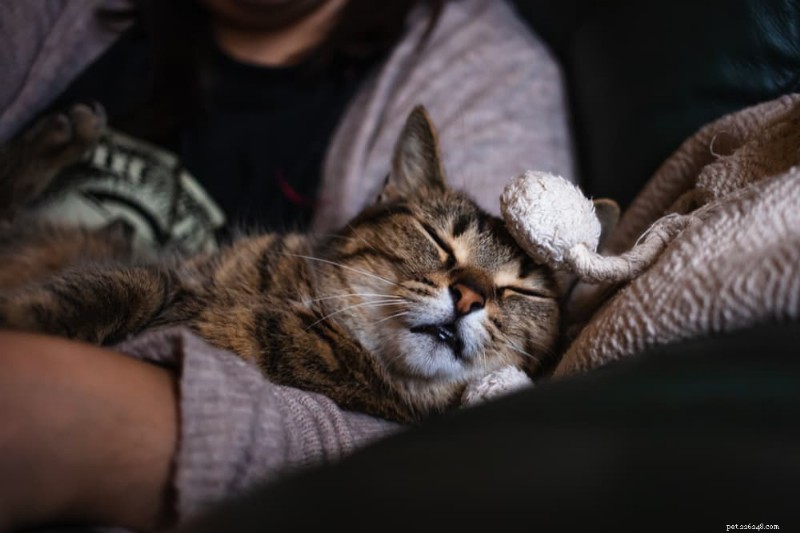
Experts view a cat’s decision to sleep on you as a strong bond signal. “If you allow your cat to sleep with you, it’s a sign of trust and inclusion in their social colony,” Holland says.
Given that cats often sleep atop one another, treating a human as part of the family is not surprising. “A loving relationship will naturally lead to snuggling and petting,” says Koski. “It’s a rewarding behavior for both of you.”
Common Sleeping Spots and Positions

Holland notes that while cats have preferred sleeping styles—such as on their backs with paws in the air, curled into a ball, or covering their faces—certain spots are consistently favored:
- Between your legs
- On your chest
- On your head
- Next to you in bed
Although we don’t fully understand why these particular positions are chosen, warmth remains a common thread. Cats love sun‑baked spots, fireplaces, or piles of clean laundry—anywhere they can bask in heat.
When the cuddle becomes a sleep‑interrupting nuisance, the next section offers gentle solutions to reclaim your bedroom.
How to Reclaim Your Bed

Retraining is entirely possible. The key is to create an equally appealing alternative and reinforce it with positive feedback.
Start by setting up a heated cat bed or a blanket that carries your scent or your cat’s own scent. “Praise and pet your cat when they settle in the new spot,” advises Koski. “Positive reinforcement turns the behavior into a habit.”
Consider your cat’s natural crepuscular rhythm. A 15–20‑minute play session followed by a small snack before bedtime helps them expend energy and signals it’s time to wind down.
If a persistent habit continues to disrupt your sleep, consulting a veterinarian or a certified cat behaviorist can provide personalized strategies. With consistent training, you and your cat can share a peaceful night’s rest.
- Pet Behavior
- Pet Breeds
- Pet Names
- Pet Adoption
- Pet Training
- Cat Stories
- Pet Health
- Adorable Pets
- Cats
- 19 Remarkable Big White Dog Breeds for Experienced Owners
- Understanding Rabbit Vocalizations: Why They Grunt and Other Common Sounds Explained
- 145 Elegant Names for Your Hairless Cat
- Essential Bull Terrier Training: Build a Well‑Behaved Companion
- Animal Alert: Monitoring Wildlife to Predict Natural Disasters
- 8 Bird Mating Dances That Are the Most Spectacular
- The Best Kid-Friendly Cat Breeds for a Happy, Healthy Family