

Recovering Escaped Cobras & Snakes: Successful Retrievals from Zoos and Homes – Part 2
 Please see Part I of this article for some cobra and python escape stories set in NYC.
The “Ditmar’s Trap”
I first became aware of snake traps through The Reptiles of North America, written by legendary Bronx Zoo curator Raymond Ditmars. Mr. Ditmars recounted capturing Northern Watersnakes (Nerodia sipedon) by securing fish to strings that were anchored to stumps in likely locations…a feat I was later to repeat successfully on several occasions (snakes have trouble backing off prey once it has been swallowed, and Watersnakes are especially ravenous feeders). If you have collected Watersnakes by hand, you’ll understand the attraction of a method that spares one’s skin!
Snakes that escape in zoos invariably wind up in the room housing the feeder rodents, drawn by the scent of prey…you might try the “Ditmar’s Trap” with a dead mouse or rat if a rodent-eating snake of your own escapes. Just be sure that the snake cannot injure itself by thrashing about, and check the trap frequently.
Minnow Traps
Although rarely used, minnow, crayfish and eel traps also work well as snake traps and can even be baited with live earthworms (I’ve captured Common Garter Snakes, Thamnophis sirtalis, in this manner) or small fishes. When setting traps in shallow water, be sure to position them so that an overnight rain will not cause the trap to become submerged, or your captives will drown. You may need to cover the traps’ rough wire entranceways with silicone to prevent snakes from injuring themselves.
Tracking Snakes
It is usually very difficult to find an escaped snake in a home. However, the old trick of spreading powder or flour about, to reveal snake tracks, is often productive.
You can even find snake tracks outdoors, if conditions are just right. During Venezuela’s dry season, I was surprised to find that Green Anacondas (Eunectes murinus) left very clear drag marks when moving from one pool to another. As the wind usually erased the tracks within an hour or so, any that I saw were bound to be fresh, and often led me to a snake.
Bird Cages as Snake Traps
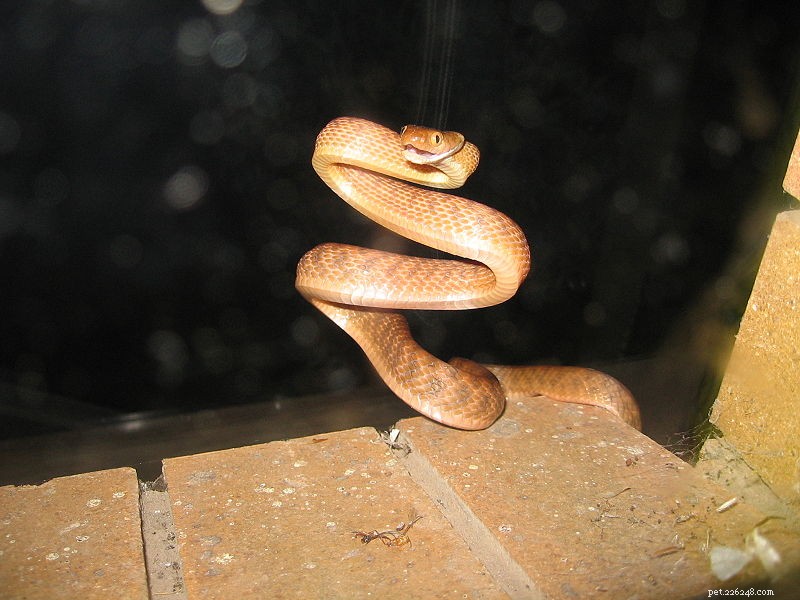
I suppose the most unusual snake traps I know of involve bird cages on the island of Guam. The Brown Treesnake (Boiga irregularis) made its way to Guam as a ship stowaway sometime in the 1940’s. With ample “snake naïve” prey, the rear-fanged predators experienced a population explosion. To date, the Brown Treesnake has caused the extinction of 9 of Guam’s 11 native bird species (5 endemics), 4-5 lizards and, possibly, 2 bats.
A colleague who went to Guam to address the situation in the early 1980’s told me that, as food supplies dwindled, the nocturnal snakes began invading homes. The keeping of pet birds is (or was!) quite popular, and bird owners often awoke to find the cage of their former pet occupied by a snake that fit through the bars on the way in, but not on the way out!
I’ve worked with this species (and 2 of its “victims”, the Guam Rail and Kingfisher) in captivity, and believe his story – they are extremely aggressive hunters.
- Why Snakes Hiss: Understanding Their Defensive Behavior
- Do Snakes Attack and Eat Cats? Understanding the Risks and How to Protect Your Pet
- Proper Feeding of Pet Snakes: Overcoming Reluctance to Eat Frozen Mice and Other Pre‑Killed Prey
- Recovering Escaped Cobras and Snakes: Strategies for Zoos and Homekeepers – Part 1
- Affordable, Expert-Approved Terrariums for Sliders, Painted Turtles & More – Part 1
- Affordable Turtle Habitats: Budget-Friendly Setups for Sliders, Painted Turtles & More – Part 2
- Barks & Bites: Protecting Pets from North American Venomous Snakes