

Beyond Webs: Unveiling Spider Hunting Techniques Beyond Silk – Part 1
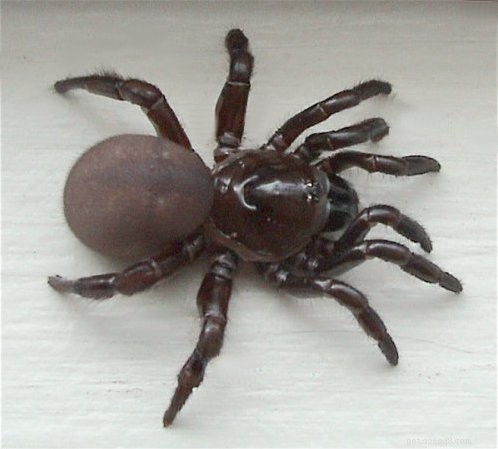 Silk webs are amazing innovations, and the “sit and wait” tarantula stategy is remarkably effective…but among the world’s spiders we also find a mind-boggling array of other hunting techniques. Some of these odd hunters, such as Fishing, Jumping and Trapdoor Spiders, occasionally appear in the trade…all are worth a closer look.
Tarantulas (Mygalomorphs) and Their Relatives
Tarantulas are the best known of the Mygalomorphs (spiders distinguished by, among other things, fangs that strike downward as opposed to side-to-side). Some relatives stray from the “sit and wait” strategy:
Trapdoor Spiders construct exquisite, hinged silken doors with which to close their burrows. After being decorated with debris, they are indistinguishable from the ground…in areas of heavy insect traffic, however, burrow clusters are common.
The spider may spend its entire life in the burrow, bursting out to grab passing insects when alerted by silken “tripwires”. Trapdoor Spiders are fascinating to observe when housed in a modified “Ant Farm” – please see the article below for further info.
Purse Web Spiders are tarantula relatives with out-sized fangs. They build a silken tube that connects to their burrow or other retreat. Bits of bark and grass camouflage the tube – those built on tree trunks bear an uncanny resemblance to vines. The spider bites through the silk to kill insects crawling over the tube. A hole is then cut and the insect is pulled into the burrow…the huge fangs are used to hold the torn edges together while the hole is repaired.
True Spiders
 The remaining spiders covered here are classified as True Spiders (as distinguished from Tarantulas). They have not received much attention from invertebrate enthusiasts or zoos, but that is changing…read on and see why.
The European Water Spider (Argyroeta aquatica) is a great favorite of mine, and manages to stand out even in a group known for bizarre adaptations. It constructs a silken bell among submerged plants and fills it with air bubbles carried among its body hairs. The spider lives within this bell and swims out to catch passing insects, fishes and tadpoles.
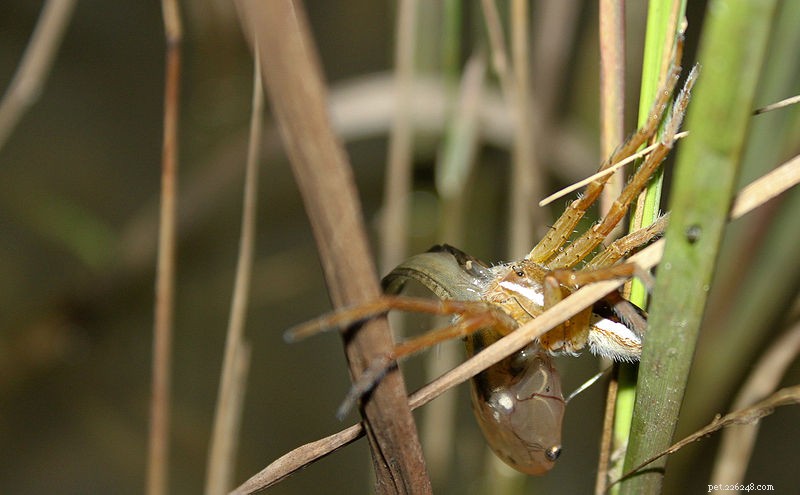
Fishing Spiders (Dolomedes spp.) float on the water or remain on emergent plants with the forelegs touching the surface. Recently, it has been discovered that some species actually lure minnows near by moving a leg in imitation of an insect! I’ve encountered some huge specimens in NY –the photo here shows an Africa species that has captured a tadpole.
Ambush Hunters
The Pine Barrens Spider (Geolycosa spp.) lives a tarantula-like lifestyle, rushing from its burrow to catch insects. I studied several populations on Long Island, NY – their burrows exceeded 12 inches in depth, and tiny stones were piled around the burrow entrance as “flood protection”.
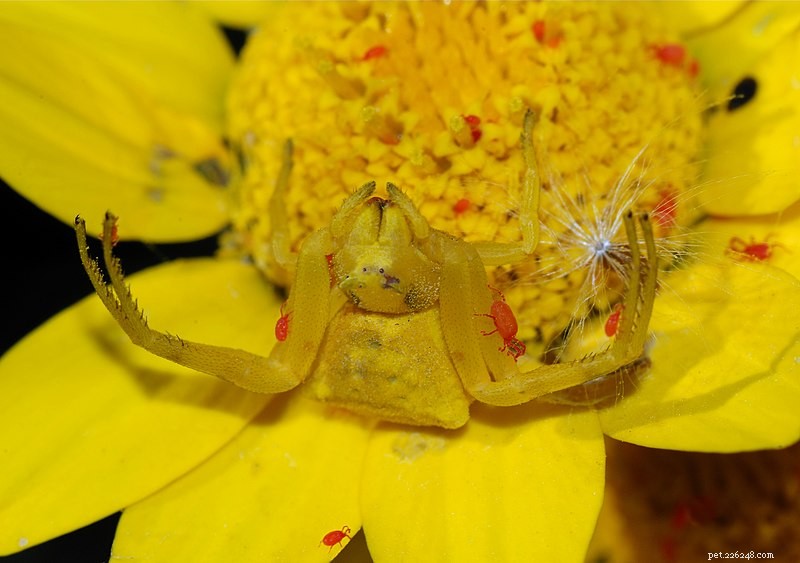 Those Crab Spiders that hunt in flowers are impossible to see, so closely do they match the color of their lairs (please see photo). Spine-covered forelegs and good vision enables them to take quite large prey. Unlike most spiders, they seem to specifically direct bites to nerve centers near their prey’s “neck”, perhaps to more quickly subdue large insects.
- Optimal Diet for Semi-Aquatic Turtles: Vegetables & Greens for Sliders, Map Turtles, & More – Part 1
- Recovering Escaped Cobras & Snakes: Successful Retrievals from Zoos and Homes – Part 2
- Semi-Aquatic Turtle Diets: Nutritious Vegetables & Greens – Part 2
- Recovering Escaped Cobras and Snakes: Strategies for Zoos and Homekeepers – Part 1
- Optimal Leopard Gecko Nutrition: Moving Beyond Crickets and Mealworms – Part 1
- Advanced Leopard Gecko Nutrition: Beyond Crickets and Mealworms – Part 2
- Beyond Webs: Advanced Spider Hunting Techniques – Swimming, Spitting & More (Part 2)