

The Chuckwalla: A Reliable, Low-Maintenance Companion for Desert Terrariums
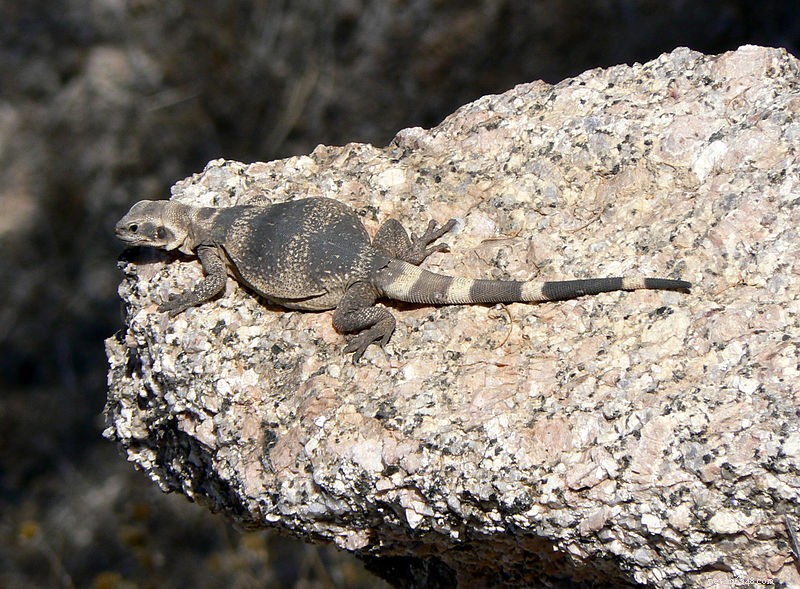 The stocky Chuckwalla (Sauromalus obesus) is one of my all-time favorite lizards. Years ago, I and others found it a quite difficult captive, as little was known of its high UVB requirements. Today, however, its husbandry is well-understood, and captive bred animals are readily available.
Food and hot basking sites are the focal points of the Chuckwalla’s life – provide it with each in proper form and you’ll find yourself with a most responsive and interesting pet. Most take quickly to hand feeding, and their vegetable-dominated diet is a plus for many herp enthusiasts.
Description
The body is squat with loose skin folds along the neck and sides, and is colored reddish to light gray with a pale yellow tail. The head, chest and limbs of males are usually black, but some sport very impressive red coloration. Females and young animals (and, for some reason, males in SW Utah) are marked with dark bars.
Adult size varies from 6-18 inches, depending upon location and subspecies. Among lizards native to the USA, large adults are exceeded in size only by the Gila Monster (Heloderma horridum).
Chuckwallas belong to the Family Iguanidae which, as originally conceived, contained over 700 species. Recent taxonomic revisions have left the family with 36 species. S. obesus and S. ater are considered to be the same species by some taxonomists.
“Chuckwalla” is derived from the word caxwal, the name given the lizard by the Cahuilla People and which was later recorded by the Spanish as chacahuala.
Range
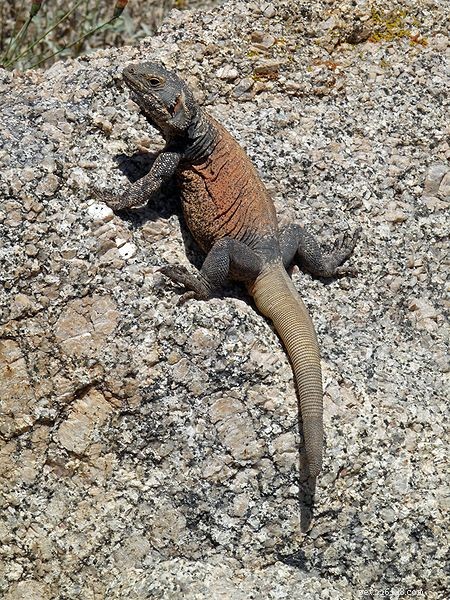 The most commonly available species, Sauromalus obesus, inhabits southwestern North America, within the Mojave and Sonoran Deserts and surrouning areas. It ranges from California through southern Nevada, southern Utah, western Arizona and northern Mexico (Baja California and western Sonora). Four subspecies are recognized.
Five additional species of Chuckwalla occur in Mexico and on several islands in the Gulf of California.
Habitat
Chuckwallas are quite specific in their habitat requirements, being limited to rocky areas within deserts. Lava flows, rock piles, outcroppings and rocky hillsides are typical Chuckwalla habitat, and in undisturbed sites may support large populations. They are diurnal and rely upon rocks for basking and to facilitate their unique escape behavior (please see Part II of this article for details).
- The Chuckwalla: A Resilient Desert Lizard – Part 2
- Keeled Box Turtle (Pyxidea mouhotii): A Resilient Species in Urgent Need of Captive Breeding
- Breeding the Green Basilisk (Plumed) and Related Species – A Comprehensive Guide
- Keeled Box Turtle: Conservation & Captive Breeding Strategies – Part 2
- Breeding Green Basilisks & Related Species: Expert Guide – Part 2
- Top 10 Steps to Launch a Successful Herpetology Career – Part 1
- 10 Proven Steps to Launch a Career in Herpetology – Part 2