

The Green Frog (Lithobates clamitans): Key Facts for Amphibian Enthusiasts – Part 2
 The widespread Green Frog (Lithobates/Rana clamitans) often provides aspiring herpetologists with an introduction to frog-keeping. Please see Part I of this article for more on its natural history.
Status in the Wild
Although fairly common throughout much of its range, in some places the Green Frog is impacted by habitat loss due to shoreline development and the introduction of Bass, Carp and other fishes, which consume eggs and tadpoles.
In recent years, deformed Green Frogs have been found in ever-increasing numbers. The cause is unknown, but pesticide or other chemical pollution is suspected. Farm ponds usually have a higher incidence of deformed individuals than do urban or rural habitats. Green Frogs are regulated as a game species in several states, as they are collected for the food trade (frog’s legs) and for use as fishing bait (ahh!).
Reproduction
Males establish small breeding territories, which they defend from other males. Both sexes use the male’s mating call to access the caller’s size and suitability as a mate.
The eggs, up to 7,000 in number, are laid in a foamy surface film. Females may breed twice yearly in the southern states. The tadpoles feed upon algae, carrion and detritus. In the southern part of the range, the tadpole stage lasts for 2-3 months; those in the north may overwinter as tadpoles. Sub-adult Green Frogs may disperse as far as 3 miles from their natal pond.
Diet
Often the most common amphibian within their habitat, Green Frogs eat and are eaten by a great many creatures, and are a vital component of the local food web.
Green Frogs consume virtually any creature capable of being swallowed -flies, spiders, mosquitoes, dragonflies, millipedes, earthworms, beetles, moths and other invertebrates, small fishes, tadpoles and frogs are all on the menu. Always hungry, they will even snap at a bit of cloth on a string moved about within their field of vision (many entered my collection years ago when they fell for this trick!).
Green Frogs and their tadpoles are an important food source for a wide variety of predators, including Giant Water Bugs, Dragonfly Larvae, various fishes, Water, Garter and Ribbon Snakes, Snapping Turtles, Otters, Raccoons and wading birds. My observations in NYC habitats lead me to believe that the American Bullfrog is a major predator there.
A Few Observations
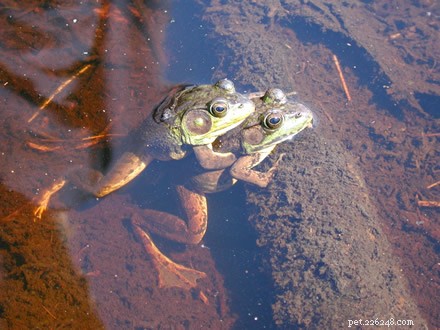 Green Frogs have provided me untold hours of pleasurable observations. I once found an adult hibernating under damp leaves in an outdoor pen (I had missed that individual when I took his cage-mates indoors for the winter). I had assumed that hibernation always occurred under water, but it seems that there is some flexibility in this. I’ve since learned that underwater hibernation is typical, and that hibernating frogs seek well-oxygenated locations; your own observations would be most appreciated.
I’d always enjoyed tossing crickets to the frogs that lived in an artificial pond at the Bronx Zoo, where I worked. Visiting children loved this, as the residents were incredibly bold, even taking food from the hand. In fact, this boldness led to a few accidents – wildly leaping Green Frogs sometimes landed too close to the pond’s resident Bullfrog, who was only too happy to gulp them down!
- Breeding the Green & Gold Bell Frog to Support Recovery of Australia's 'Extinct' Gold Spotted Bell Frog – Part 1
- Breeding Green and Gold Bell Frogs & Reviving the Presumed Extinct Gold‑Spotted Bell Frog – Part 2
- Green Frog (Lithobates clamitans): Meet the USA’s Most Common Pond Frog
- Discover the Green Frog – USA’s Friendly Pond Amphibian, Part 3
- Breeding the Green Basilisk (Plumed) and Related Species – A Comprehensive Guide
- Breeding Green Basilisks & Related Species: Expert Guide – Part 2
- Smokey Jungle Frog (Leptodactylus pentadactylus): Natural History & Expert Captive Care – Part 2