

Smokey Jungle Frog: Natural History, Breeding & Care – Part 1
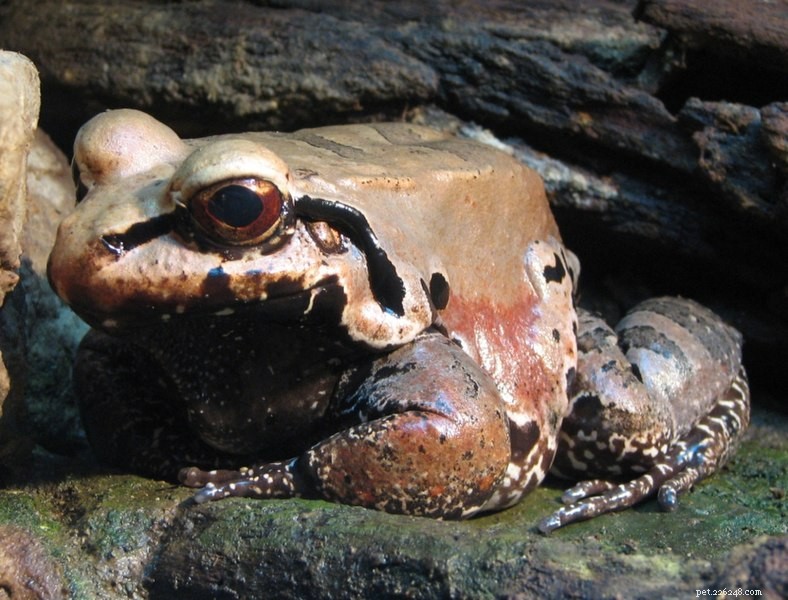 I’ve studied and cared-for a great many frog species in my time, but count the robust Smokey Jungle Frog, also known as the South American Bullfrog (Leptodactylus pentadactylus), as one of the most beautiful and mysterious of all. I’ve been very fortunate in having bred this frog in captivity, and today will examine its natural history and reproduction. I’ll move on to diet and its unique habits in Part 2.
Range
This frog occurs from Honduras and northern Nicaragua through Venezuela to French Guinea and south to southern Columbia, Ecuador, northern Brazil, Peru and Bolivia. Due to its secretive nature, the southernmost limits of its range are not well known.
Habitat
Usually found in lowland rainforests near slow-moving streams, the Smokey Jungle Frog is sometimes encountered far from permanent water sources. It commonly frequents dimly-lit, heavily-vegetated habitats.
Although it resembles semi-aquatic species in body-form, this frog is largely terrestrial. Adults shelter in burrows at the bases of trees, and are entirely nocturnal. The burrows are utilized on a long term basis. Juveniles are reportedly active by day, but those I’ve raised have ventured out only after dark.
Description
With a snout-vent length of 7.4 inches, this is one of Latin America’s larger Anurans. Variably colored in gray, tan and reddish-brown, and with irregular black markings, it is spectacular in appearance. Adult males have thick forearms, 2 black spines on the chest and a black spine on each thumb.
Juveniles, more brightly-colored than adults, are usually a shade of rust or reddish-brown.
Reproduction
Males call from the water’s edge during the rainy season, which occurs from May-November, depending upon location; territorial calls are issued from within burrows. The females lay approximately 1,000 eggs while grasped by the males in pectoral amplexus (below the forearms).
Male Smokey Jungle Frogs use their powerful rear legs to whip the jelly surrounding the eggs into a frothy mass of sperm, jelly, skin secretions, air and water. This nest surrounds the eggs and is deposited in a natural (or possibly self-dug) depression in the ground, usually at the water’s edge. The tadpoles are washed into waterways by the rain.
Terrestrial Nests
Interestingly, nests are sometimes deposited far from the water’s edge, and metamorphosis is achieved entirely on land. In these instances, the tadpoles do not leave the nest until they have transformed into frogs. It is assumed that they feed upon the nest itself, as well as upon eggs and each other, while developing. The tadpoles are very resilient to desiccation, and are kept moist by the frothy nest.
Rearing the Tadpoles
Smokey Jungle Frog tadpoles are large, reaching a length of 2.5-3.5 inches before transformation. They initially feed upon algae and the nest itself, and gradually add aquatic invertebrates, carrion and tadpoles to their diet.
I’ve bred this species several times, with the tadpoles always being moved into water upon hatching. They fed ravenously upon algae, soaked greens, dead minnows and blackworms, and transformed at 2.5 – 2.8 inches in length. Dead tadpoles were consumed by tank-mates, but I have not determined if actual predation occurred.
In the future I hope to raise a clutch in the nest, without water, in an effort to better understand their unique breeding strategy.
- Mastering Newt Care: Natural History & Captive Management – Part 1
- Smokey Jungle Frog (Leptodactylus pentadactylus): Natural History & Expert Captive Care – Part 2
- Mudpuppy: Natural History & Care Guide – Part 1
- Expert Guide to Mudpuppy (Waterdog) Care – Part 2: Habitat and Light Management
- Softshell Turtles: Expert Care & Natural History Guide – Part 2
- Trans-Pecos Ratsnake Care Guide: Natural History & Housing Tips – Part 2
- Pickerel Frog (Lithobates palustris): Natural History & Expert Care Guide