

Rough & Smooth Green Snakes: Expert Care for Naturalistic Terrariums – Part 1
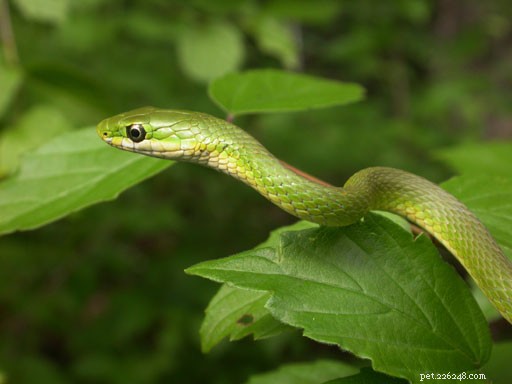 Larger rodent-eating snakes, especially those that take well to handling, have long dominated reptile collections. However, there is another side to snake-keeping – small, insectivorous species that, unlike their larger relatives, thrive in naturalistic terrariums. Of these, my all-time favorites are the Rough and Smooth Green Snakes (Opheodrys aestivus and O. vernalis).
The captive care information below refers mainly to the Rough Green Snake, which is more commonly kept, but applies to the Smooth Green as well.
Natural History
The Rough Green Snake ranges from southern New Jersey to the Florida Keys and west to eastern Kansas and Mexico, with isolated populations in Iowa, Missouri and New Mexico. Largely arboreal, it is usually found near water, into which it may retreat when disturbed. Large adults may exceed 4 feet in length, but most individuals are smaller.
The Smooth Green Snake occurs further north, into southern Canada, but overlaps the range of the Rough Green in southern and western portions of its distribution. It also climbs well, but often forages on the ground. It tops out at 2 feet or so in length.
Many people report that both species often occur at high densities in certain areas, and that the eggs of many females may be found together. Interestingly, students of mine consistently claim to have observed Rough Green Snakes in abandoned lots in NYC (Bronx), but I have been unable to confirm this.
Pros and Cons
The care of Green Snakes differs from that of more popular species in many important regards – they rarely do well if handled often, prefer densely planted, slightly humid terrariums and require a varied, insect-based diet.
That being said, there is much to recommend them. Green Snakes are beautifully colored and, because of their small size, we can see many of their natural behaviors in captivity. They are also quite active and their efforts at tracking down live insects in complex displays are very interesting to observe.
The Terrarium
A vertically-oriented “tall style” aquarium of at least 30 gallon capacity is ideal is ideal for Green Snakes –cramped, bare quarters will lead to stress and early death.
Substrate and Furnishings
 Green Snakes favor humid surroundings – a substrate that retains some moisture, such as Hagen Jungle Earth, should be used – no bare, newspaper-lined cages for these fellows! The substrate should be misted daily and allowed to dry out over a period of 2 hours or so, as consistently wet conditions will lead to fungal infections of the skin.
Plenty of cover, especially in the form of live plants, is essential – Pothos, Peace lilies, Cast Iron, Snake Plants, Chinese Evergreens and other sturdy terrarium standbys work very well.
Thin branches, preferably with intertwining Grapevine or artificial vines, should take up most of the air space. Arboreal hideaways in the form of entwined branches and leaves will provide the security these snakes need in order to feel at home and behave normally. In common with many shy species, Green Snakes are more likely to show themselves when provided with a densely-planted enclosure. When suitable cover is provided, they tend to calm down and become more, not less, visible.
A moist retreat should always be available. Rolled cork bark filled with damp Sphagnum Moss is ideal.
- Recovering Escaped Cobras & Snakes: Successful Retrievals from Zoos and Homes – Part 2
- The Ultimate Guide to Selecting the Perfect Substrate for Reptiles, Amphibians & Invertebrates – Part 1
- Discover Sunburst & Green Diving Beetles: A Fresh Take for Insect Keepers – Part 1
- Breeding the Green Basilisk (Plumed) and Related Species – A Comprehensive Guide
- Rough & Smooth Green Snakes: Expert Care & UVB Lighting for Thriving Terrariums
- Advanced Care Guide for Aquatic Sunburst & Green Diving Beetles – Part 2
- Breeding Green Basilisks & Related Species: Expert Guide – Part 2