

Common Musk Turtle: The Ideal Pet Choice & Guide to Related Species
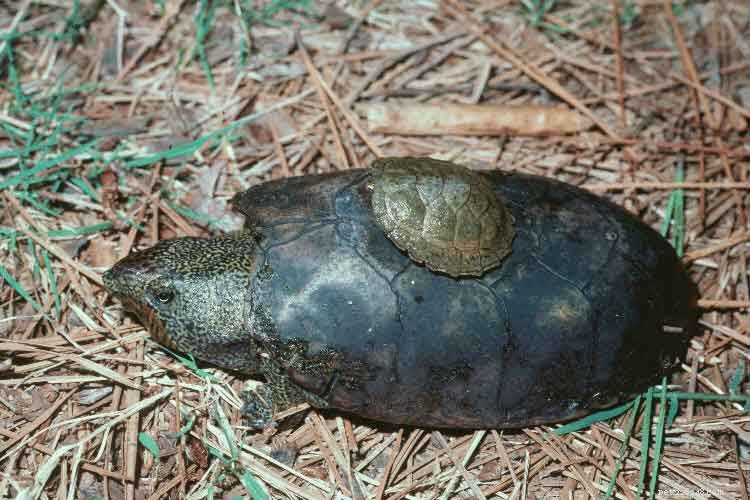
 As a boy working for an animal importer in NYC, I was much taken by the first hatchling Common Musk Turtle (Sternotherus odoratus) I encountered. The minute, jet-black beast, much smaller than a baby Red-Eared Slider, was irresistible. Last month that very same turtle turned 46 (please see photo). So I am, of course, partial to the species, but there are actually very good reasons to keep this fascinating turtle and its relatives.
Description
This turtle rarely exceeds 4 inches in length (record: 5 3/8 inches); males average 3 inches. The highly-domed carapace is olive-brown to black and often algae-coated. The plastron is small, leaving a good deal of flesh exposed. The skin is gray to black, and there are two yellow stripes on the head and a pair of sensory barbels (fleshy protuberances) on the chin and throat.
Musk Turtles bear glands that can emit a foul-smelling secretion designed to deter predators. Fortunately, captives quickly abandon this habit.
Range
The Common Musk’s range extends from southern Ontario and Maine to Florida and west to southern Wisconsin and central Texas. It is one of the few turtles still to be found within NYC.
Habitat
The highly aquatic Common Musk Turtle favors the slow-moving waters of swamps, canals, farm ponds and river edges, but occasionally occurs in fast-moving streams.
Oddly, they sometimes climb trees to heights of over 6 feet when basking, aided by their small size and mobile legs (the plastron is much reduced). Musk Turtles sometimes surprise people by dropping into boats passing below basking sites!
Reproduction
 Egg-laying occurs from February through June, depending upon the latitude, with mating concentrated in the spring.
The average clutch contains 2-5 eggs (range 1-9); 4 clutches per year may be produced in the southern part of the range. The eggs are deposited in a shallow nest (muskrat lodges are favored in some areas), within decaying logs, or below leaf litter. Several females may share 1 nest site.
The incubation period is 9-12 weeks; the tiny hatchlings measure ¾ of an inch in length. Sexual maturity is reached in 3-5 years for males and 5-11 years for females.
Diet
Although reported to eat plants on occasion, the Common Musk feeds mainly upon crayfishes, fish, carrion, insects, leeches, tadpoles and snails.
Hatchlings, vulnerable to predation due to their small size, are consumed by bullfrogs, fishes, giant water bugs, raccoons and other creatures.
Captive Care
As turtles go, Common Musks are quite simple to care for. Reptomin can comprise 50-60% of the diet, with the balance being supplied by other commercial aquatic turtle foods, earthworms and minnows.
While Musk Turtles occasionally bask, they differ from many other turtles in not requiring UVB light to synthesize Vitamin D. Along with Snapping, Soft-Shelled and certain other aquatic species, they can apparently obtain sufficient Vitamin D from their diets.
Other Mud and Musk Turtles
The 26 Mud and Musk Turtle species (Family Kinosternidae and Staurotypidae) share a common body plan and general behaviors, yet show an astonishing range of adaptations to diet, habitat and predators. Among them we find both North America’s smallest turtle and brutes with jaws capable of crushing a finger. Very few receive attention from hobbyists or zoos, yet nearly all are hardy and can be bred in captivity. I’ve had the good fortune of keeping 15 or so species…following is an introduction to some of my favorites.
Note: All Mud and Musk Turtles can deliver painful and, in the case of the Mexican Giant Musk, dangerous bites. Many calm down in captivity, but extreme caution is always necessary.
Mexican Giant Musk Turtle, Staurotypus triporcatus
This 15-inch-long turtle shares its habitat with several crocodilians, and has developed an extremely thick shell (and, some say, a pugnacious disposition!) in response. It ranges from Veracruz, Mexico to Honduras, and is known locally as the Guau.
A Giant Musk under my care at the Bronx Zoo is now in its 70’s, and has lost none of its willingness to bite when handled. Notoriously difficult to pair up, captive-bred animals have only recently become available. It is a mollusk specialist, easily crushing clams and smaller turtles in its massive jaws…mine even made short work of hard-shelled snails known as Periwinkles.
Flattened Musk Turtle, Sternotherus depressus
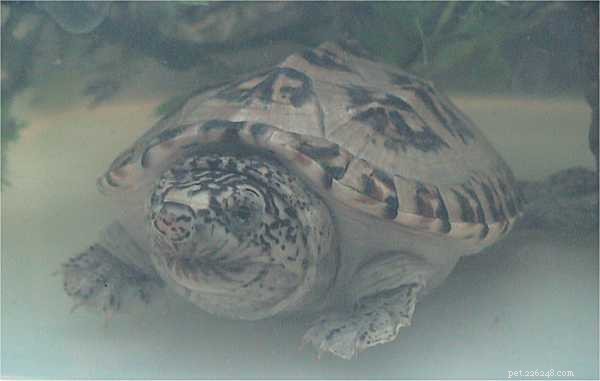
This smallest of North America’s turtles is a mere 3 – 4.5 inches in length, and lives only in northwest Alabama’s Black Warrior River. Unlike its relatives, all of which sport high, almost “tortoise-like” carapaces (most pronounced in the Razorback Musk Turtle, see photo), its upper shell is extremely flat. Some believe this adaptation assists it in hiding from its many predators.
In nature this species hybridizes with the Loggerhead Musk, S. minor.
Mud Turtle, Kinosternon subrubrum
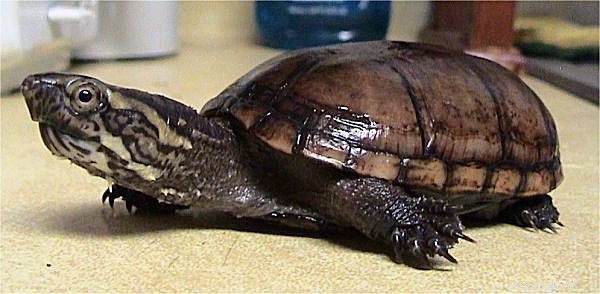
Four subspecies of Mud Turtle have been identified, with the eastern race being endangered in several states. Now bred in captivity, this droll little turtle is an excellent choice for novice turtle-keepers.
The Eastern Mud Turtle often frequents brackish waters…in NY, it is known only from salt marshes and tidal streams.
Narrow-Bridged Musk Turtle, Claudius angustatus
This most unusual turtle is only rarely kept or bred. Although but 5 inches long, its jaws are incredibly wide, and it can reach further back with its neck than even the Common Snapper. Some speculate that this arrangement helps them to catch frogs, which are common in the shallow, weedy ponds they inhabit.
This is a “hands-off” turtle – I’ve had 30-year captives that remained as aggressive as the day they were collected. Despite that, they do well if provided whole fishes, snails, crayfishes and earthworms. Their pugnacious nature complicates breeding – I’ve yet to find a compatible pair.
Striped Mud Turtle, Kinosternon bauri
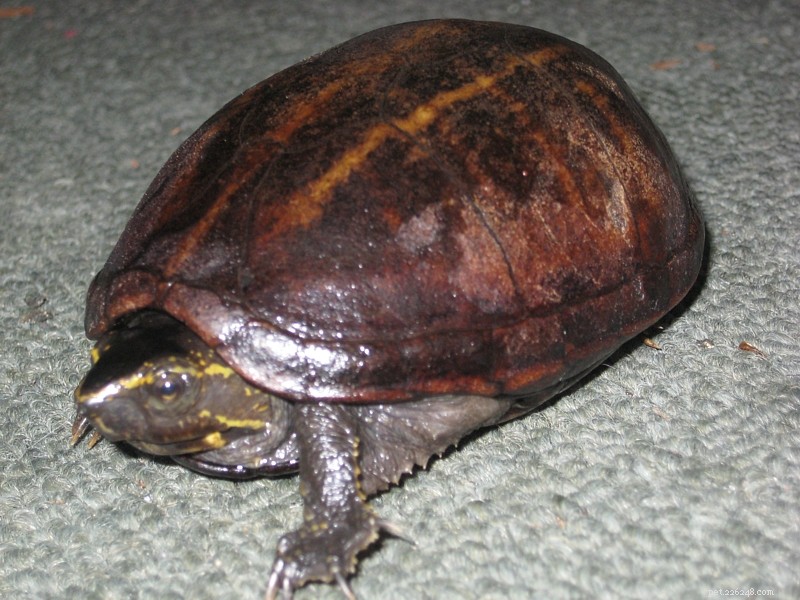
Sporting a lightly-striped, olive-brown carapace, the Striped Mud Turtle (please see photo) inhabits swamps and canals from southern Georgia to the Florida Keys.
This turtle appears regularly in the trade…perhaps because, unlike its largely aquatic relatives, it frequently travels overland. It has been bred in captivity and makes a fine pet, although those I’ve kept tended to burrow into the earth for extended periods (wild specimens aestivate during droughts).
- Celebrate Your Pet’s Love: Thoughtful Holiday Gifts for Furry Friends
- Reeve’s Turtle (Mauremys reevesii): The Ideal Companion for Red‑Eared Slider Enthusiasts
- Must-Have Supplies for a Healthy Pet Reptile
- The Ultimate Guide to Building a Healthy Reptile Habitat
- Rabbits: The Ideal Family Companion
- Build the Ideal Pet Shed: A Step‑by‑Step Guide for Dog Owners
- The Transformative Power of Pets for the Elderly