

Painted Turtle Care & Natural History: Expert Tips for Owners
This article is one of a series in which I plan to provide a brief introduction to both popular and rarely-kept amphibians, reptiles and invertebrates. I’ll cover such topics as unique habits in the wild, common concerns in captive care, pet pros and cons, husbandry tips and so forth. Detailed care articles will follow…until then, I would enjoy receiving your questions and comments. Today we’ll take a look at the most widespread of all North American Chelonians, the Painted Turtle (Chrysemys picta).
Range
The Painted Turtle is the only freshwater turtle to range clear across the length and breadth of the USA. The combined range of the 4 subspecies (the Eastern, C. p. picta, Western, C. p. bellii, Midland, C. p. marginata, and Southern, C. p. dorsalis) extends from southern Canada to northern Mexico, and encompasses roughly ¾ of the United States.
Why keep Painted Turtles?
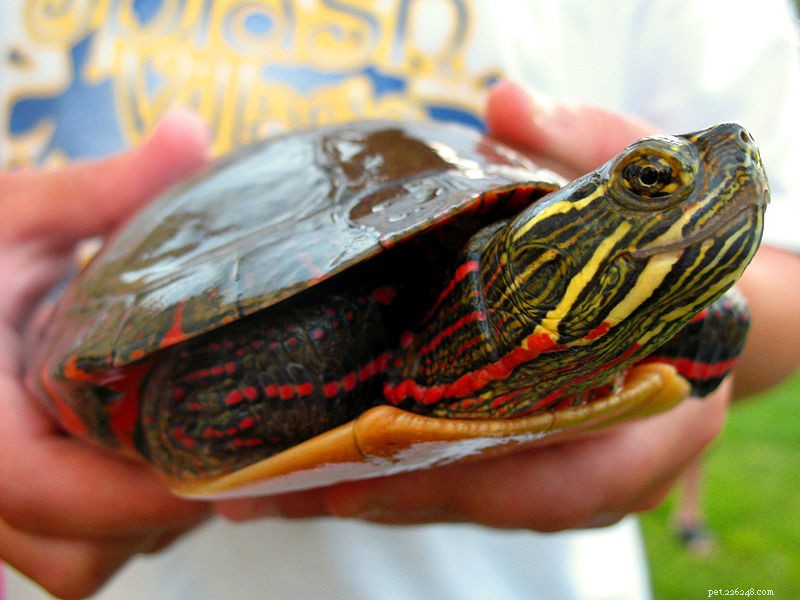
Were it not so familiar to folks here in the USA, this most brightly-colored of the world’s turtles would certainly receive more attention from hobbyists – friends in other countries certainly hold it in high esteem. Unlike most turtles, the brilliant red, orange and yellow highlights do not fade with age – some of mine even appeared to intensify as time when on!
I consider the Painted Turtle a much better choice as a pet than the more popular Red Eared Slider. The subspecies are varied in color, hybridize at the edges of their range (a 22 year old at the Bronx Zoo appears to be an Eastern/Midland mix) and are all quite hardy when given proper care. They are far more cold tolerant than most Sliders (Eastern Painted Turtles have survived being frozen in a block of ice)… wild caught individuals under my care go off feed each winter but remain active (at room temperature) and lose little if any weight by spring.
Another point in their favor is size – most top out at 8 inches in length with the largest (female Western Painted Turtles) being 9.5 inches long. However, although they are smaller than Sliders, they are just as active – hatchlings should be started in a 20 gallon aquarium, and a pair of adults will need a tank of at least 75 gallon capacity, or an outdoor pond.
Diet
Painted Turtles are easy to feed, and can be kept in peak condition with a diet comprised of Reptomin, Freeze Dried Shrimp, minnows, earthworms, insects and dandelion and other greens (please see the article below for notes on feeding vegetables). Most other aquatic turtle foods can also be offered from time to time.
Basic Necessities
Other necessary husbandry tool are readily available – a strong filter (I favor the ZooMed Canister), basking platform, UVB source and an incandescent basking light that warms the platform area to 90 F or so.
- Mastering Newt Care: Natural History & Captive Management – Part 1
- Red-Eyed Treefrog (Agalychnis callidryas): Captive Care Guide & Natural History
- Mudpuppy: Natural History & Care Guide – Part 1
- Dwarf Chameleons: Expert Care Tips & Natural History Insights
- Fire Skink (Mochlus fernandi): Natural History & Expert Care Guide
- Rhinoceros Iguana: Natural History, Care Guide, and Habitat Insights
- Mossy Treefrog (Theloderma corticale): Expert Guide to Care and Natural History