

Vine Snakes: Agile, Tree‑Climbing Carnivores of the Americas
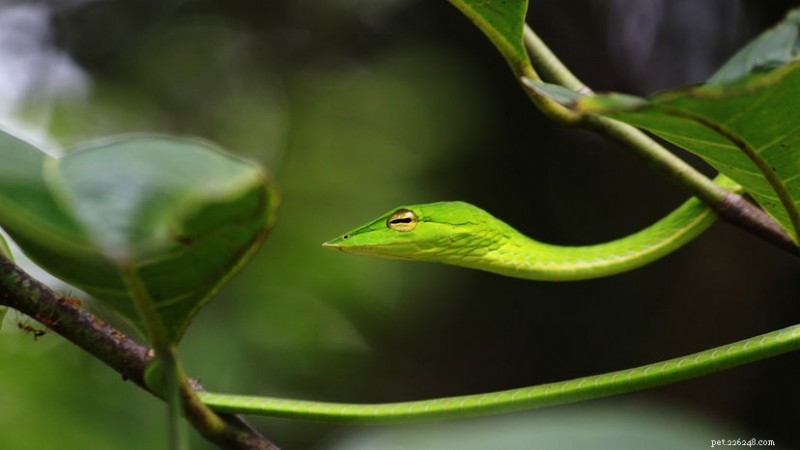
Vine snakes (genus Oxybelis) are among the most slender and adept arboreal reptiles found in the tropical forests of Central and South America. Their thin, laterally compressed bodies allow them to glide silently between branches, while their vivid green or brown coloration makes them nearly invisible in foliage.
Physical Characteristics
Typical vine snakes reach about 5 ft (1.524 m) in length, though their fine bodies often give the impression of a much smaller animal. A laterally compressed shape facilitates rapid, precise movements in the canopy, and weakly keeled scales provide subtle texture that blends with the bark and leaves.
Key Species
- Oxybelis fulgidus – The green vine snake, native to Central and South America, uses its bright green hue to stalk birds, lizards, and frogs.
- Oxybelis aeneus – Known as the brown vine snake, it ranges from the southern United States to northern South America and blends into dry leaves and branches.
- Oxybelis brevirostris – The short‑snouted vine snake of Central America, also called Cope’s vine snake.
- Oxybelis koehleri – Inhabits tropical and subtropical forests, specializing in small vertebrates.
- Oxybelis transandinus – The Trans‑Andean vine snake, found in Ecuador and Colombia’s rainforests, excels at remaining hidden in dense vegetation.
Behavior and Diet
These snakes are solitary, diurnal hunters that rely on stealth and exceptional vision to ambush prey. Their mild venom subdues small birds, lizards, and frogs, which they swallow whole thanks to a highly flexible jaw. Because they hunt from within the canopy, vine snakes enjoy a plentiful supply of arboreal prey.
Habitat
Vine snakes thrive in tropical and subtropical forests, where their coloration provides camouflage among leaves and bark. Dense tree canopies and abundant vines give them the ideal environment for swift, silent movement between branches.
Reproduction and Life Cycle
Females lay clutches of six to ten eggs in concealed spots within foliage or among branches. Hatchlings are fully independent from birth, sharing the same body shape and coloration as adults, which affords immediate camouflage. They grow steadily, reaching adult size within a few years.
Conservation Status
Currently, vine snakes are not listed as endangered. However, ongoing deforestation and habitat loss in tropical forests pose a threat to their populations. Conservation efforts focused on preserving forest ecosystems benefit not only vine snakes but the broader biodiversity they support.
- Butter Lettuce and Guinea Pigs: A Trusted Guide to Safe, Nutritious Feeding
- Do Dogs Have Night Vision? How They See in Low Light
- From Aggression to Affection: How a Tough Dog’s Transformation Restored a Foster Family
- Why Tarantulas May Perish While Moulting – What You Need to Know
- How to Foster Cats and Dogs: A Beginner’s Guide
- Top Dog Bathing Products Reviewed: Make Bath Time Easy & Stress-Free
- Mudi Dog Behavior: Traits, Temperament, and Family Compatibility