

Glass Lizards: Legless Lizards That Can Regrow Their Tails
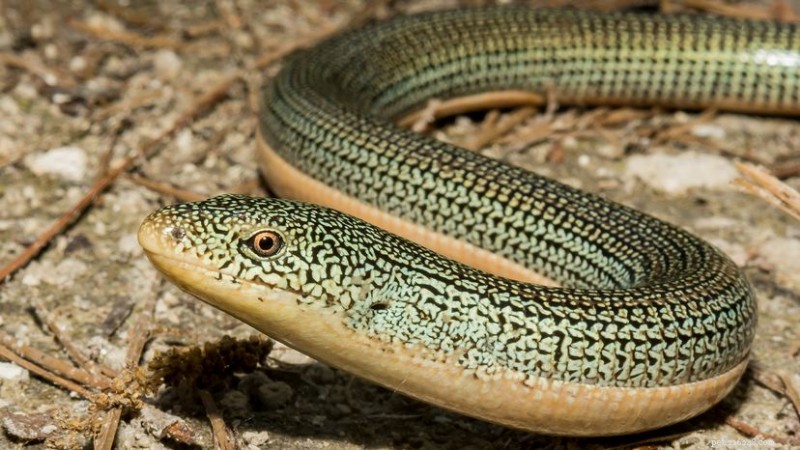
While glass lizards may resemble snakes, they are actually legless lizards with distinct anatomical features that set them apart. They are known for their remarkable ability to autotomize—break off— and later regenerate their tails, a defense mechanism absent in true snakes.
Glass lizards possess external ear openings, movable eyelids, and inflexible jaws. Unlike snakes, which rely on flexible jaws and venomous fangs to subdue larger prey, glass lizards feed primarily on insects, small rodents, frogs, and other reptiles that fit within their limited gape.
Habitat and Distribution
Glass lizards are cosmopolitan, occurring across the Americas, Europe, Asia, and North Africa. They favor loose, sandy soils and vegetation-rich environments where they can slip into burrows and evade predators. Their non-venomous nature and lack of robust hind limb musculature mean they typically retreat by tail autotomy rather than engaging in pursuit or combat.
Key Species in North America
Eastern Glass Lizard (Ophisaurus ventralis)
Widespread in the southeastern United States, the eastern glass lizard can grow up to 3 ft (0.9 m). Its long, slender tail accounts for roughly two‑thirds of its total length. A distinctive lateral groove runs from head to tail, and it thrives in sandy, grassy coastal plains, preying on insects, small rodents, frogs, and other lizards.
Slender Glass Lizard (Ophisaurus attenuatus)
Noted for its exceptionally long and thin body, the slender glass lizard spans southeastern and central U.S. regions—from coastal plains to east Texas and up to Illinois. It inhabits open fields, pine flatwoods, and grasslands, where it hunts small snakes, insects, snails, and other invertebrates. Dark longitudinal stripes along its body distinguish it from other glass lizards.
Other Global Species
- Asian glass lizard (Ophisaurus gracilis)
- European glass lizard (Pseudopus apodus)
- Indian glass snake (Ophisaurus apodus)
- Island glass lizard (Ophisaurus compressus)
- Mojave fringe‑toed lizard (Ophisaurus mojavensis)
- Slender glass lizard (Ophisaurus attenuatus)
Subspecies of Slender Glass Lizard
- Eastern slender glass lizard (Ophisaurus attenuatus longicaudus) – also called the Florida worm lizard
- Western slender glass lizard (Ophisaurus attenuatus attenuatus)
Reproduction and Life Cycle
Breeding occurs from late spring to early summer. Females lay 7–15 eggs in concealed sites beneath leaf litter, dead wood, or long grass. If the nest is exposed, the female may abandon the clutch. Eggs hatch approximately two months after deposition.
Safety and Ecological Role
Glass lizards are non‑venomous and rarely bite unless heavily provoked. Their weak jaws and absence of fangs make their bites generally harmless to humans. When handled, grip the upper neck; grasping the tail can trigger autotomy, compromising the lizard’s escape ability during regeneration.
As natural predators of pest insects and rodents, glass lizards can benefit gardens and yards. Despite their eerie appearance, they pose no threat to humans or pets.
Content vetted by a HowStuffWorks editor after initial AI drafting.
- Mastering Bite Inhibition: Key to Safe, Socialized Dogs
- 8 Clear Signs Your Dog Could Have Arthritis
- How to Foster a Dog: A Trusted Step-by-Step Guide
- Irvine Pet Adoption Fair – Home For The Holidays 2024
- Longevity and Care for Ameraucana Chickens
- What Your Cat Really Feels During Social Distancing
- Recognizing the Signs a Dog Is Nearing the End of Life