

Amethystine Python: Australia's Largest Native Snake
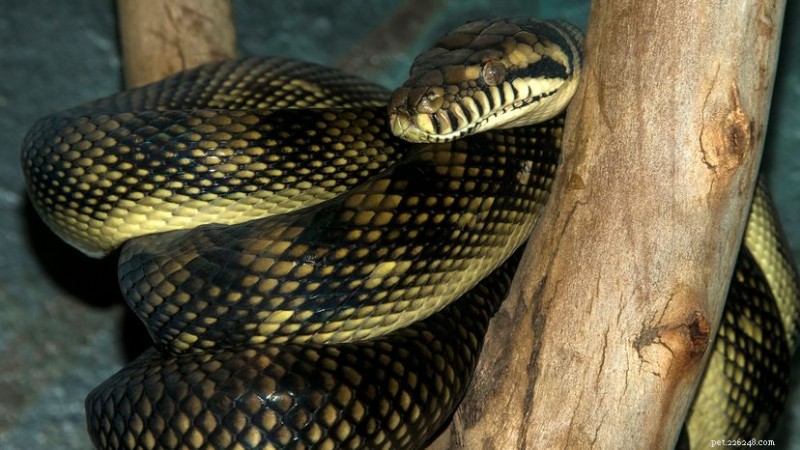
The amethystine python (Morelia amethystina) is a nonvenomous yet formidable predator that roams the northern reaches of Australia. Its sheer size and stealth have earned it a place among the world’s largest snakes.
In late 2023, a resident of North Queensland was startled to find a massive python perched on his kitchen counter—a stark reminder of how close these reptiles can be to human habitations.
Photographs taken in Cape Tribulation, within the Daintree Rainforest, captured an amethystine python crossing a bustling road, illustrating its adaptability and the quiet coexistence between wildlife and modern infrastructure.
Taxonomy
Kingdom: Animalia – Phylum: Chordata – Class: Reptilia – Order: Squamata – Family: Pythonidae – Genus: Morelia – Species: Morelia amethystina.
Like all pythons, this species is nonvenomous and relies on constriction to subdue prey. The genus Morelia includes several large, mostly arboreal pythons native to Australia and nearby islands.
The Amethystine Python Complex
Historically treated as a single species, further research has divided the complex into five distinct members of the genus Morelia. These species occupy Australia, Indonesia, and Papua New Guinea, sharing traits such as nonvenomous constriction, a carnivorous diet, and arboreal proficiency.
Recognizing the complex’s internal diversity is crucial for accurate biodiversity assessments and targeted conservation measures.
Physical Features
Amethystine pythons can reach lengths of up to 8 m (26 ft), although most adults measure between 3–5 m (10–16 ft). Their robust, muscular bodies and powerful tails enable efficient constriction.
They display a dark base color—ranging from green to brown to black—accented by lighter, irregular patterns. The scales emit a subtle milky iridescence that can reveal hints of amethyst in bright light, aiding camouflage in forested environments.
Despite their bulk, these snakes are agile climbers, able to navigate trees and rocky outcrops with ease. Their heads are slightly broader than their necks, and they possess flexible jaws with backward‑curving fangs for gripping.
They feature small, vertically‑squared pupils suited for nocturnal vision, and heat‑sensing pits along the upper lip to detect warm‑blooded prey in low light.
Native Habitat
Their range spans the tropical north of Australia—including Queensland, the northern Northern Territory, and Western Australia—as well as parts of Indonesia (Sulawesi, Maluku) and Papua New Guinea. They thrive in rainforest, savanna, and areas adjacent to human settlements.
Within these ecosystems, they serve as apex predators, regulating populations of small mammals, birds, and reptiles, thereby maintaining ecological balance.
Hunting
Primarily nocturnal, amethystine pythons rely on stealth and patience. They often remain motionless, camouflaged on the forest floor or in the canopy, awaiting prey before launching a rapid, precise strike.
Once captured, the snake’s constricting muscles compress the prey until suffocation. Their climbing ability allows them to pursue arboreal targets such as birds and bats, while their proximity to water sources makes them adept at catching mammals drawn to drinking sites.
Diet
Wild individuals consume rodents, bats, possums, birds, and smaller reptiles. Larger specimens can subdue wallabies and even small deer. In proximity to human habitation, they occasionally prey on domestic fowl.
Feeding frequency decreases with body size; larger pythons may eat only a few times per year, while juveniles feed more regularly. In captivity, a diet of appropriately sized rodents is essential to prevent obesity and health issues.
Mating Season
Reproduction typically occurs from July to November, coinciding with the late dry and early wet seasons. Males track scent trails to locate receptive females, sometimes engaging in non‑violent wrestling to establish dominance.
Copulation can last several hours. After a gestation period, females lay clutches of 12–40 eggs, which they incubate by muscular shivering that maintains optimal temperature. Hatchlings emerge after ~60 days, fully independent and ready to hunt.
Conservation Status
Listed as “Least Concern” on the IUCN Red List, the amethystine python enjoys a stable, widespread population. Its adaptability to varied habitats has contributed to this status.
Potential future threats include habitat loss, climate change, and illegal collection for the pet trade. Ongoing monitoring and targeted conservation strategies remain essential to safeguard the species.
Snake on a Plane
In 2013, a 9‑foot (2.7 m) scrub python was discovered clinging to the wing of a Qantas flight from Cairns to Port Moresby. The snake struggled against wind and cold, but the flight continued uneventfully.
Herpetologist David Williams noted that such snakes are common near Cairns airport, suggesting the animal may have entered the aircraft during loading. Unfortunately, the python did not survive the ordeal.
This article was produced with the aid of AI and subsequently fact‑checked and edited by a HowStuffWorks editor.
- Top 9 Trusted Veterinarians in Brooklyn for Your Pet's Health
- Understanding Your Dog’s Vision: Care Tips for Healthy Eyes
- Top Grooming Tools Every Long-Haired Cat Owner Needs
- How a Dog’s Nutritional Needs Change with Age
- How to Calm Your Cat: Proven Ways to Stop Constant Meowing
- Understanding Beagle Aggression: Causes and Solutions
- Slovakian Wirehaired Pointer: Traits, Training, and Lifestyle Needs