

Mudpuppy: Natural History & Care Guide – Part 1
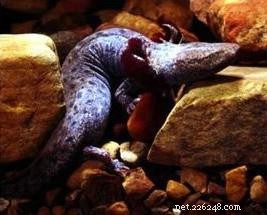 A Mudpuppy (Necturus maculosus) was the first large aquatic salamander I kept in captivity, and I remain as intrigued by them today as I was in childhood. Increasingly rare in the wild, Mudpuppies or Waterdogs make quite hearty captives if attention is given to their unique needs. Today we’ll take a peek at their lives in the wild, and move on to husbandry in Part 2.
Classification
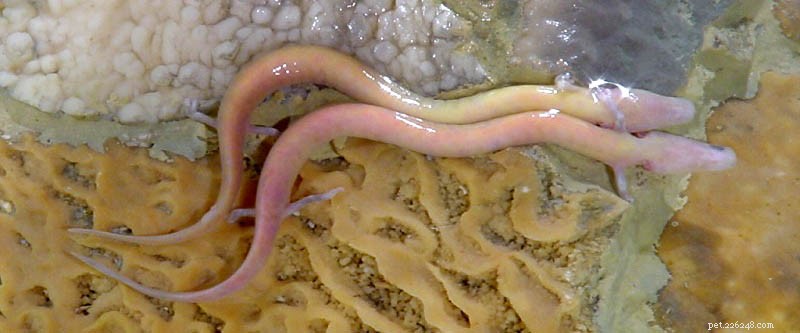
The Mudpuppy shares the Family Proteidae with 4 similar species, all native to North America, and the Olm (Proteus anguinus). The Olm, limited in distribution to Northern Italy and the Balkans, spends its entire life in subterranean streams (please see photo of white salamanders). I’ll highlight this blind, other-worldly creature in the future.
Description
Occasionally reaching 17 inches in length, the Mudpuppy is among North America’s largest salamanders. They sport feathery, red external gills and are variably colored in shades of gray, brown or rust.
Range
Mudpuppies range from Southeastern Manitoba and Southern Quebec through the Mississippi River drainage to Northern Georgia and Louisiana. Those in the Hudson and several neighboring rivers are believed by some to have been introduced.
Habitat
These entirely aquatic bottom-dwellers inhabit streams, lakes and rivers. They may be found in shallow and deep water, with one individual being taken at a depth of 90 feet (Lake Michigan).
Population density is largely governed by the presence of suitable hiding and breeding sites, i.e. logs, rock slabs and undercut banks.
Status
Mudpuppies are believed declining throughout much of their range. Actual population levels are difficult to assess due to their nocturnal, secretive ways, but they are threatened by siltation and pollutants.
Mudpuppies are sometimes killed as by-catch in recreational and commercial fishing operations, and are (hopefully “were”!) used as fishing bait. They are considered endangered in New York, Maryland, Indiana and North Carolina.
Longevity
One captive reached 34 years of age; longevity in the wild possibly exceeds 20 years.
Reproduction
Mudpuppies mate in the fall, with communal breeding sites occasionally recorded. Males deposit spermatophores (sperm-filled capsules) on the substrate; females take these into the cloaca with the cloacal lips.
The eggs, 30-90 in number, are deposited in the spring. They are attached to the roof of a natural or self-made depression below a rock or log, and are guarded by the female until hatching occurs (5-9 weeks). Maturity is reached in 4-6 years.
Mudpuppies are neotenic – the larvae retain external gills (they also develop lungs) and do not transform into terrestrial adults.
Diet
Crayfishes, caddis fly larvae, shrimps, snails and other aquatic invertebrates, fishes, earthworms, salamanders and tadpoles.
Additional Information
 The common names refer to the erroneous belief that these salamanders “bark” when disturbed and to the fact that the head appears dog-like at certain angles.
Much like fishes, Mudpuppies possess a system of sensory organs (the lateral line) along the sides of the body that detects changes in water motion and pressure.
Unlike most amphibians, Mudpuppies do not hibernate, and even feed throughout the winter. In fact, studies indicate that winter foraging may be increased in order to take advantage of the fact that predatory fishes are less active at this time.
Mudpuppies can obtain oxygen from either air or water, using lungs, gills or the skin. Individuals from warm ponds have large gills; the gills of those inhabiting well-oxygenated rivers are reduced in size.
- Mastering Newt Care: Natural History & Captive Management – Part 1
- Expert Guide to Mudpuppy (Waterdog) Care – Part 2: Habitat and Light Management
- Fire Skink (Mochlus fernandi): Natural History & Expert Care Guide
- Softshell Turtles: Comprehensive Natural History & Proven Care Tips – Part 1
- Softshell Turtles: Expert Care & Natural History Guide – Part 2
- Mertens’ Water Monitor: Natural History & Expert Captive Care Guide – Part 1
- Trans-Pecos Ratsnake Care Guide: Natural History & Housing Tips – Part 2