

Pickerel Frog (Lithobates palustris): Natural History & Expert Care Guide
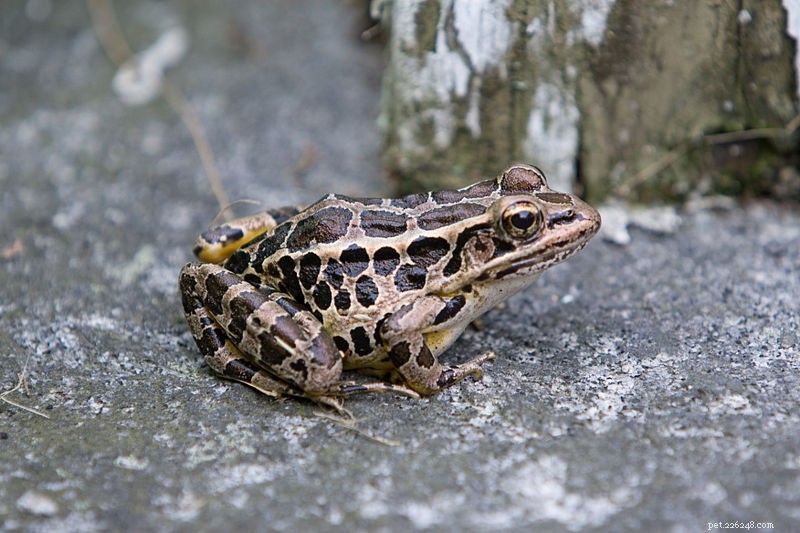 Pickerel Frogs, Lithobates palustris, are “early risers” from winter hibernation and may travel quite far to reach their breeding ponds and summer habitats. As a result, they often become trapped in swimming pools, window wells and other such areas. Each spring I receive a number of requests for information concerning their care and rehabilitation. Often, folks mistake them for the better-known (but often rather scarce) Leopard Frog, Lithobates pipiens.
Description
The body ranges from tan to greenish-brown in color and is marked with parallel rows of “almost square” black spots; a bright yellow or orange patch is present on the inner thighs. Pickerel frogs grow to a length of 2-3.5 inches and are slender in build.
Range
Found throughout much of eastern North America, from Nova Scotia through southern Quebec, Canada, south to southern South Carolina and Mississippi and west to eastern Minnesota and eastern Texas; absent from prairie habitats in the Midwest and the extreme Southeastern USA. They have disappeared from most large cities and developed areas.
Habitat
In the north, Pickerel Frogs are found mainly along cool, clear streams. In the south, they occur in marshes, farm ponds, woodland pools and flooded meadows. In contrast to most North American frogs, several populations are cave-adapted.
They are often found at the water’s edge, among shoreline vegetation, but may wander far from water to hunt in fields and woodland edges.
Status
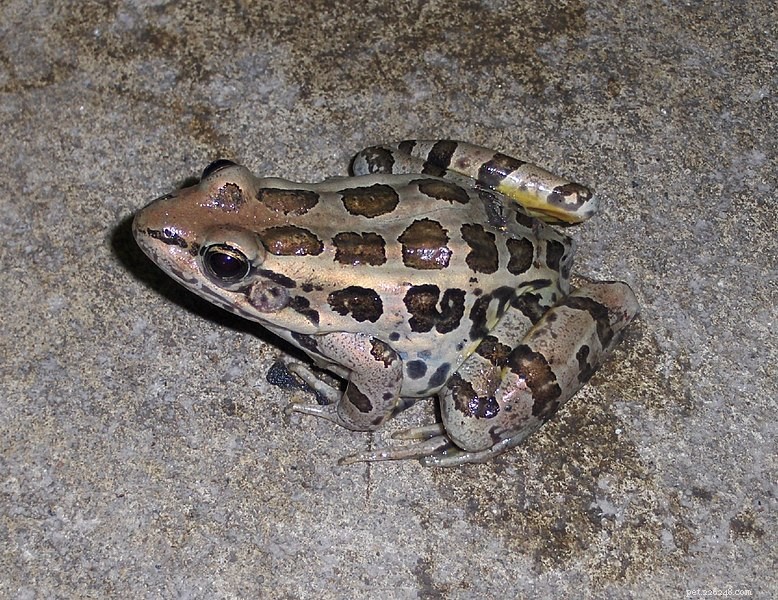 Pickerel Frogs are declining in many areas, with local extinctions common, and are stable in others. They appear to be very sensitive to pollutants and, in the northern part of the range, to warm temperatures.
Pickerel Frogs are listed as “declining or of special concern” in Wisconsin, Iowa and Minnesota, and are most likely extinct in Kansas. This species was formerly fairly common within NYC (I observed them in a large park in the Bronx years ago), but may now survive only along a few unpolluted streams on Staten Island. I have found them in highly acidic bogs on Long Island, in waters that supported few if any other amphibians.
Unfortunately, zoos pay them little attention and they are rarely bred by hobbyists.
Reproduction
Adults migrate from stream edges and terrestrial habitats to quiet, usually fishless ponds, vernal pools, and marshes as winter ends (December in the south, May in the north). The eggs are attached to submerged vegetation at or near the water’s surface, often in areas that receive a good deal of sunlight. The eggs hatch in 8-24 days. The tadpoles feed upon algae and decaying plants and animal matter, and transform in 60-90 days.
Diet
Grasshoppers, dragonflies, beetles, moths, butterflies, spiders, earthworms, sow bugs, crickets and other invertebrates; possibly tadpoles, fish, smaller frogs and salamanders.
Defenses
Skin toxins render Pickerel Frogs unpalatable to most predators, but they are consumed by mink, bullfrogs and green frogs. The tadpoles apparently lack skin toxins, and are preyed upon a wide range of animals, including fishes, newts, turtles and aquatic insects.
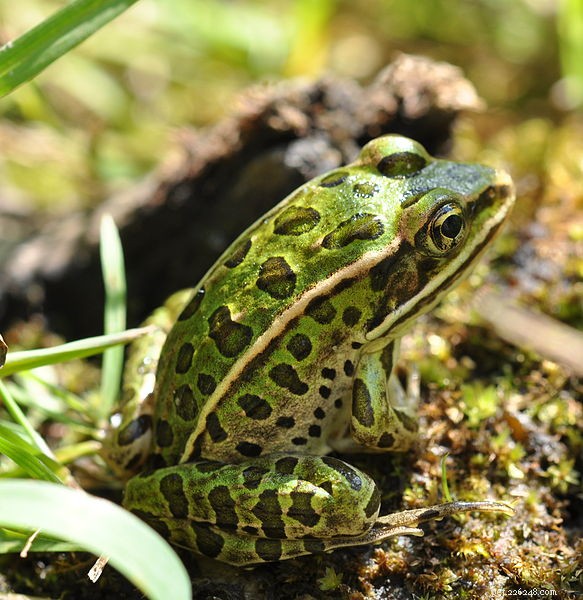 The Leopard Frog, Lithobates pipiens, resembles the Pickerel Frog and shares much of its range (please see photo). The Leopard Frog lacks powerful skin toxins but may be avoided by predators due to its similarity to the Pickerel Frog, a phenomenon known as Mullerian Mimicry.
Residues from the Pickerel Frog’s skin toxins may be fatal to other frogs. It is theorized that Pickerel Frogs may, by releasing toxins, exclude other frogs from their habitat, but this has not been definitively established. Other species have died after being transported in plastic buckets that formerly held Pickerel Frogs.
The bright yellow or orange “flash colors” on the pickerel frog’s inner thighs may serve to startle predators as the frog leaps away or to advertise the presence of skin toxins.
Captive Care
Pickerel Frogs may be kept as I’ve described for Green Frogs in this article.
However, they are quite high strung – more so than most native frogs – and should be given plenty of room and lots of cover. Stressed individuals may release skin toxins that are fatal to other frogs, so they should therefore be housed alone. Please write in for further husbandry information.
- Mastering Newt Care: Natural History & Captive Management – Part 1
- Smokey Jungle Frog (Leptodactylus pentadactylus): Natural History & Expert Captive Care – Part 2
- Smokey Jungle Frog: Natural History, Breeding & Care – Part 1
- Mudpuppy: Natural History & Care Guide – Part 1
- Fire Skink (Mochlus fernandi): Natural History & Expert Care Guide
- Rhinoceros Iguana: Natural History, Care Guide, and Habitat Insights
- The Green and Black Poison Frog: Natural History & Expert Captive Care