

Flying Snakes Unveiled: Cutting-Edge Research & Proven Captive Care Tips
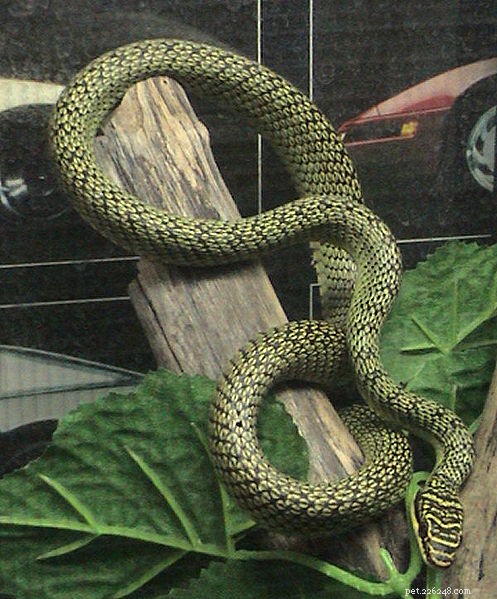 Of all the gliding animals, Flying Snakes (Genus Chrysopelia) appear to me to be the most unlikely…they just don’t seem suited to moving through the air. Yet they do, and quite well – not matching the abilities of flying squirrels, but certainly right up there with gliding geckos and frogs. A recent study shed some light on their unique abilities, and suggests that they may serve as models for small, agile flying vehicles.
Natural History
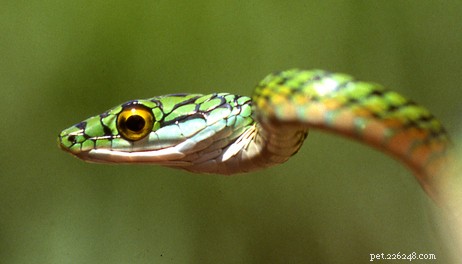
Five species of Flying Snakes, sometimes known as Asian Parrot Snakes (not to be confused with Latin America’s Parrot Snakes, Genus Leptophis; please see photo) range throughout much of South and Southeast Asia. The Ornate Flying Snake (Chrysopelia ornata) and, less commonly, the Paradise Flying Snake (C. paradisi), are sporadically offered for sale in the USA.
Markings and color varies greatly among individuals. All, however, live up to the “ornate and paradise” parts of their names, exhibiting rich and complicated patterns and hues of blue, green, black and, in some, red and orange.
Captive Care
Flying Snakes are rear-fanged and produce mild venom. The venom affects only the animals upon which they feed, and is not considered dangerous to people, but care should be exercised by keepers.
The wild-caught Paradise Flying Snakes I kept years ago in zoo collections proved somewhat difficult captives, refusing all but small lizards and frogs. I’ve been informed by colleagues that captive bred specimens (which are not common), readily accept “scented” pinkies and mice. Ornate Flying Snakes seem more willing to consume rodents straight away – reluctant feeders can be tempted by a lizard-scented pink mouse.
The largely arboreal Flying Snakes are ill-at-ease on the ground, and should be housed in tall terrariums stocked with branches and, if possible, sturdy live plants. While not overly-shy, they definitely prefer the security offered by vegetation (please see article below).
Temperatures of 78-80F (85-88F at the basking site) suit them well. Shredded bark makes an ideal substrate. If sprayed each day it will help maintain the high humidity favored by Flying Snakes…just be sure it dries within an hour or so and that the snakes have access to dry basking sites.
Flying Snakes, being diurnal and arboreal, may benefit from the provision of UVA and low UVB radiation (the Zoo Med 2.0 bulb is worth trying).
Studying Snake “Flight”
 Researchers at Virginia Tech investigated the Paradise Flying Snake’s unique airborne skills by tossing individuals from a 50-foot-tall water tower and filming the (happily successful!) “flights”. Analysis of their body position showed that a complicated set of movements (rigid and moving body sections, tilting) allowed the snakes to travel outward from their take-off site by up to 79 feet (while believed to be an escape mechanism, gliding may be a means of travel as well – field research is lacking). The snakes, described as “one long wing” by one biologist, moved through the air at 26-33 feet per second, and all landed safely.
The study was published in the November, 2010 issue of Bioinspiration and Biomimetics (please see below), along with articles on the unique airborne abilities of gliding geckos, gulls and hummingbirds. Further studies of these animals may lead to advances in robot and air vehicle technology.
- Red-Eyed Treefrog (Agalychnis callidryas): Captive Care Guide & Natural History
- Painted Turtle Care & Natural History: Expert Tips for Owners
- Dwarf Chameleons: Expert Care Tips & Natural History Insights
- Asian Flying Frog (Golden Treefrog): Natural History & Expert Care Guide
- Assassin Bugs: Care, Spider-Hunting Behavior, and Expert Insights – Part 1
- Mossy Treefrog (Theloderma corticale): Expert Guide to Care and Natural History
- Jumping Spiders: Expert Care, New Species, and the Surprising Video‑Watching Behavior