

Jumping Spiders: Expert Care, New Species, and the Surprising Video‑Watching Behavior
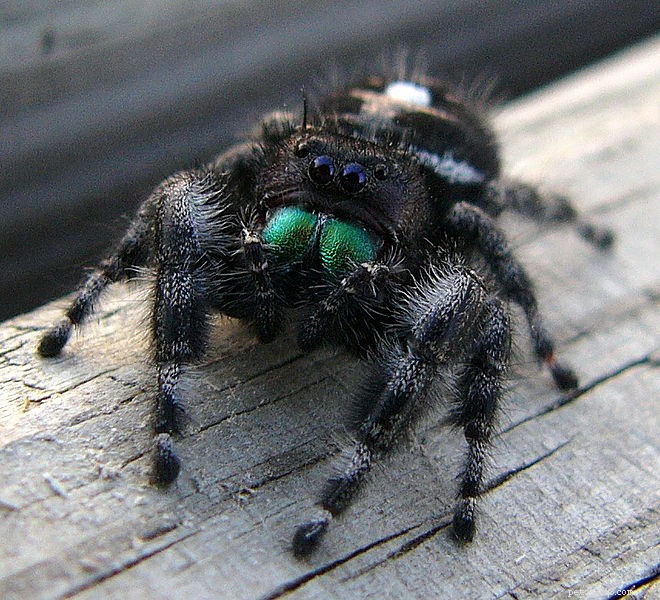 As a bug-hunting child, I was once startled to come upon a housefly that appeared to be walking on its hind legs. Closer inspection revealed that the unfortunate insect was being carried in a head-up position by a Jumping Spider. I was aware that a variety of these brilliantly-colored little beasts inhabited my Bronx neighborhood, and became interested in how they managed to capture such elusive prey without a web. I began reading and collecting, and was soon fascinated by their keen eyesight and cat-like stalking techniques. They would follow my finger, leap on a feathers pulled by a string, and even display to a mirrors.
I’ve recently learned that biologists are showing videos to Jumping Spiders in an attempt to learn more about their remarkable eyes (which allow for forward, backward, an sideways vision simultaneously), and that a new ant-mimicking Jumping Spider with enormous fangs has turned up in Borneo. I’ll highlight this new information below, and review their natural history and captive care.
A 360 Degree Field of Vision
Animals that are on the menus of other creatures generally have eyes set well back and to the sides of their heads. This arrangement gives mice, deer and others a wide field of vision, with the only bind spots being well to their rear. Predators, such as foxes and hawks, usually have forward-facing eyes, to allow for accurate focusing on prey.
Jumping Spiders, which are both predator and prey, take vision a step further. Research recently published in the journal Royal Society Biology Letters establishes that their eye placement and function allows for a field of vision that is very close to 360 degrees. In effect, Jumping Spiders can see directly behind their bodies, to all sides, and forwards – simultaneously! In lab experiments, the spiders watched both videos and people’s actions with apparent interest (I’m not sure how much they understood, but then again I miss a lot as well!). As most spiders see very little in the way of detail, these advanced abilities are quite surprising.
A Unique Visual System
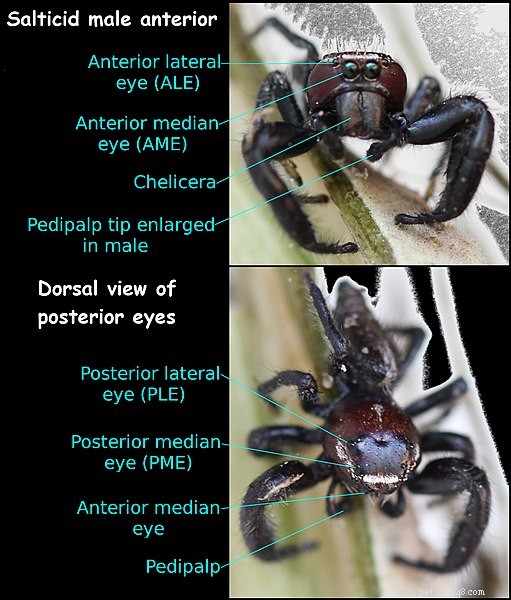
University of Massachusetts researchers discovered that the retinas of the 2 principal eyes are shaped like boomerangs. These retinas rest in tubes located within the spiders’ heads. By moving these tubes, Jumping Spiders can scan a very wide area about the body. This method of visualizing the environment has not been previously recorded. The principal eyes also see color and detect ultraviolet light. Ultraviolet light enhances the spiders’ colors, and plays a role in species recognition and courtship.
Six secondary eyes, located on the sides and rear of the head, detect motion and detail, and also allow the spiders to see objects directly behind the body.
Future Research
Researchers hope that further study will reveal how Jumping Spider brains process visual images, knowledge that may offer insights into the workings of our own eyes and brains.
Natural History
The Jumping Spider family, Salticidae, is the spider world’s largest. Nearly 5,000 species have been described, and many more, no doubt, await discovery. Jumping Spiders may be found in habitats ranging from rainforests and deserts to cities and seashores. I’ve collected several species, each varying in color and size, within NYC.
Hunting Techniques
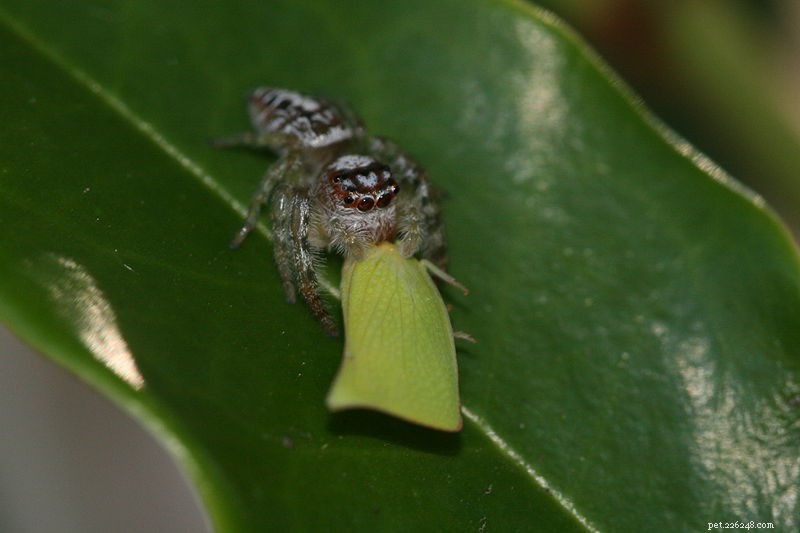 I’ve always been fascinated by those Jumping Spiders known as “ant mimics”. Their bodies have an insect-like “waist”, and they move about with jerky steps, in imitation of their favorite food. Some even hold the front pair of legs upright, so that they seem to bear antennae! Thus disguised, they are able to approach ants without being attacked. I imagine the spiders also gain some protection from predators by being associated with ant colonies. Please see this article for photos of an amazing, huge-jawed ant mimic recently discovered in Borneo.
In addition to stalking their prey with cat-like stealth, Jumping Spiders utilize other hunting styles. Several have been observed to take detours when moving in on a potential meal. Amazingly, these detours sometimes place the spiders in positions where they cannot see the insect being stalked. Whether “planning” or memory comes into play is not yet known.
Several Jumping Spiders specialize in capturing web-building spiders, inducing their prey into striking range by vibrating webs in imitation of a trapped insect. Some even rappel into webs on silk strands!
Small Legs, Long Leaps
Unlike the large rear legs of grasshoppers and other notable jumpers, those of Jumping Spiders are smaller than the front legs. Rather than relying upon muscle strength, Jumping Spiders utilize hydraulic pressure to facilitate their amazing leaps.
Jumping Spiders in Captivity
 I cannot understand why so few spider enthusiasts keep these fascinating creatures. Active by day and extremely bold, Jumping Spiders will reveal much about their lifestyles in small, simple enclosures. In contrast to nearly every other spider, they will follow your movements with interest. The colors and mating dances of the males are thrilling to observe, and captive breeding is possible. Please post questions below if you would like detailed information on their care.
Jumping Spiders are not known to be dangerously toxic, but should not be handled as their venoms are not well-studied. Spiders can be gently nudged into a plastic container via tongs when being collected or transported.
Jumping Spider fans may also be interested in keeping the Giant Crab or Huntsman Spider (Heteropoda venatoria), a species I’ve collected and bred over many years; please see this article for further information.
- 12 Common Spiders in New York: Identification & Safety Guide
- Insects & Spiders: A Beginner's Guide to Exotic Pets
- Expert Guide to Mudpuppy (Waterdog) Care – Part 2: Habitat and Light Management
- Assassin Bugs: Captive Care & Spider‑Hunting Tactics – Part 2
- Mossy Treefrog (Theloderma corticale): Expert Guide to Care and Natural History
- Flying Snakes Unveiled: Cutting-Edge Research & Proven Captive Care Tips
- New Scorpion Species Discovered Near Tucson and in the Ecuadorian Andes