

Caring for Latin American Tiger Ratsnakes in Captivity: Expert Tips & Guidelines
The first time I saw an adult Tiger Ratsnake (Spilotes pullatus pullatus) streaking through the brush in Costa Rica, I was immediately struck by the appropriateness of its local name – the Thunder and Lightning Snake. Large, fast-moving, and eye-catching in coloration, this impressive beast stopped me in my tracks and made me gasp. I’d captured dozens of adult Green Anacondas and handled thousands of other snakes in zoos and the wild, but this Tiger Ratsnake was in a class by itself. Small wonder that it draws attention throughout its huge range, where it is known by many common names, including Tropical Ratsnake and Tropical Chicken Snake (the latter refers to its food preference on farms). The first individual I encountered eluded me, but I was eventually able to get my hands on other wild specimens, and to care for a few in captivity.

Uploaded to Wikipedia Commons by Geoff Gallice
Description
Although not usually classified among the “giant serpents”, the Tiger Ratsnake is actually one of the longest snakes in the Americas. Adults average 6-7 feet in length, but may reach 10 feet; 14-foot-long individuals have been reported. They vary a good deal in color and pattern, but whether lemon-yellow with indigo-blue blotches or solid black speckled with orange, they are always stunning.
Natural History
The Tiger Ratsnake may be found from southern Mexico through Central America and across much of South America to northern Argentina. It also occupies Trinidad and Tobago. Five subspecies have been described. While it seems absent from the Amazon Basin, I wouldn’t be surprised if field surveys uncovered it there in the future.
Highly adaptable, the Tiger Ratsnake inhabits rainforest edges, open woodlands, brushy grasslands (please see habitat photo), thorn scrub and similar habitats. It readily colonizes farms, ranches and the outskirts of developed areas, where it is alternately welcomed as a rodent predator and persecuted for taking chickens and their eggs. Tiger Ratsnakes are equally at home on the ground or well-up in trees.
Tiger Ratsnakes are constrictors, and actively search out a wide variety of prey. Their appetites know no bounds – ground squirrels, rats and other rodents, possums, rabbits, bats, birds and their eggs, lizards, frogs, and other snakes are all consumed with equal gusto. Chickens and ducks (and cats, I’ll bet!) are taken near farms and villages.
Tiger Ratsnakes as Pets
It’s difficult for most snake enthusiasts to resist this huge, spectacularly-colored serpent, and the few that appear for sale are always quickly snatched-up (at premium prices!). However, it’s important to understand that Tiger Ratsnakes require more space and upkeep than similarly-sized species…think in terms of an adult Indigo Snake or Cribo. They have fast metabolisms, and their waste products are copious.

Uploaded to Wikipedia Commons by David from Miami, United states
The Terrarium
Tropical Ratsnakes are quite active and require considerably more room than do typical North American ratsnakes (they are not close relatives, but the terminology is established in the pet trade). Adults do best in custom-built cages measuring at least 6 x 5 feet. Stout climbing branches will be well-used.
A hide box should always be available, but many individuals prefer a forked tree branch screened by hanging plants (this model, which features suction cups, works well) to typical caves; even long-term pets may be stressed if forced to remain in the open.
Substrate
Cypress mulch, eucalyptus bark and similar materials may be used as substrates; due to this snake’s vigorous movements, newspaper tends to wind up crumpled in a corner. Washable terrarium liners may be used for younger animals kept in aquariums.
Heat and Light
Tiger Ratsnakes fare well in a temperature range of 78-86 F; night-time temperatures can be allowed to drop to 75 F or so. A spotlight-type bulb should be used to create a basking spot of 90 F.
Large enclosures are necessary if a thermal gradient (areas of different temperatures) is to be established. Thermal gradients, critical to good health, allow snakes to regulate their body temperature by moving from hot to cooler areas.
A ceramic heater, heat pad, or red/black reptile night bulb can be used to provide heat after dark.
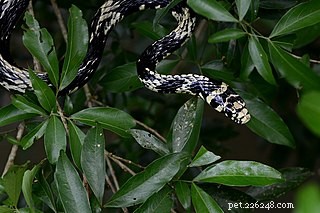
Uploaded to Wikipedia Commons by Geoff Gallice
Feeding
As mentioned above, Tiger Ratsnakes accept a huge array of prey items. Captives do fine on a straight mouse and rat diet. Unlike some snakes, they tend not to become “fixated” on certain foods, so you can offer variety in the form of chicks, gerbils and other creatures without fear of causing a problem (I had a Green Anaconda that accepted only muskrats, another that “insisted” on wild-caught Norway rats!). Hungry individuals strike wildly, so exercise care at feeding time.
Water for drinking and soaking must always be available. Bowls should be filled to a point where they will not overflow when the snake curls up within, as damp conditions will lead to fungal infections of the skin and other health problems.
Breeding
Captive breeding is fairly regular, but it would be great to see more interest in this spectacular snake. Pairs must be monitored carefully, as aggression may occur. However, unlike many similar species, compatible pairs can usually be housed together year-round. A clutches generally contain 8-15 eggs, which may be incubated in moist vermiculite (1:1 ratio of water to substrate by weight) at 80 F for 70-80 days.
Handling
Wild-caught individuals must be approached with caution. Many calm down in time, but even long-term pets tend to move about when held, and can be difficult to control. Care must be exercised, as they seem always on the lookout for food, may strike at nearby movements.
- Mastering Newt Care: Natural History & Captive Management – Part 1
- Leopard Tortoise Captive Care: Space, Lifespan & Commitment
- Diamondback Terrapin Care: Conservation, Habitat, and Home Guidelines
- Mudpuppy: Natural History & Care Guide – Part 1
- Fire Skink (Mochlus fernandi): Natural History & Expert Care Guide
- Rhinoceros Iguana: Natural History, Care Guide, and Habitat Insights
- Trans-Pecos Ratsnake Care Guide: Natural History & Housing Tips – Part 2