

Captive Care for the World’s Largest Snake: Managing the Green Anaconda
 For a snake enthusiast such as I, not much can top the thrill of working with Green Anacondas (Eunectes murinus), in the wild and breeding them in captivity. I consider myself very fortunate, and realize that the childhood dream I was able to live is not available to most people. So I’m somewhat torn when asked to comment on Anacondas in private collections. Capable of killing an adult, and far too large to be accommodated in most homes, they are obviously not suitable choices for most people. However, Anacondas do appear in the trade, and have been successfully kept and bred. For those with the required space, training and finances, they are, I know, hard to resist. Today I’ll cover the key points to consider before making a decision on these fascinating, but dangerous, behemoths.
If you really are set on owning a large, usually aggressive aquatic snake, you might consider the Yellow Anaconda, Eunectes notaeus. It is not an animal to be taken lightly, but makes a more reasonable pet than the Green Anaconda. Actually, I suggest “cutting your teeth” on an adult Florida Green Watersnake, Nerodia floridana. Reaching nearly 6 feet in length, this often vile-tempered beast is a handful, and may change your mind about its larger cousins!
Natural History
I’ve posted several articles on Green Anaconda natural history and field research, and so will summarize here. Please see the articles linked below for greater detail.
Size
The Green Anaconda may exceed 400 pounds in weight, and is the world’s heaviest snake. It vies with the Reticulated Python for the title of longest serpent. There is one fairly reliable record of a 33-foot-long specimen and an unverified report (eastern Columbia, 1944) of 37.5 foot individual. In the course of tagging over 500 Anacondas, the largest I and co-workers encountered was just over 17 feet long and weighed 215 pounds.
Range and Habitat
Green Anacondas are found in Trinidad, Venezuela, Columbia, Brazil, northern Bolivia, northeastern Peru, Guyana and French Guiana. Highly aquatic, they inhabit rivers, swamps, flooded grasslands and the fringes of cattle ranches.
Diet and Human Predation
Green Anacondas have been documented as taking young tapir, capybara, sheep, dogs, pigs, tegus, other anacondas, frogs, herons, ducks, fishes and other animals. I have encountered Anacondas in the act of consuming a 60 pound White-tailed Deer, a 5-foot-long Spectacled Caiman and a large Side-necked Turtle.
A (happily unsuccessful!) attack on a co-worker of mine during a field study seemed to be a feeding response; other attacks were reported to me by several residents of Venezuela’s llanos region. The only reliably documented cases of human predation by snakes have involved Reticulated, African Rock and, possibly, Burmese Pythons. Please see the article below for more on huge snake meals.
Housing
Setting up the Terrarium
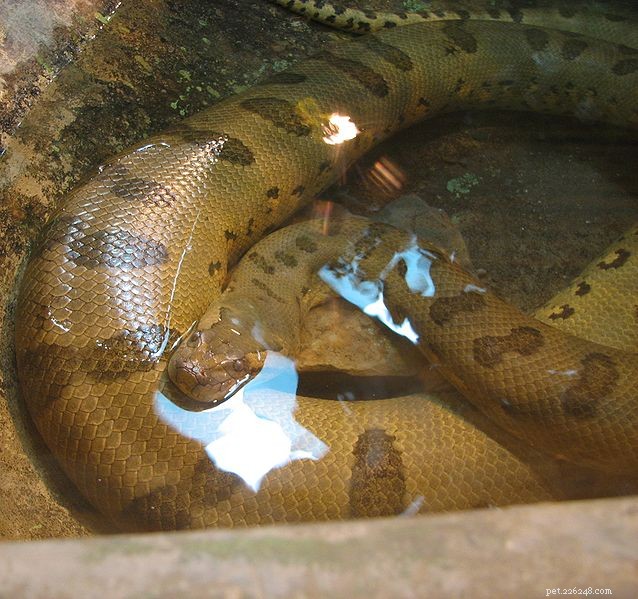 Hatchlings measure 18-36 inches and can be accommodated in a 55 gallon aquarium equipped with 6-8 cage clips. They will need increasingly larger quarters as they grow. Large commercial enclosures will work for a time, but after 2-3 years a homemade cage or re-designed room will be necessary. Security is a major concern, as all large constrictors are immensely powerful and expertly locate any weaknesses in their enclosures.
The huge volume of waste products produced by even moderately-sized individuals necessitates a floor drain in most cases.
Anacondas prefer water bowls to caves as hiding spots. Plastic plants floating on the water’s surface will provide them with security. A hide box should also be available (I’ve found wild individuals in riverside caves).
Substrate
Newspapers, butcher paper and washable terrarium liners work well for young snakes. Larger animals are best kept in enclosures that can be scrubbed and hosed-out; wooden floors are best protected by linoleum tiles.
Do not use wood chips, as they can lodge in the mouth during feeding and cause infection-prone cuts.
Light, Heat and Humidity
Anaconda enclosures should be maintained at 78-86 F, and provided with a basking site of 95 F. A temperature gradient is important to their health, and can only be effectively established in a large enclosure.
Bulbs located within cages must be protected by wire guards. Heat pads or pig blankets may be located beneath the cage floor (do not place these within the cage, due to burn risk). Red/black reptile night bulbs and ceramic heaters can be used to provide night-time heat.
Water temperature is important, as that is where your snake will spend most of its time. Water bowls for small snakes may be located beneath a basking light; large pools will require a heater protected by a ventilated PVC tube.
A UVB light source is not necessary.
Feeding
Hatchlings can take adult mice or rat pups, and soon graduate to adult rats. Rabbits are usually the least expensive option for moderately-sized to large Anacondas. Other options for adults include guinea pigs, ducks, chickens, fish and suckling pigs.
Captive Anacondas sometimes exhibit very distinct food preferences (often duck), and refuse all but their favored prey. One individual under my care would eat wild-caught but not lab-raised Norway Rats, and another refused all but Muskrats. A 10-foot-long individual can be expected to consume 100-150 pounds of food yearly.
A 60 pound deer consumed by a wild Anaconda is the largest meal I’ve witnessed. The largest reliably documented in the literature is a 100 pound Peccary consumed by a 26’9” specimen in French Guiana.
Anacondas will tackle huge food items, but digestive disorders may result; the desire to “test” your snake’s capacity should be resisted. I used 12-15 pound pigs and rabbits for the 16-18 foot-long individuals under my care.
A second experienced person should always be present when snakes over 6 feet in length are fed. Food should be offered (and uneaten food removed) with a long-handled snake tongs after the snake had been maneuvered into a safe area with a snake hook. Anacondas, no matter how long in captivity, will not distinguish between food and owner; anything moving within range will be bitten!
Vitamin/mineral supplements are not necessary.
Water bowls should be filled to a point where they will not overflow when the snake curls up within. While the skin diseases suffered by many snakes held in damp conditions seem not to commonly affect Anacondas, dry areas should be available.
Long-Term Planning
Please consider that a 24-inch-long Green Anaconda can reach an unmanageable size very quickly. Zoos rarely if ever accept unwanted animals, but if you find yourself with a snake that you can no longer keep, please write me for assistance.
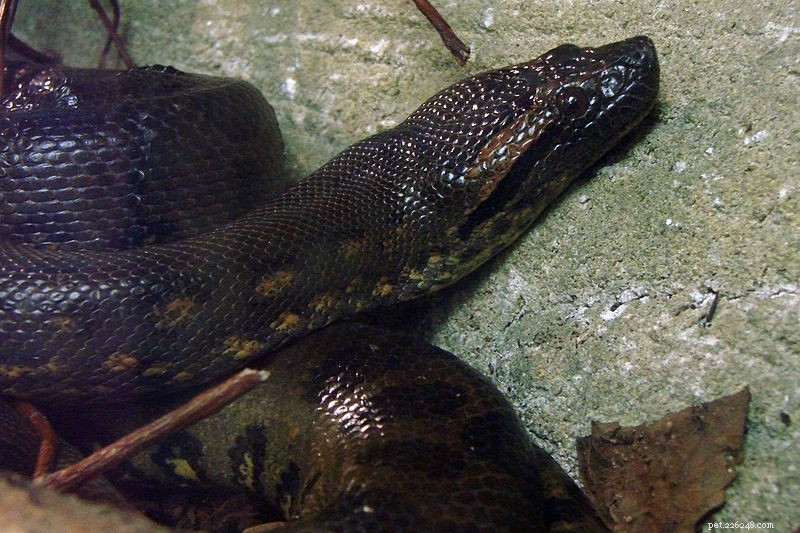 Of course, unwanted pets should never be released…the feral Burmese Python situation in Florida is a sad example of what can happen. Many years ago an old-time animal collector told me of a litter of Anacondas that escaped from a roadside zoo near the Everglades…I trust that reports would have surfaced by now, but Anacondas are very secretive, so I’m never quite certain of what to expect…
Important Precautions
Many of the Anacondas I’ve cared for have remained quite aggressive even after decades in captivity. Long-term pet Burmese Pythons have killed adult owners and children; Green Anacondas have the same potential.
As regards the seemingly docile individuals that are sometimes reported, it should be borne in mind that snakes are not domesticated animals, and must never be handled carelessly; otherwise calm snakes may react to odors or vibrations that people cannot sense. Two well-experienced adults should always be on hand when specimens over 6 feet in length are fed, cleaned or moved.
- Green Anaconda: Inside the World’s Largest and Most Powerful Snake
- The Green Anaconda: Inside the World’s Largest Snake – A Natural History (Part 1)
- Trans-Pecos Rat Snake (Bogertophis subocularis): Natural History & Captive Care Overview – Part 1
- The Green and Black Poison Frog: Natural History & Expert Captive Care
- Corn Snakes: A Comprehensive Guide to Their Natural History and Care in Captivity
- Inside the World’s Largest Snake: How a Bronx Zoo Team Cared for Reticulated Python Samantha
- The Mighty Green Anaconda: Amazon's Waterborne Predator