

The Green Anaconda: Inside the World’s Largest Snake – A Natural History (Part 1)
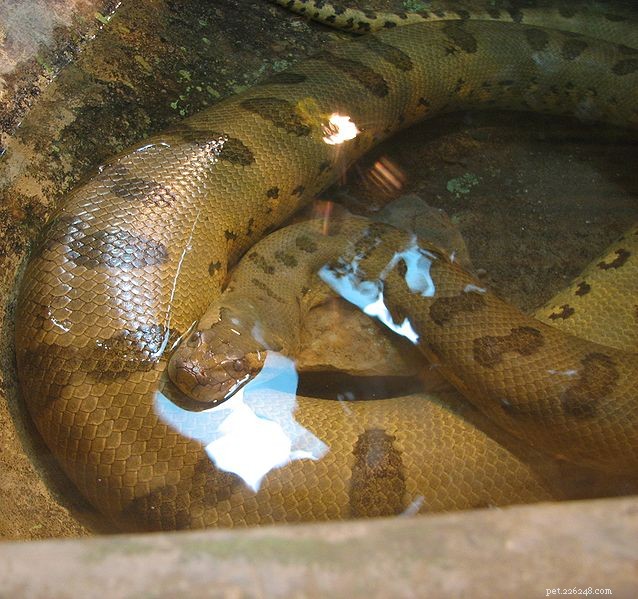 Working with Green Anacondas (Eunectes murinus) in the Bronx Zoo and participating in a capture/tagging project in Venezuela was a childhood dream come true. While I cannot recommend a potentially deadly behemoth as a pet, interest in them is always high…today I’ll highlight the natural history of this impressive giant.
Description
A stout animal that may exceed 400 pounds in weight, this is the world’s heaviest snake. It vies with the Reticulated Python for the title of longest serpent.
In the past, 25-foot-long animals were encountered, but an individual approaching 20 feet is considered large today. There is a fairly reliable record of a 33-foot-long Green Anaconda; an unverified field report from Eastern Columbia (1944) claims an individual of 37.5 feet. In the course of tagging over 500 specimens, the largest I and my co-workers encountered in Western Venezuela was just over 17 feet long and tipped the scale at 215 pounds.
Wild males rarely exceed 12 feet in length, and are thinly built. A captive male under my care was, however, as heavily built as any female and measured in excess of 15 feet; colleagues report similar experiences.
The dorsal surface is dark green, olive or grayish-green and marked with irregular black blotches. The ventral surface is yellow with black blotches. The eyes and nostrils are dorsally located, an adaptation to the largely aquatic lifestyle.
Range
Trinidad and much of tropical South America east of the Andes – Venezuela, Columbia, Brazil, Northern Bolivia, Northeastern Peru, Guyana and French Guiana.
Habitat
Green Anacondas are almost completely aquatic and rarely stray far from water. They inhabit rivers, swamps, lakes and flooded grasslands.
Status
 Status is difficult to ascertain due to the nature of the habitat, but declines have been documented; listed on CITES Appendix II.
Feared and often killed when encountered, Green Anacondas are hunted in some areas for their skin and fat (believed to be of medicinal value). They are also threatened by the expansion of farms and ranches.
Longevity
Captives have lived in excess of 31 years; unknown in the wild
Reproduction
Several males (2-12) coil about a single female, drawn by the pheromones she releases. Spurs alongside the cloaca are rubbed against the female to help elicit copulation. Successful males may introduce a waxy plug into the cloaca in an attempt to assure paternity.
Green Anacondas give birth to 10-100 live young after a gestation period of approximately 6 months. The size and number of young are related to the size and health of the mother. Examples from animals under my care: a 20-foot-long female gave birth to 50 young averaging 3 feet in length; a 13-footer produced a dozen youngsters averaging 24 inches.
Gravid females bask far more frequently than do others, and may consume the fetal membrane and infertile eggs passed with the young. Newborn Green Anacondas are secretive and rarely seen; little is known of their natural history.
- Mastering Newt Care: Natural History & Captive Management – Part 1
- Leopard Tortoise (Stigmochelys pardalis): A Comprehensive Overview – Part 1
- Mudpuppy: Natural History & Care Guide – Part 1
- Green Anaconda: Inside the World’s Largest and Most Powerful Snake
- Softshell Turtles: Expert Care & Natural History Guide – Part 2
- Trans-Pecos Rat Snake (Bogertophis subocularis): Natural History & Captive Care Overview – Part 1
- Captive Care for the World’s Largest Snake: Managing the Green Anaconda