

Comprehensive Guide to Monitor Lizard Care, Natural History & Behavior
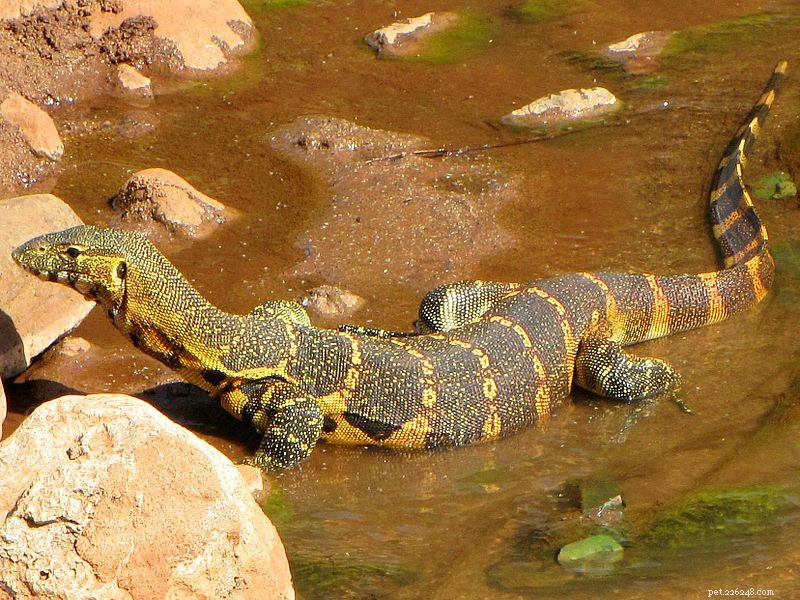 I’ve had the good fortune of caring for 15-20 monitor species during my zoo career. From the diminutive Storr’s to the massive Water, Lace, Crocodile and Komodo Monitors, all have instilled in me the feeling that they were, somehow, “more complicated” than other reptiles. Indeed, recent studies have confirmed that they are, among lizards, highly advanced. While some are too large for the average household, several moderately-sized and even dwarf varieties are being bred by hobbyists, and all make fascinating and responsive captives.
The following information can be applied to the care of Savannah, Black Tree, Nile, Merten’s and most other monitors. However, details vary; please post below for information on individual species, and be sure to add your own thoughts and observations on monitor lizard care.
Natural History
Seventy-three monitor species (Family Varanidae) range across Asia, Africa and Australia. Nile Monitors (Varanus niloticus), introduced to south Florida, are a major environmental concern there. Lace Monitors (V. varius) and other large speciesare usually the dominant predators in their habitats. While most dwell in warm regions, Desert Monitor (V. griseus) populations in Kazakhstan are adapted to Vermont-type winters.
The 8 inch-long Short-Tailed Monitor (V. brevicauda), is the smallest member of the group. The Komodo Dragon (V. komodoensis), the world’s largest lizard, occasionally tops 10 feet in length.
Monitors take prey ranging in size from termites to deer. The recently-discovered Sierra Madre Forest Monitor (V. bitatawa) and the Philippine Monitor (V. olivaceus) are unique in consuming fruit, while the Komodo Dragon has attacked and killed people.
In 2005, it was discovered that several species produce venom that affects their prey’s blood pressure and clotting ability.
Five new species, one topping 6 feet in length, have been described in the past several years (please see articles below).
Behavior
Monitors are ever-alert, and easily startled by noises and sudden movements. They vary greatly in personality – some become quite docile, while others remain wary of people. All are very responsive, and quickly learn to anticipate regular feeding times.
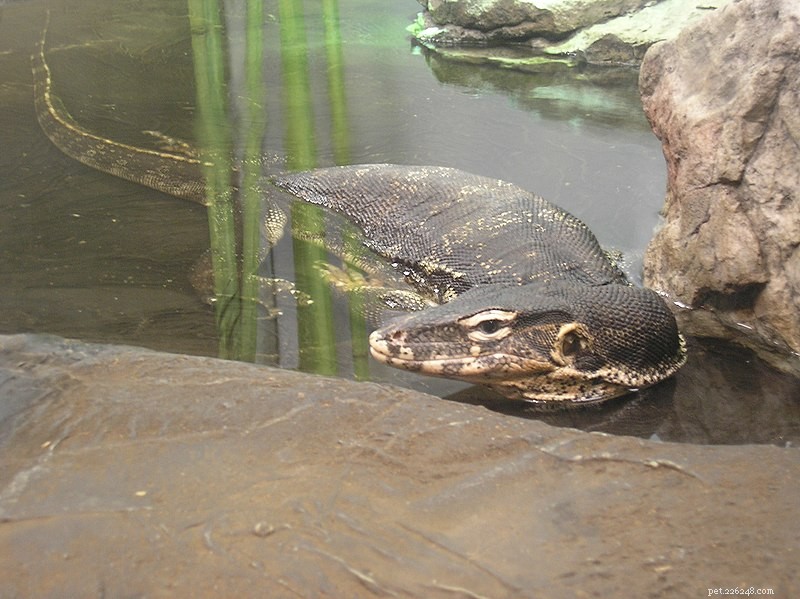 Crocodile and Water Monitors (V. salvadorii and V. salvator), and other large species, can be dangerous and are not suitable for most private collections. Adult Water Monitors are, pound-for-pound, one of the strongest animals I’ve ever restrained (I was the Bronx Zoo’s head mammal keeper for a time, and so thought I could handle most anything!). All monitors can inflict severe bites and scratches. The mouth and tail (which is whipped about in self-defense), should never be allowed near one’s face. Operating policies in most zoos require that 2 experienced keepers be present when large monitor exhibits are entered.
New monitor facts frequently come to light. Recently, a Black Tree Monitor was observed using its front foot to extract an insect from a crevice; this behavior has not been documented in any other lizard.
Housing
The Enclosure
Hatchlings and small species, such as the 14-inch-long Storr’s Monitor (V. storri), may be housed in 30-55 gallon aquariums.
Merten’s Monitors (V. mertensi) and others in the 3-4 foot range are best kept in homemade cages measuring at least 4x4x4 feet. Height is an important consideration for arboreal species such as Black Tree Monitor (V. beccarii). Savannah Monitors (V. exanthematicus) and others that approach 5 feet in length need correspondingly larger quarters; modified cattle troughs are a useful option.
The 6-7 foot-long Nile, Lace, Crocodile and Water Monitors require room-sized enclosures with drainable pools.
Predator-proof outdoor cages are the ultimate in “luxury accommodations” (some folks use modified bird aviaries). If a safe, escape-proof room is available, out-of-cage exercise time can make a real difference in your lizard’s quality of life.
Furnishings
Stout branches, wooden shelves and secure hide boxes should be arranged according to each species’ individual needs (please post questions below). A water bowl large enough for bathing is essential; the aquatic Merten’s Monitor should be provided with a large swimming area.
Substrate
Sand is suitable for Desert Monitors and others native to arid habitats, while cypress mulch works well for forest dwellers such as Green Tree Monitors (V. prasinus). I’ve found Crocodile Monitors prone to foot abrasions when kept on concrete, and have since used rubber mats or rubber-coated floors for all large species.
Although impactions due to swallowed substrate are rare, food should be provided in large bowls or via tongs, so that ingestion is limited.
Light
Monitors need daily exposure to UVB light. Use a high-output bulb, such as the Zoo Med 10.0, and position the basking site within 6-12 inches of it. Mercury vapor and halogen bulbs broadcast UVB over greater distances and emit beneficial UVA radiation as well.
Heat
Temperature should be maintained at a range of 79-85 F for most species. Incandescent bulbs should be used to create a basking site. While some do well with basking sites set at the more-or-less “standard” lizard temperatures of of 90-95 F, many monitors need to warm themselves to 120 F or even higher; please post below for details on individual species. Ceramic heaters or red/black reptile “night bulbs” may be employed to provide heat after dark. Under-tank heaters may be used to create a warm basking surface.
Provide your monitor with the largest home possible, so that a thermal gradient (areas of different temperatures) can be established. Thermal gradients, critical to good health, allow reptiles to regulate their body temperature by moving between hot and cooler areas.
Humidity
Storr’s and Savanna Monitors, and other desert/grassland adapted species, develop health problems in damp enclosures, while rainforest dwellers such as Blue Tree Monitors (V. macraei) need access to humid and dry areas.
Companions
Males will fight savagely and cannot be housed together, and females sometimes battle for dominance. Juveniles may get along, but they must be watched carefully.
Feeding
 Strict attention to diet is essential if you are to succeed with monitors. Nutritional deficiencies can develop quickly, and are difficult to treat. High calcium intake and exposure to UVB light is especially important for young animals.
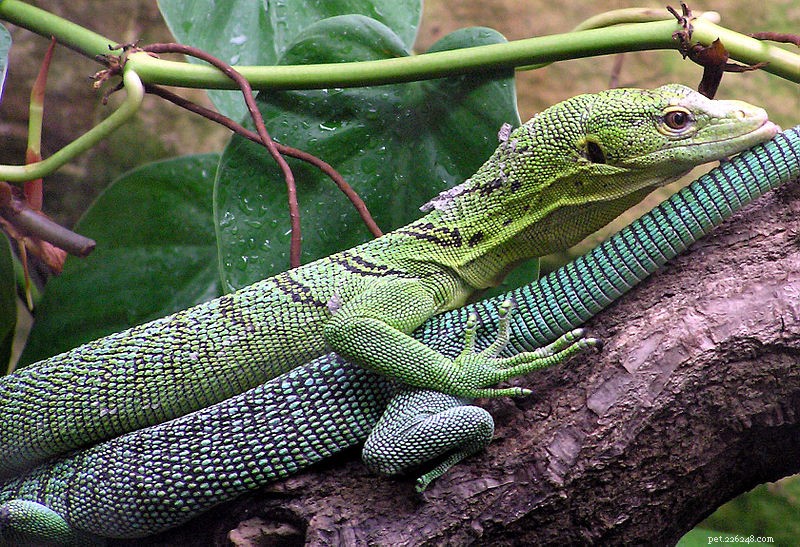
Small, largely insectivorous species (i.e. Blue and Green Tree Monitors) need a highly-varied diet comprised of roaches, crickets, butterworms, hornworms, super mealworms, wild-caught insects and other invertebrates; pink mice can be offered 1-2 times weekly. Canned snails and grasshoppers, and hard-boiled eggs, can be used to provide variety.
Nile Monitors and similar species fare well on mice and rats alone; whole freshwater fishes are an excellent rodent-alternative for Water and Merten’s Monitors.
Food (other than vertebrates) should be powdered with Tetra ReptoCal or Zoo Med ReptiCalcium. Vitamin/mineral supplements such as Reptivite should be used 2-3 times weekly.
- Mastering Newt Care: Natural History & Captive Management – Part 1
- Fire Skink (Mochlus fernandi): Natural History & Expert Care Guide
- Mertens’ Water Monitor: Natural History & Expert Captive Care Guide – Part 1
- Mertens’ Water Monitor: Expert Natural History & Captive Care Guide – Part 2
- The Ultimate Guide to Chameleon Care: Natural History & Home Habitats
- Comprehensive Guide to Dart Poison Frog Care & Natural History
- Collared Lizard Care & Natural History: Expert Guide for Enthusiasts