

Breeding the Malayan Leaf Frog: Tips for Successful Captive Propagation
The wonderfully bizarre Malayan Leaf Frog, Megophrys nasuta, has always been a somewhat difficult species to keep. However, we now have a better understanding of its needs, and captive breeding is becoming more regular. As it turns out, the Malayan Leaf Frog’s reproductive behavior is as unusual as its appearance.
Natural History
Malayan Leaf Frogs range from southern Thailand through the Malayan Peninsula, Indonesia and Sumatra to Borneo. Despite the large range, uncanny camouflage and a preference for forested habitats renders them difficult to find. Little is known of their status and conservation needs.
Malayan Leaf Frogs are classified in the family Megophryidae, a group of 150+ largely nocturnal, leaf-mimicking species. Most prefer walking to hopping, and many are largely unstudied.
Early Problems: Supply and Care
A shortage of males was the main impediment to breeding this frog when it first began showing up in the USA. Even working through my Bronx Zoo connections, it was well over a year before I could find a male in the mid 1980’s. It seemed that collectors did not bother with the thin, 3 ½ inch-long males since the stout, russet-colored females, which reached 6 ½ inches in length, brought a much higher price.
Also, Malayan Leaf Frogs are difficult to transport…many new arrivals bore snout injuries, which often led to fatal infections.
Basic husbandry was and remains a problem for some keepers. Despite their tropical origins, these forest specialists fare best at temperatures of 66-70 F; most were kept warmer and did not thrive. They do not last long on a diet comprised of 2-3 insect species; roaches, silkworms, sowbugs, earthworms and wild-caught invertebrates are essential to their long-term health (please see article below).
Courtship
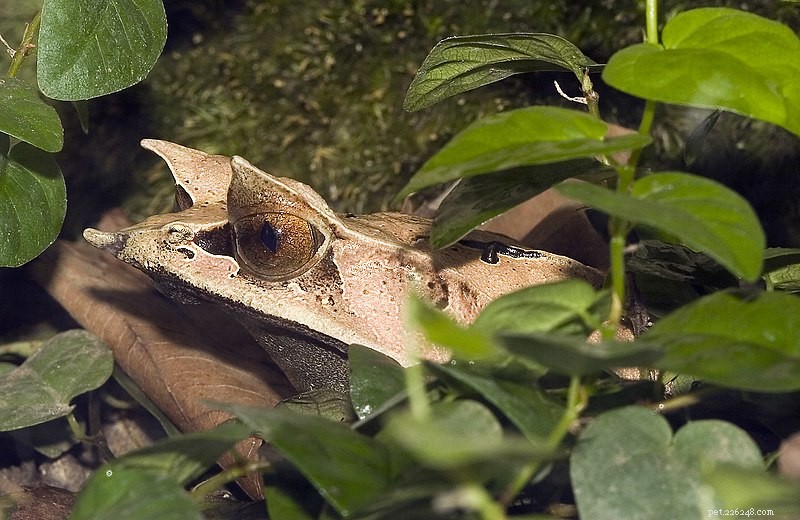 Males begin calling sporadically throughout the year, it seems. Their odd voices sound like a person “clucking” their tongue (please see video below).
A rain chamber might be useful in stimulating bringing these frogs into breeding condition, but it seems not absolutely necessary. A 4-inch-deep, well-filtered pool should be available at all times, in case breeding should commence.
Amplexus
In common with African Clawed Frogs, Surinam Toads and other “primitive species”, male Malayan Leaf Frogs grasp females just above the rear legs when entering the mating embrace. This position is known as Inguinal Amplexus. Most other frogs utilize Axillary Amplexus, wherein the female is grasped just behind the front legs.
Egg Deposition Sites for Cave-Breeders
Curved pieces of cork bark should be positioned over the water area in the terrarium. Malayan Leaf Frogs are unique in that females attach their eggs to the ceilings of natural caves and other such shelters (you can try artificial caves as well, but cork bark offers, I believe, the best attachment site).
The jelly surrounding each clump of eggs is extremely thin, so take care not to jostle the caves when you check them.
The eggs hatch in 10-12 days, at which time the tadpoles slide down strands of jelly (which may reach 6 inches in length) to the water.
Rearing the Tadpoles
The 1/2-inch-long tadpoles should be transferred to a filtered aquarium that has been set up before hand; undergravel, sponge or corner filters are preferable, as the delicate frogs-to-be cannot tolerate swift currents. Water temperatures should be slightly higher than is acceptable for adults; 75-77 F works well.
The tadpoles will remain motionless for 2 days after hatching. Malayan Leaf Frog tadpoles have huge, funnel-shaped mouths and are, like African Clawed Frog tadpoles, filter feeders. However, these unique mouthparts do not develop until 6-8 days after hatching; prior to that, the tadpoles do not feed. This is an unusually long fasting period for a tadpole… and is a very frustrating period for keepers!
Once equipped to eat, the tadpoles will swim about sucking in finely-crushed tropical fish food flakes and fry foods. Provide live plants and floating cork bark, as resting tadpoles tend to group up near such shelters.
Metamorphosis
Rear legs appear by day 70-80, at which time the tadpoles are nearing 2 inches in length. The mouthparts then begin to regress, and the tadpoles cease feeding and remain motionless on the tank bottom. The front legs sprout within a few days.
At this point, reduce the water level to 1 ½ inches, and provide easy access to land; platforms, gravel islands or tilting the aquarium (to provide a sloped land area) all work well. The emerging froglets are barely 1/2 inch long, and must be kept cool and moist, and should be provided with access to a shallow water source and plenty of cover. Newly-transformed Malayan Leaf Frogs will choose leaf-letter or growing plants over caves as shelters. Live pothos plants root in gravel and serve well as hideaways.
The classic “horns” above the eyes do not appear until the frogs are at least 1 month of age. Age at sexual maturity has not been definitively established, but reportedly may occur as quickly as age 11 months in captivity.
Feeding Young Frogs (Metamorphs)
While pinhead crickets are the simplest diet to provide, relying solely upon crickets, even if they are powdered with a vitamin/mineral supplement, and will lead to a very poor survival rate. Best to set up breeding colonies of fruit flies, flightless house flies (for use as the frogs grow), earthworms, flour beetles, springtails and sow bugs well ahead of time, so that a supply of newly-hatched invertebrates of several species is assured.
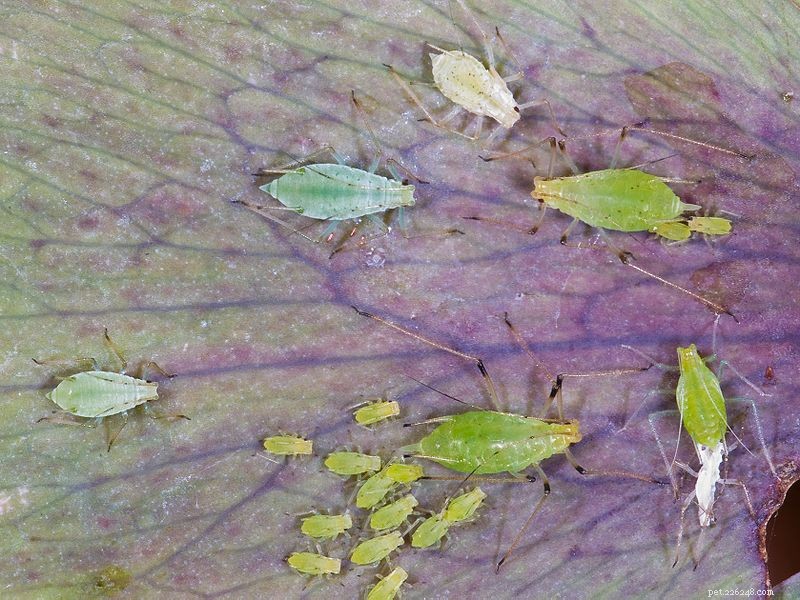
Aphids (please see photo), tiny moths, leaf litter invertebrates and wild-collected “meadow plankton” will ensure your success in raising these captivating but delicate little fellows (please see article below).
- Breeding the Green & Gold Bell Frog to Support Recovery of Australia's 'Extinct' Gold Spotted Bell Frog – Part 1
- Breeding the Rosy Boa: A Comprehensive Guide for Successful Reproduction
- Feeding Habits of African Clawed Frog Tadpoles: A Comprehensive Guide
- Smokey Jungle Frog: Natural History, Breeding & Care – Part 1
- New Discovery: Fang-Bearing Tadpoles of the Vampire Flying Frog (Rhacophorus vampyrus)
- Historic First: North American Captive Breeding of the Giant Horned Lizard
- Mastering African Clawed Frog Breeding: Proven Techniques & Care