

Reticulated Python: Life, Habits, and Urban Presence of the World’s Largest Snake
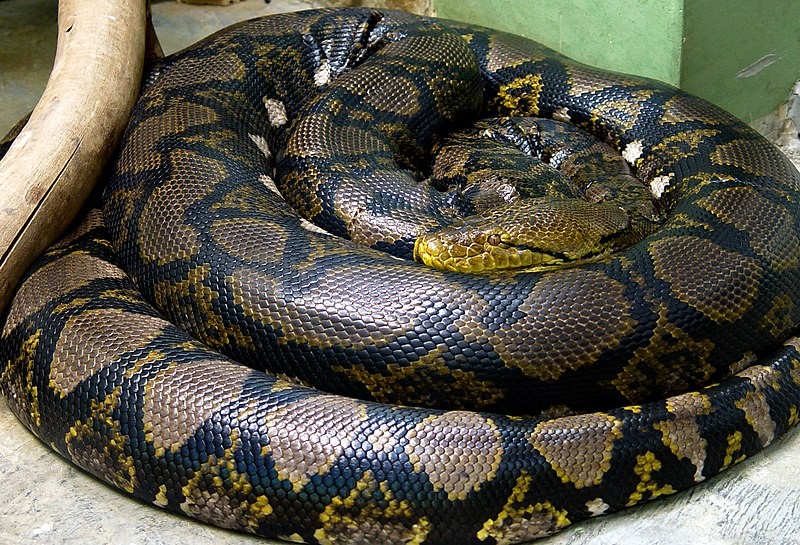 The massive Reticulated Python, Broghammerus (formerly Python) reticulatus is one of the world’s best known snakes, and always the main attraction at zoo reptile houses. It is also widely bred in private collections, although such is ill-advised given the potential dangers inherent in keeping such a formidable beast (even after decades in captivity, most retain their irascible temperament). Today I’d like to explore a lesser known side of this impressive snake – its habits in nature, and its amazing ability to thrive even in large, crowded cities.
Description
The Reticulated Python, or “Retic” as it is known to herp enthusiasts, vies with the Green Anaconda for title of world’s longest snake (an Anaconda would be twice as heavy as a Retic of the same length, however). Stories abound as to its potential size, but the longest reliable measurement appears to be 32 feet, 9 inches; individuals longer than 23 feet are exceedingly rare.
I was on hand to unpack a much-touted giant that was collected in Java and eventually purchased by the Bronx Zoo. While impressive, she measured a “mere” 21 feet…but was, I learned, far more powerful than any captive of the same size!
The background color is yellowish-tan, marked with an intricate, lattice-like (“reticulated”) pattern of black blotches and oval markings. Although striking when viewed up close, these markings provide excellent camouflage by disrupting the snake’s outline among fallen leaves and shadows.
Range
This snake occupies a huge range that extends throughout much of east and Southeast Asia, including many adjacent islands. It may be found in India, Bangladesh, Brunei, China, Malaysia, the Philippines, Singapore, Thailand, Cambodia and Vietnam, and is capable of crossing stretches of open ocean to colonize islands.
Three subspecies have been described – Broghammerus reticulatus reticulatus, found throughout most of the range, B. r. saputrai, limited to Selayer Island in the Flores Sea and B. r. jampeanus, found only on Tamahjampea Island, Indonesia. The 2 island races are much smaller than the nominate subspecies, and are becoming well-established in the pet trade.
Habitat
Despite its massive size, the Reticulated Python is extremely adaptable and occupies a wide variety of habitats; a nearby source of water is common to most. Woodlands, rainforests, brushy grasslands, overgrown fields, swamps, riversides, farms and towns are all utilized, and it is established in several large cities, including Bangkok and Singapore.
Status
The range is expanding in some places due to human activities; Retics may establish new populations in agricultural and urban areas, where they prey upon rodents and domestic animals.
However, it is also heavily utilized in the skin trade and for food in some parts of the range…from 2000-2007 Malaysia and Indonesia exported over 2,600,000 wild-caught snakes, and a good many more were likely unreported. The Reticulated Python is listed on CITES Appendix II; Fortunately, it breeds well in captivity.
Longevity
Captives have survived for over 30 years; unknown in the wild.
Reproduction
 In common with related species, the female protects her eggs and incubates them. Female Reticulated Pythons engage in a “shivering” motion that can raise their core temperatures and the temperature of the egg clutch.
Females deposit 30-100 eggs after a gestation period of 100-150 days. The eggs hatch in approximately 85 days. The hatchlings are 30-32 inches long-large enough to consume adult mice right away and become sexually mature at a length of approximately 10 feet.
Diet
The range of animals taken is vast and includes an astonishing variety of reptiles, mammals, amphibians and birds. Adults concentrate on large prey items such as monkeys, deer, antelope, wild pigs and monitor lizards. There are authenticated reports of sub-adult tigers, leopards and crocodiles being consumed, and people have been taken on several occasions. Domestic geese, ducks, chickens, goats, sheep, pigs, dogs and cats are on their menu around farms and in cities.
All pythons have thermo-receptive sensory pits, located along the upper jaw, that assist in locating warm-blooded animals at night. Prey is killed by constriction, with death resulting due to compression of the lungs (suffocation) and heart failure (trauma to the heart and blood vessels).
Reticulated Pythons are, along with Burmese Pythons, Green Anacondas and African Rock Pythons, the only constrictors known to have killed and, in some cases, consumed people.
Urban Pythons and Uninvited Zoo Guests
While Florida’s introduced Burmese Pythons have received much attention in recent years, the Reticulated Python actually has a far longer association with people in its natural range. In fact, the Retic appears unique among large constrictors in its ability to adapt to human presence, with large populations having been established in the heart of Bangkok and Singapore.
On a visit to the Bronx Zoo some time ago, zookeepers from the Singapore Zoo informed me that Reticulated Pythons are a menace to zoo animals, with a 40 pound cape hunting dog having been consumed by a large female in one instance…and I thought raccoons and skunks were troublesome! Zoo employees also remove several hundred Retics from the city of Singapore each year.
Giant Meals
 The appetites and eating abilities of this species have been much investigated in zoos. Perhaps the most startling account is give by the legendary Carl Hagenbeck of the Hamburg Zoo – a 25 foot Reticulated Python consumed a 71 pound ibex (a wild goat) several days after eating 2 domestic goats of 28 and 39 pounds, for a grand total of 138 pounds of food within a few days!
The largest meal reliably documented to have been taken by this (or any snake) seems to be a 130 pound impala antelope; this reported by James Oliver of the Bronx Zoo. The species’ most elegant meal may be a Siamese cat (including bells and collar) that was taken by a specimen that found its way into the palace of a former king of Siam (Thailand)! Please see the article below for more on huge meals taken by other snakes.
- Mastering Newt Care: Natural History & Captive Management – Part 1
- Fire Skink (Mochlus fernandi): Natural History & Expert Care Guide
- Trans-Pecos Rat Snake (Bogertophis subocularis): Natural History & Captive Care Overview – Part 1
- Burmese Pythons in the Wild: Exploring the Natural History of a Giant Snake
- Corn Snakes: A Comprehensive Guide to Their Natural History and Care in Captivity
- Inside the World’s Largest Snake: How a Bronx Zoo Team Cared for Reticulated Python Samantha
- Wild Rabbits: Habitats, Behaviors, and Survival Strategies