

Japanese & Chinese Fire‑Bellied Newts: Natural History & Care Guide
Please see The Natural History and Captive Care of Newts, Part I for general information. Today we’ll take a look at newt that has long been popular with amphibian enthusiasts, the Japanese Fire-Bellied Newt (Cynops pyrrhogaster). This species is often confused with the Chinese Fire-Bellied Newt, C. orientalis. Chinese Fire Bellied Newts are smaller, with less-distinct paratoid glands and smoother skin (shown here in the photo of 2 submerged animals). They can be cared for in much the same manner as their Japanese cousin.
Description and Range
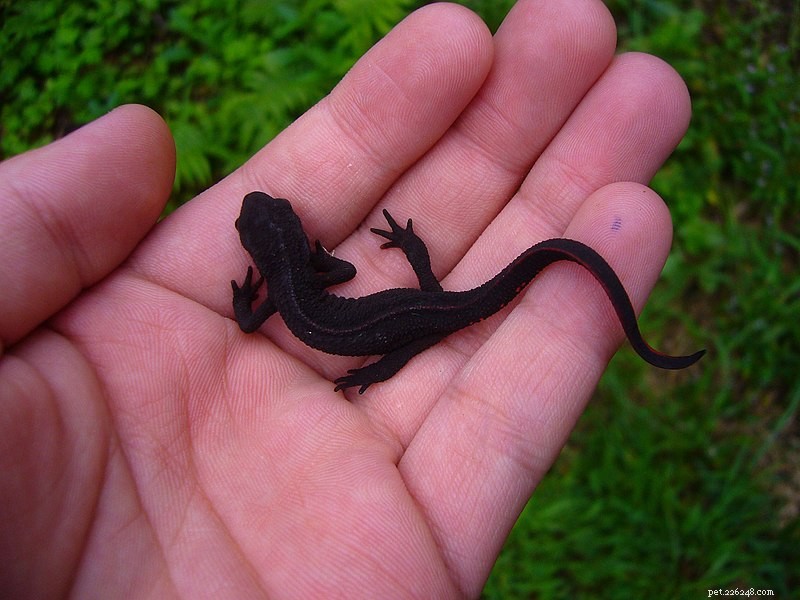
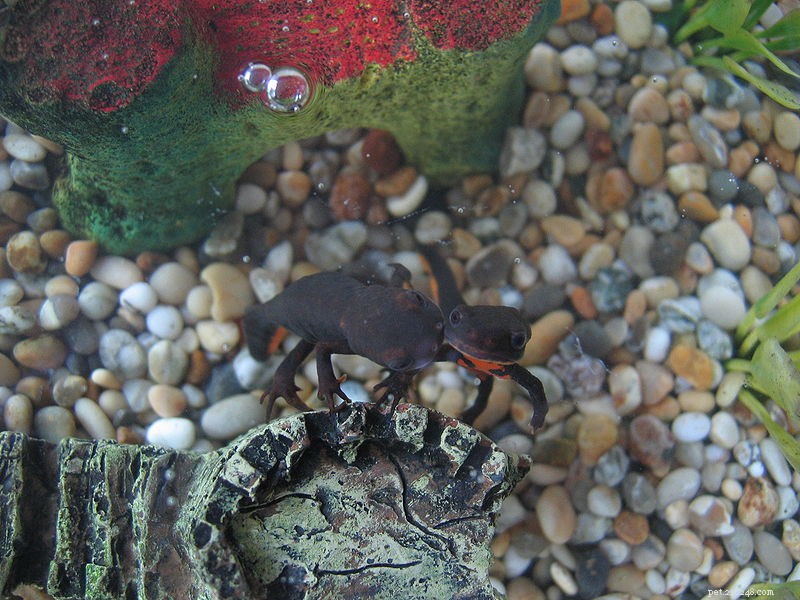 Sometimes sold as the “Fire-Bellied Salamander”, this largely aquatic, 3-5 inch-long member of the family Salamandridae inhabits quiet, plant-choked waters in Japan. Six fairly distinct races (“Kanto Race”, etc.) have been identified.
The upper surface of this newt is dark brown to jet black and sometimes slightly spotted with red, while the abdomen is strikingly patterned in orange or deep red. The bright coloration serves to warn potential predators of the powerful skin toxins. Toxin-containing paratoid glands, similar to those possessed by toads, are located along the sides of the head.
Temperature Cautions
The Japanese Fire-Bellied Newt makes a hardy terrarium inhabitant but, like many of its relatives, becomes susceptible to fungal infections and skin diseases at temperatures over 76°F. Cooler is almost always better when it comes to keeping newts…the Fire Belly will do fine at average room temperatures, and is most content at 65-68F.
Housing
An aquarium for adults can contain fairly deep water with floating cork bark or a plastic basking platform as a land area. They do not wander extensively on land or require land-based shelters, being content to float around on cork bark while they rest. They show to their best advantage in tanks laden with live plants.
As Fire-Bellied Newts inhabit still waters, filtration should be mild…the smaller sizes of various Herp Filters are ideal. Despite their aquatic nature, these newts can climb up the sides of glass, so the aquarium needs to be well-covered.
Diet
 Japanese Fire-Bellied Newts rely heavily upon scent to find their food and thus will accept Reptomin Select-A-Food, Gammarus Supplement and similar dried foods. Other favorites include live earthworms, blackworms, snails, tiny fishes, and insects. Like most newts, they become rather tame in captivity, readily accepting food from one’s fingers.
Breeding
Japanese Fire-Bellied Newts should be overwintered on wet moss at 40 to 50°F if breeding is to be successful. Courtship begins in the water with the male butting the female’s body with his head and blocking her progress should she try to move away. The paratoid glands are rubbed along her body and the tail is used to fan pheromones meant to stimulate her into courtship behavior.
The spermatophore is picked up by the female’s cloacal lips in typical salamander fashion. Eggs are individually attached to aquatic plants, with the tip of a leaf folded over each egg by the female. The incubation period is short, generally less than 2 weeks.
The larvae sport external gills and are best reared on blackworms, brine shrimp, mosquito larvae, bloodworms and similar live foods. They develop into the semi-aquatic adult form within 2-4 months and attain sexual maturity at approximately 2 years of age.
- Mastering Newt Care: Natural History & Captive Management – Part 1
- Mudpuppy: Natural History & Care Guide – Part 1
- Painted Turtle Care & Natural History: Expert Tips for Owners
- Dwarf Chameleons: Expert Care Tips & Natural History Insights
- Fire Skink (Mochlus fernandi): Natural History & Expert Care Guide
- Rhinoceros Iguana: Natural History, Care Guide, and Habitat Insights
- Greater Siren (Siren lacertina): Natural History, Care, and Fascinating Behaviors