

Breeding and Rearing Grasshoppers & Locusts for Premium Reptile & Amphibian Nutrition
 The Domestic or House Cricket is perhaps the world’s most popular herp food, the closely-related locusts, grasshoppers and katydids have been neglected as a food source here in the USA. However, many are easily collected and bred in captivity, and offer important nutrients lacking in commercially-bred insects. What’s more, they are colorful, active and extremely interesting to work with – don’t be surprised if you begin keeping them as more than just a food item!
Natural History
Grasshoppers, crickets, locusts and katydids are classified in the Order Orthoptera. Over 20,000 species, inhabiting environments ranging from deserts to mountain tops, have been described. The USA is home to 1,000+ species.
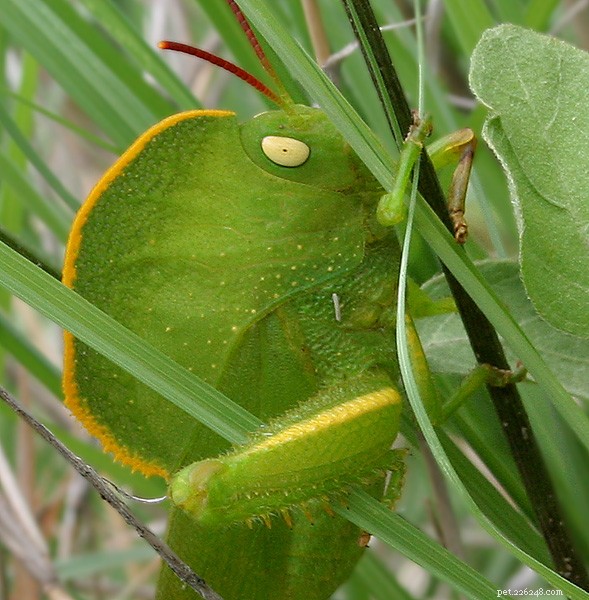
Many grasshoppers sport a fantastic array of colors and shapes; some are barely visible to the naked eye, while others, such as New Guinea’s Phyllophora grandis, top 5 inches in length (please see photo of a Hooded Grasshopper).
Several species are important crop pests. Swarms of Africa’s Desert Locust, Schistocerca gregaria, may exceed 50 billion in number and reach densities of 200 million per square mile (please see video below). A swarm of this size weighs an estimated 70,000 tons, and each day consumes as much food as does the combined populations of NYC, London, Paris and Los Angeles! In 1949, a locust swarm in Oregon and California cleared 3,000 square miles of every speck of vegetation.
Locusts (Short-Horned Grasshoppers)
Large size and tremendous breeding potential render locusts a great food source for larger herps, spiders and scorpions. Nymphs can be fed to nearly any insectivorous pet.
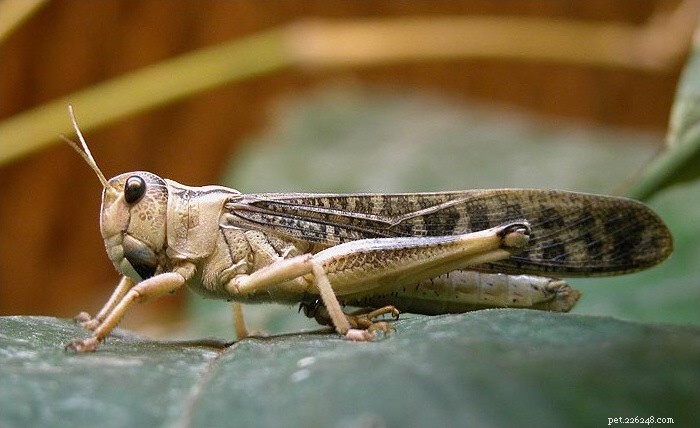
The Migratory Locust, Locusta migratoria, is the only species (other than the House Cricket) to be bred commercially. It is readily available in theUK, but difficult to find in the USA (biological supply houses and private breeders are the best sources).
Locusts can be reared in aquariums, but do better in large wire enclosures, as air flow and low humidity (below 30%) are critical to their health. Provide as much crawling and climbing space as possible, and maintain a temperature of 88-95 F. They will eat nearly any type of green produce or grass, along with wheat bran…providing a varied diet will ensure a nutritious meal for your pets.
Females will deposit up to 200 eggs in containers containing 5-6 inches of moist sand and peat moss; shallow containers will impede egg-laying. The egg-containers are best removed to a separate enclosure for hatching and rearing. The incubation period averages 2-3 weeks, and the nymphs reach adult size in approximately 2 months.
North American Grasshoppers and Locusts
 I’ve raised Red-Legged Grasshoppers and Carolina Locusts and have found them to be generalists that will accept most any type of native grass or store-bought produce. Their appetites are truly amazing…it’s easy to imagine the havoc a swarm can bring down on farmland. I place grasshopper food in water-filled jars (stuffed with cotton) so that it remains fresh.
Unfortunately, the eggs of most US natives require a period of cold temperatures if they are to hatch. I’ve had some luck refrigerating eggs at 38 F for 4 weeks, but the technique needs fine-tuning. Collecting (in pesticide-free areas) via sweeping a net through tall grass is more effective than breeding. If you collect in the spring, you’ll have plenty of nymphs that are easy to rear to the size you need.
Hatari Invertebrates stocks an ever-changing array of live grasshoppers, crickets and katydids that can be purchased and used as breeding stock (8 species currently listed). The eggs of species native to the extreme southern USA may hatch without a cooling-off period.
Please note that Lubber Grasshoppersand most other colorful species contain toxins and should not be used as a food item.
Katydids and Tree Crickets
Katydids and tree crickets usually stay high above ground, but may sometimes be collected around outdoor lights or by “foliage-beating” (please see article below). Most are specific as to food choice and egg-deposition sites, and are best used shortly after being collected.
These nocturnal songsters lack the hard exoskeletons of grasshoppers, and are a great food for arboreal herps and those without strong jaws. Treefrogs, anoles, chameleons and many geckos become, for lack of a better phrase, “very excited” when offered katydids.
Interesting note: Adding 40 to the number of chirps made by a Snowy Tree Cricket in 15 seconds will tell you the temperature in degrees F!
Native Crickets
Camel Crickets, Field Crickets, Mole Crickets and other native and introduced species contain different nutrients than House Crickets, and are often easy to collect.
Most need humid retreats, and readily accept fish food flakes and vegetables. One species that I collect in NYC matures at the size of a 10-day-old House Cricket, and is a valuable addition to the diets of smaller animals. Adult Field Crickets have very strong jaws and should be used with caution.
Canned Grasshoppers
Canned grasshoppers are an excellent alternative to live insects for certain pets. Exoterra’s Grasshoppers are large and fully winged; Zoo Med’s Grasshoppers are wingless and a bit smaller.
Grasshoppers as Pets
I’ve had some fantastic experiences keeping grasshoppers and their relatives in zoos and my own collection. From carnivorous Katydids to huge, colony-dwelling Cave Crickets, they have never failed to surprise me with interesting behaviors. Please write in if you’d like to more information on this fascinating hobby.
- Are Wild-Caught Invertebrates Safe for Reptiles & Amphibians? Key Concerns Explained
- Optimal Shelter Placement for Reptiles & Amphibians: A Practical Guide
- Groundbreaking Field Research Uncovers Novel Feeding Patterns in Reptiles and Amphibians
- Reptile Hobbyists: Champions of Conservation or Contributors to Declines?
- Undergravel Filters: A Proven Solution for Reptile and Amphibian Aquariums & Terrariums
- Comprehensive Live Food Care for Reptiles, Amphibians, Tarantulas, and Scorpions
- Salmonella Prevention: Key Guidelines for Reptile & Amphibian Owners