

Designing Effective Sub‑Surface Basking Sites for Semi‑Aquatic Turtles, Newts & Frogs
 I’ve found the Penn Plax Turtle Pier to be one of the most useful of all basking platforms. In addition to providing a haul-out site that does not take away from the swimming area, it can be used by reptiles and amphibians in a variety of other ways. Today I’d like to describe two “fine points” that are sometimes over-looked when semi-aquatic terrariums are designed.
Sub-Surface Resting and Basking Spots
Many semi-aquatic turtles do not often fully emerge from the water, but rather rely upon resting sites that are just below the surface. Included among these are Mud, Musk, Snapping and Chinese Big-Headed Turtles. In the wild, these turtles, as well as Green Frogs, Ribbed Newts and many other amphibians, rest upon submerged logs, branches and rocks that almost, but not quite, reach the water’s surface. From such locations, they can watch for predators and prey and, possibly, obtain some UVB exposure (UVB rays do not penetrate very far into water). In aquariums, driftwood is also useful in this regard…please see the article below.
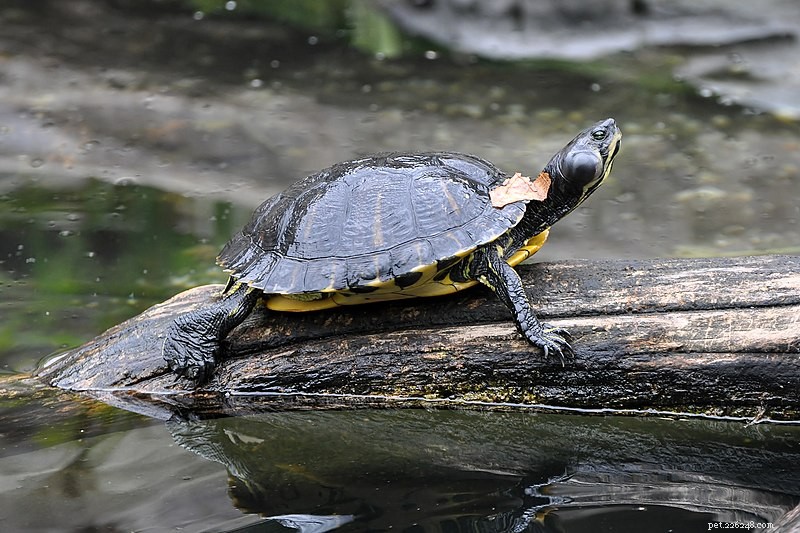
Red-Eared Sliders, Painted, Map and other turtles bask on open, exposed logs and such as adults, but often rest upon submerged. Hatchling turtles of all kinds, perhaps because they are on the menus of so many predators, are often reluctant to bask in plain view, preferring to remain partially submerged.
The support beams below the Turtle Pier’s top level (please see photo), and its partially submerged ramp, allow animals to rest and breathe while remaining in the water. The Common Musk Turtle shown in the accompanying photos spends nights on both surfaces, where she can easily reach the surface with her snout. This is an important consideration, as constantly swimming to the surface, can be detrimental to the health of turtles that are not strong swimmers by nature; this is especially true for hatchlings. In natural habitats, young Snapping Turtles and other bottom-dwellers utilize sunken branches and aquatic plants as “ladders” when rising to breathe.
A Basking and Feeding Platform
The upper surface of the pier is flat and smooth, ideal for both turtles and amphibians. It is equipped with an indented area designed to hold gravel, which can be used to offset the weight of heavy specimens.
I’ve also discovered that this surface greatly simplifies the feeding of American Bullfrogs, Leopard Frogs, and similar species (long story…please see the article linked below for details).
Other Features
Other useful features include strong suction cups that hold the Turtle Pier in place even in bare-bottomed tanks, a free-floating platform that adjusts to any water level, and extension bars that allow for use in extra-high aquariums. Three sizes are available; the one pictured here is the largest, and is set up in a 30 gallon long-style aquarium.
The main basking surface and the support beams shield part of the tank from light somewhat, and in doing so form an aquartic shelter and protected resting place.
And, despite lacking the mechanical skills of a chimpanzee (which, in all fairness, are considerable), I was able to snap the Turtle Pier together in minutes!
Additional Notes
The Common Musk Turtle (Sternotherus odoratus) pictured here showed up in a shipment I received while working at a pet store in NYC…in 1969! She is the oldest animal in my collection, with her nearest competitor being a 30-33 year-old Black-Chinned Red Salamander (Pseudotriton ruber schrencki).
The Musk Turtle’s cave is a 110-year-old roof tile from the Bronx Zoo’s Reptile House. The cave is positioned to allow easy access to the Pier’s ramp…not essential, but useful, especially for “less athletic” swimmers and hatchlings.
The filter is a Supreme Ovation Submersible. Although not designed specifically for reptiles, I’ve used this filter with great success since the original model was introduced over 20 years ago (the first such filter, I believe).
Next: Mudskippers?
I plan to look into the possibility of using the Turtle Pier in brackish/marine aquariums. I’ve long been a fan of exhibits that portray animals in human-influenced settings. While working at the Bronx Zoo, I was able to indulge this interest when designing Norway Rat and House Mouse exhibits, but I’ve not had much of a chance to do so for herps and fishes. I can picture the Turtle Pier encrusted with Mussels and Anemones, and being used by Mudskippers, Hermit Crabs and Bumblebee Gobies…not herps, of course, but Mudskippers are about as close as a fish can get!
- 100 Perfect Names for Your Turtle or Tortoise
- Optimal Diet for Semi-Aquatic Turtles: Vegetables & Greens for Sliders, Map Turtles, & More – Part 1
- Penn Plax Turtle Pier: The Ultimate Basking Solution for Turtles & Amphibians
- Essential Vitamin & Mineral Support for Aquatic Frogs, Turtles, and Newts – Part 1
- Comprehensive Guide to Vitamin & Mineral Supplements for Aquatic Frogs, Turtles, and Newts – Part 2
- Expert Care Guide for Red‑Eared, Map, and Painted Turtles
- Comprehensive Guide to Supplies for Red‑Eared Sliders & Similar Turtles