

Eastern Newt Subspecies & Hybrids: A Pet Owner’s Guide – Part 2
Quite a few subspecies of the Eastern Newt (Notopthalmus viridescens) have made their way into the pet trade. All are hardy, interesting and possible to breed in captivity. Please see Part 1 of this article for information on their care and feeding. The following descriptions and habitat information should help in identifying your newt. However, natural and captive-generated hybrids can complicate the process – please write in if you need assistance.
Eastern Newt Subspecies
The Red-Spotted Newt (Notopthalmus v. viridescens) is the widest ranging and most commonly kept of the group. It often fits the type description one finds in pet care guides, and may be found from Canada’s Maritime Provinces west to the Great Lakes and south to central Georgia.
The Central Newt (Notophthalmus viridescens louisianensis), bears tiny red spots that lack black outlines; some individuals are unspotted. It ranges from Eastern Texas to Lake Superior, and the Eft stage is generally skipped.
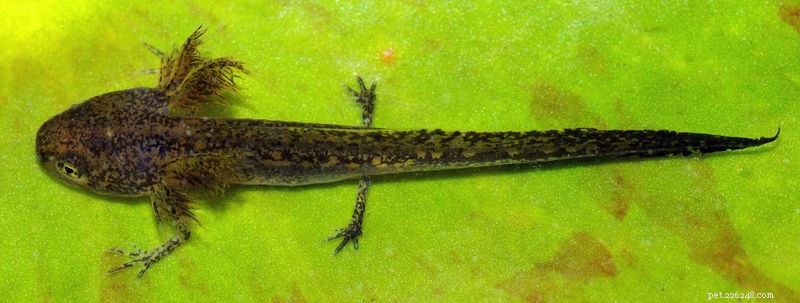
Along the Coastal Plain, populations may be neotenic, retaining gills and an aquatic lifestyle throughout their lives (basically reproducing as “adult larvae”, please see photo).
The Peninsula Newt (Notophthalmus viridescens piaropicola) is limited to quiet canals, ponds, and ditches in peninsular Florida. It is much darker than most Eastern Newt subspecies, with some individuals being nearly black. The eft stage is rare and neoteny is common. I have seen some very attractive hybrids that resulted from pairings of this animal and lighter subspecies.
The Broken-Striped Newt (Notopthalmus viridescens dorsalis) can be found only along the coastal plain in North and South Carolina. It is unique among the eastern Newts in having a red dorso-lateral stripe that is broken in one or two places along the head and body. It usually passes through the terrestrial Eft stage (please see photo).
Related Species
 The Striped Newt (Notophthalmus perstriatus) is closely related to but of a different species than the Eastern Newt. It bears a red dorsal stripe that is continuous along the body and breaks near the head and tail. The black border of the red stripe is not as dark as that of the Broken-Striped Newt. It occupies a small range that extends from southern Georgia to northern Florida.
The Black-Spotted Newt (Notopthalmus meridionalis), also a distinct species, has large black spots in place of the Eastern Newt’s red ones. It occurs from south Texas into Mexico and is limited to the moist areas around ponds and swamps. As the general area overall is fairly dry, this newt’s actual range is spotty and discontinuous; it is classified as Endangered by the IUCN.
- Eastern Newts' Diet: What They Eat in the Wild and as Pets
- Mastering Newt Care: Natural History & Captive Management – Part 1
- Ball Python Won’t Eat? Effective Feeding Strategies for Common Fasting Issues – Part 2
- The Eastern Newt: A Comprehensive Guide to Subspecies, Hybrids, and Pet Care – Part 1
- Leopard Geckos in the Wild: Unveiling the Natural History of a Beloved Pet
- Greek Tortoise: The Ideal First‑Time Pet Tortoise – Care Tips & Insights
- Newt vs. Salamander: Understanding Their Key Differences