

Explore Frog Facts, Natural History & Behavior: Your Expert Guide to Amphibian Pets
Those with an interest in frogs and toads will never be bored…among the 6,200 known species are found some of the world’s most fascinating and unusual animals. Many amphibian pets may, with proper care, live for 10, 20 or even 50 years, and can be wonderful animals to keep and observe. A number engage in complex social behaviors that range from hand-signaling to the feeding of tadpoles…and well-adjusted captives are often not at all shy about doing so before an audience!
I cannot remember a time when I was not fascinated by frogs and toads, and my amphibian-keeping friends and Bronx Zoo colleagues often voice the same sentiment. But what is it that draws us to keep, study and breed these marvelous creatures? True, some species, due to their ability to survive near people, become our first herp pets…as did Bullfrogs, American Toads and others when I was growing up in the Bronx, but there’s more to it than that. Part of the answer, I believe, lies in their amazing diversity of forms and lifestyles…some of which stretch the limits of believability. Please be sure to post your own thoughts and experiences below, as well as any questions you may concerning choosing a pet frog or caring for individual species.

Uploaded to Wikipedia Commons by Pixeltoo
Range and Habitat
Frogs and toads live on every continent except Antarctica, and have adapted to an amazing variety of habitats – rainforests, deserts, icy streams, mountain lakes, salt marshes, farms, houses, cloud forests, big cities, caves, gardens and many more. Surprises abound…here in North America, Wood Frogs live within the Arctic Circle and American Bullfrogs thrive in the heart of Manhattan!
Size
The smallest frog, discovered in New Guinea in 2011, is barely as large as a pea, while the largest, Africa’s Goliath Frog, measures 3 feet long with legs outstretched. Sometimes weighing in at 9 pounds, male African Bullfrogs are devoted parents (for a time, anyway…at a certain point they will enthusiastically gobble up their progeny!); I still recall being astonished at footage of one defending its tadpoles from 2 young lions!
Unusual Survival Strategies
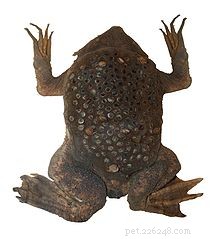
There are lung-less and tongue-less frogs, gliders and burrowers, frogs that brood their eggs in vocal sacs and others that form lifelong pair bonds. The first time I bred Surinam Toads, and witnessed 100 tiny frogs emerging from their mother’s back (please see photo), I thought I had seen the oddest of all amphibian breeding strategies.
But that amazing experience turned out to be just the tip of the iceberg. In 2011, tree-dwelling, wood-eating tadpoles were uncovered, and we learned that Fringe-Limbed Treefrogs tadpoles feed upon their father’s skin! And tadpoles of the aptly-named Vampire Treefrog have fangs. Please see the articles linked below for further information on these mind-boggling “firsts”.
Behavior in Captivity
Frogs vary greatly in their reactions to captivity, both among the various species and between individuals of the same species. It’s impossible to summarize what you may expect to see, so I’ll just highlight some popular species and “trends”. I have many frog care articles (individual species) posted…please be sure to write in below for more information, advice and links to articles.
Uploaded to Wikipedia Commons by Dein Freund der Baum
A surprising number of species, including Poison Frogs, Mantellas, Fire-Bellied Toads, Dwarf Clawed Frogs and African Clawed Frogs, are active by day and always foraging, exploring and interacting. Others, such as the Argentine Horned Frog, may spend days in a single spot. Toads of many if not most species tend to be quite calm and seemingly “trusting” of people, and often take food from the hand. Most nocturnal frogs will eagerly feed by day once they have settled in.
White’s Treefrogs are always ready to perch on one’s arm, but in general frogs should be handled only when necessary, and with wet hands so that the skin’s protective mucus covering is not removed. Horned and African Bullfrogs have tooth-like projections known as odontoid structures, and can bite savagely unless grasped behind the front legs. Poison Frogs and other tiny, agile species are best moved by being urged into a plastic container.
- Amphibian Behavior & Natural History: Highlights from Current Field Research
- Smokey Jungle Frog (Leptodactylus pentadactylus): Natural History & Expert Captive Care – Part 2
- Painted Turtle Care & Natural History: Expert Tips for Owners
- Dwarf Chameleons: Expert Care Tips & Natural History Insights
- Pickerel Frog (Lithobates palustris): Natural History & Expert Care Guide
- Comprehensive Guide to Dart Poison Frog Care & Natural History
- American Box Turtles: Comprehensive Care & Natural History Guide