

American Box Turtles: Comprehensive Care & Natural History Guide
 The beautifully-patterned American Box Turtles (Terrapene spp.) are very popular among reptile enthusiasts worldwide. They are extremely responsive, intelligent, calm, and may live for 60-100 years…what more could a turtle fan want! Unfortunately, there are many misconceptions concerning their care. The following information will enable you to meet their needs…please post any specific questions you may have.
Note: Box Turtle populations have declined drastically. In addition to habitat loss and road-kill, many were exported to foreign pet markets when European tortoises were protected by law. Please purchase only captive-bred animals.
Natural History
Four Box Turtle species – the Eastern, Spotted, Ornate and Coahuilan – range from southern Canada through most of the USA and into Mexico. Ten uniquely-colored subspecies, including the Florida, Gulf Coast and Yucatan Box Turtles, are also recognized.
Box Turtles frequent woodlands, marshes, fields, agricultural land, and many other habitats. Some, such as the Eastern Box Turtle (T. carolina), are largely terrestrial, while Three-Toed Box Turtles (T. carolina triunguis) and others split their time between land and shallow water. The Coahuilan Box Turtle (T. coahuila), the group’s only truly aquatic member, is found only in Mexico’s Cuatro Cienegas Basin. Several of my colleagues at the Bronx Zoo studied this species in the wild, and I had the good fortune to work with a breeding group for many years; please look for my future article on this most unique turtle.
Although certain other turtles posses shell hinges that allow the plastron (lower shell) to be drawn up (“like a box”), in no group is this ability so well developed as the American Box Turtles (please see photo).
Behavior
When properly accommodated, Box Turtles take very well to captivity and quickly learn to “beg’ for food. They seem to exhibit a degree of curiosity and problem-solving abilities not evident in others. That being said, there are exceptions…
The World’s most Aggressive Box Turtle
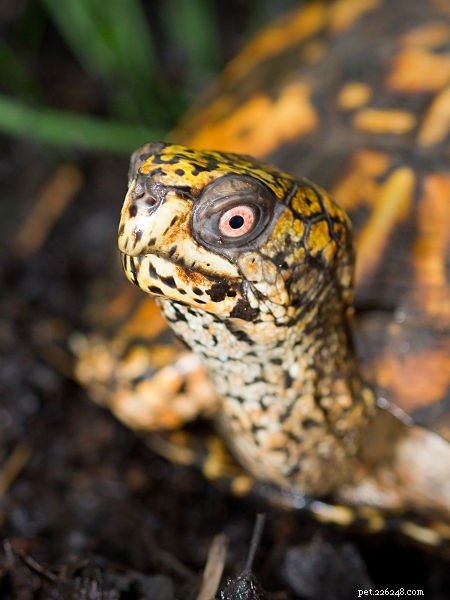 Years ago a co-worker of mine found an adult Eastern Box Turtle abandoned at the back door of the Bronx Zoo’s Reptile House as he left for the day. Needing to leave right away, he secured the turtle in a storage locker. Next day, the typical hectic life of a zookeeper kicked in, and the turtle was forgotten for several days.
My co-worker then liberated the turtle and placed it on a table for examination. When he lowered his head to table level to get a better look, it ran over and clamped down on his nose, leaving a long-lasting scar. Our vets checked the animal and found him none-the-worse (physically!) for his experience. But thereafter, he attacked whoever came near, even going so far as to follow people, clamber onto their shoes, and bite down on pants or legs! Eventually he found a home at a small zoo where he proved more amenable to female turtle company and sired quite a few offspring!
Housing
Setting up the Terrarium
Box Turtles are quite active and need spacious enclosures. Glass aquariums are unsuitable, except, perhaps, for hatchlings.
Adults do best in enclosures that have been constructed with their needs in mind; outdoor maintenance is ideal when weather permits. The Table Top Cage described on the Tortoise Trust website is very useful. Plastic-bottomed rabbit cages and cattle troughs can also be modified as turtle homes.
Shelters are important to the well-being of pet turtles. Suitable hiding spots include deep substrates and “turtle huts”
Box Turtles need a water bowl large enough for soaking.
Substrate
The ideal substrate is a mix of slightly-moist cypress or other wood chips and sphagnum moss. I like to include fallen leaves as well. The substrate should be of a depth that allows the turtle to bury itself, as this is their typical means of hiding in the wild.
Light
Box Turtles need daily exposure to UVB light. Natural sunlight is best, but be aware that UVB rays do not penetrate glass or plastic, and that fatal overheating can occur quickly.
Your turtle should be able to bask within 6-12 inches of a high-output UVB florescent bulb, such as the Zoo Med 10.0. Mercury vapor and halogen bulbs broadcast UVB over greater distances, and emit beneficial UVA radiation as well. Be sure to provide shaded areas as well
Heat
Temperatures should range from 70-80 F, with a basking site of 85-88 F. Incandescent bulbs may be used by day; ceramic heaters or red/black reptile “night bulbs” are useful after dark.
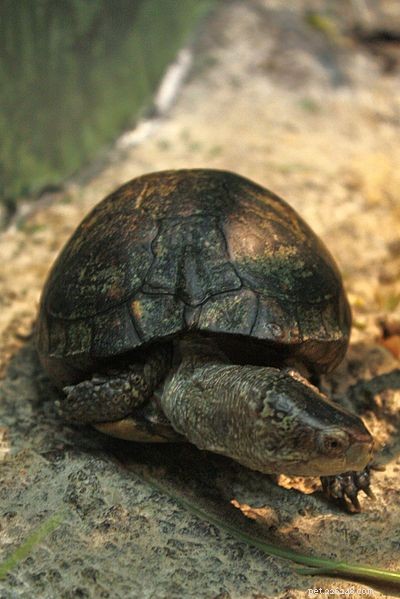 Provide your turtle with the largest home possible, so that a thermal gradient (areas of different temperatures) can be established. Thermal gradients, critical to good health, allow turtles to regulate their body temperature by moving between hot and cool areas. In glass aquariums and other small or poorly-ventilated enclosures, the entire area soon takes on the basking site temperature.
Humidity
Box Turtles, even those native dry habitats, require access to humid substrates. Low humidity has been linked to eye and ear infections and kidney disease. The substrate should be misted at least twice daily; a dry basking area must also be available.
Companions
Females and youngsters often co-exist, but must be watched as dominant individuals may prevent others from feeding. Males fight viciously, and usually harass females with near-constant mating attempts.
Feeding
Note: Certain species have unique dietary preferences; Coahuilan Box Turtles, for example, are more carnivorous than most. Please post questions concerning those you keep.
Animal Foods
Young Box Turtles are largely carnivorous. As they mature, increasing amounts of plant material is added to the diet. Youngsters should be fed a diet comprised largely of whole animals. Earthworms, snails and slugs, which can be collected from pesticide-free areas, are important food items. Tossing a handful of leaf litter into the terrarium will elicit hunting behaviors and keep your lets well-occupied. Food market and canned snails are excellent alternatives.
Other nutritious foods include pre-killed pink mice, super mealworms, roaches, sow bugs, waxworms, grasshoppers, grubs, crickets and canned invertebrates marketed for pet reptiles.
Low fat dog food, canned box turtle diets or moistened Reptomin Food Sticks should be mixed into most meals. Try some of the foods mentioned below as well.
Plant Foods
Approximately 50% of the diet for adults should be as described above. The balance should be comprised of salads containing chopped various berries, kale, dandelion, yams, apples, pears, squash, mushrooms, carrots and other produce.
Supplements
 The calcium requirements of Box Turtles are quite high. All food should be powdered with Tetra ReptoCal, Zoo Med ReptiCalcium or a similar product; a cuttlebone may also be left in the cage. Vitamin/mineral supplements (i.e. Reptivite with D3) should be used 2-3 times weekly.
Feeding Tips
Adults can be fed 5-7 times weekly, juveniles daily. Box Turtles often become “spoiled”, and consume 1-2 food items to the exclusion of others. Strawberry jelly can be used to entice your turtles to accept a wider variety of foods. Please see this article for further information and tips.
What’s Next, and What Can I Do?
Box Turtles can be quite hardy pets, but only if their exacting requirements are met. Please post any questions you may have below and I’ll be sure to respond quickly.
If you are concerned about turtle conservation, please consider joining a turtle interest group. The NY Turtle and Tortoise Society is my favorite.
- Mastering Newt Care: Natural History & Captive Management – Part 1
- Fire Skink (Mochlus fernandi): Natural History & Expert Care Guide
- Softshell Turtles: Comprehensive Natural History & Proven Care Tips – Part 1
- Softshell Turtles: Expert Care & Natural History Guide – Part 2
- Rhinoceros Iguana: Natural History, Care Guide, and Habitat Insights
- The Ultimate Guide to Chameleon Care: Natural History & Home Habitats
- American Wood Turtle Care Guide: Essentials & Natural History